
Do the Kurds only have a paper ladle left?

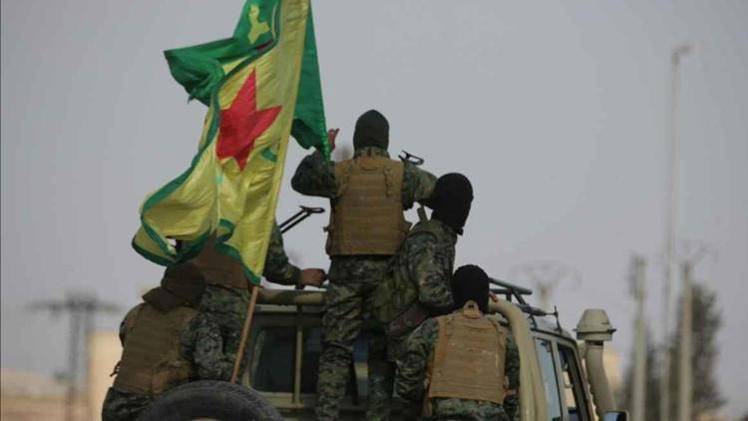
While Kurdish groups maintained an armed presence in the Sheikh Maqsoud and Ashrafieh neighborhoods of Aleppo, areas densely populated by Kurds, violent clashes erupted last week when the Damascus administration launched an offensive. Following casualties, the armed Kurdish groups withdrew from the area, and the Damascus administration under Ahmed al-Sharaa, with the support of Turkey, initiated a new wave of attacks on the areas held by the SDF in northern and eastern Syria. The declared goal was to “force the SDF to pull back east of the Euphrates.” As a result, the SDF withdrew from some areas where it had previously controlled oil fields.
The Syrian Democratic Forces (SDF) is known as a formation that established what was effectively an autonomous administration at the start of the Syrian civil war and has close links to the political Kurdish movement in Turkey. For many years, it has been a target for Turkey, which does not want a Kurdish-led administration tied to Abdullah Öcalan and the PKK just across its border. However, there is also the fact that the SDF is a structure dominated by Syrian Kurds; in other words, it is made up of the Kurdish people of the region.
Throughout the civil war in Syria, the SDF fought against ISIS and pushed it back. Through that struggle, the SDF became seen as a "friend" to the United States. Although Turkey opposed the SDF’s presence west of the Euphrates, in consideration of the US policy, it was not actively operational against the group east of the river for some time.
But in roughly ten days, this picture changed completely. First, the US essentially abandoned the SDF and the Syrian Kurds.
Barrack's Statements
On 20 January, US Ambassador to Türkiye and Special Envoy for Syria Tom Barrack made statements about Washington’s policy toward Kurdish groups in Syria. Barrack said that the “greatest opportunity” for Kurds was cooperation with the transition government led by Ahmed al-Sharaa, and that rights not granted under Assad might be possible under a new government.
He also noted that the primary reason for the US presence in northeastern Syria was to combat ISIS, that the SDF had defeated ISIS and was holding thousands of ISIS fighters in camps, and that at that time there was no functioning central government in Syria. But “Today the situation has fundamentally changed,” he said, noting that Syria’s central government had joined the international coalition against ISIS, undermining the main rationale for the US–SDF partnership.The SDF’s purpose of being the main anti-ISIS force on the ground has expired. From now on, Damascus is willing to take over this task.
This shift encouraged not only greater Turkish operational appetite toward the SDF but also intensified the Damascus administration’s attacks targeting the region. Kurdish groups led by the SDF found themselves increasingly squeezed.
What Has Been Offered and Gained?
In the latest situation, the Syrian administration announced a ceasefire on 20 January providing for a four-day pause in the clashes with the Syrian Democratic Forces (SDF). According to the Fırat News Agency (ANF), the SDF also stated that they would comply with the ceasefire.
The Damascus administration noted that the ceasefire was declared in order to open space for consultations regarding the integration of Hasakah into the Syrian state. It was stated that a four-day period was granted to the SDF to this end.
According to the official Syrian news agency SANA, if an agreement is reached at the end of this process, Damascus forces will not enter the city centers of Hasakah and Qamishli and will remain only in their suburbs.
According to the same proposal, the timeline and details of the Hasakah Governorate's integration with the central government will be discussed later. In addition, Mazloum Abdi will be granted the authority to determine the names who will serve as the Deputy Minister of Defense of Syria and the Governor of Hasakah.
Domestic Repercussions in Turkey
It’s hard to know how these developments will evolve. The situation has reverberated in Turkey, where tensions are already high.
Following a group meeting organized by the DEM Party in Nusaybin to protest the advance of Damascus forces, a group marching to the border lowered the Turkish flag there. After the images drew backlash, the DEM Party issued a statement condemning the incident, but heavy criticism came from Ankara on January 21.
President Recep Tayyip Erdoğan said, "We will surely find those dirty hands reaching for our flag and will definitely hold those traitors accountable.", while MHP Chairman Devlet Bahçeli held the DEM Party responsible for the incidents.
Emphasizing that DEM Party Co-Chair Tuncer Bakırhan's speech "further intensified the atmosphere of provocation and tension," Bahçeli stressed that he found the developments alarming and said the DEM Party "has to make a decision": "Is the DEM Party on the side of the founding leader of the PKK, or against him? Will it stand as a reserve force for terrorism, or will it serve a future without terrorism?"
In a speech he delivered in Nusaybin on 20 January, Tuncer Bakırhan reacted to Bahçeli’s statement that “the SDF does not represent the Kurds,” saying: “Are we going to ask you who represents whom? The SDF most certainly represents the Kurds.” He went on to say the following: “Mr Devlet Bahçeli says ‘the founding leader of the PKK,’ but he does not repeat what he (Abdullah Öcalan) actually says. He (Bahçeli) says that ‘every inch of Syria must be cleaned, dried out’. Are you a dry cleaner?”
What Lies Ahead for the Process?
While the situation in Syria is full of unknowns and anxieties about the future of Kurds in the region, how the political “process” in Turkey will proceed is an open question.
There has been no public statement from İmralı, and if any message regarding these developments has been made by Öcalan, it hasn’t reached the public. We do not know what Öcalan has said or will say about what is happening.
However, it is clear that the ongoing political process has suffered a major blow. Although these are not irreparable damages, it is not hard to imagine that a significant portion of the Kurds in Turkey, represented through the DEM Party and its voters, have fallen into despair.
Internationally speaking, one might possibly make this analogy: In the final periods of the Ottoman Empire, after the1877-78 Ottoman-Russian War, Patriarch Mkrtich Khrimian also traveled to the Congress of Berlin to present the case for the Armenians. This was because a reform to be carried out in the regions where Armenians lived in Anatolia was also on the agenda. However, the Armenians returned from the congress empty-handed. After returning to Istanbul, Patriarch Khrimian delivered a notable speech at the Patriarchate to describe his disadvantaged position at the negotiating table using the following analogy: "There was a cauldron in the middle and all the states held an iron ladle in their hands. In my hand, there was only a paper ladle."
Let us hope that what befell the Armenians a century ago does not happen to the Kurds in the Middle East as well. However, in the Syrian context today, we can say that while the US, Israel, the Damascus administration, and Turkey hold iron ladles, it it appears that for now the Syrian Kurds have only a paper ladle left.


