


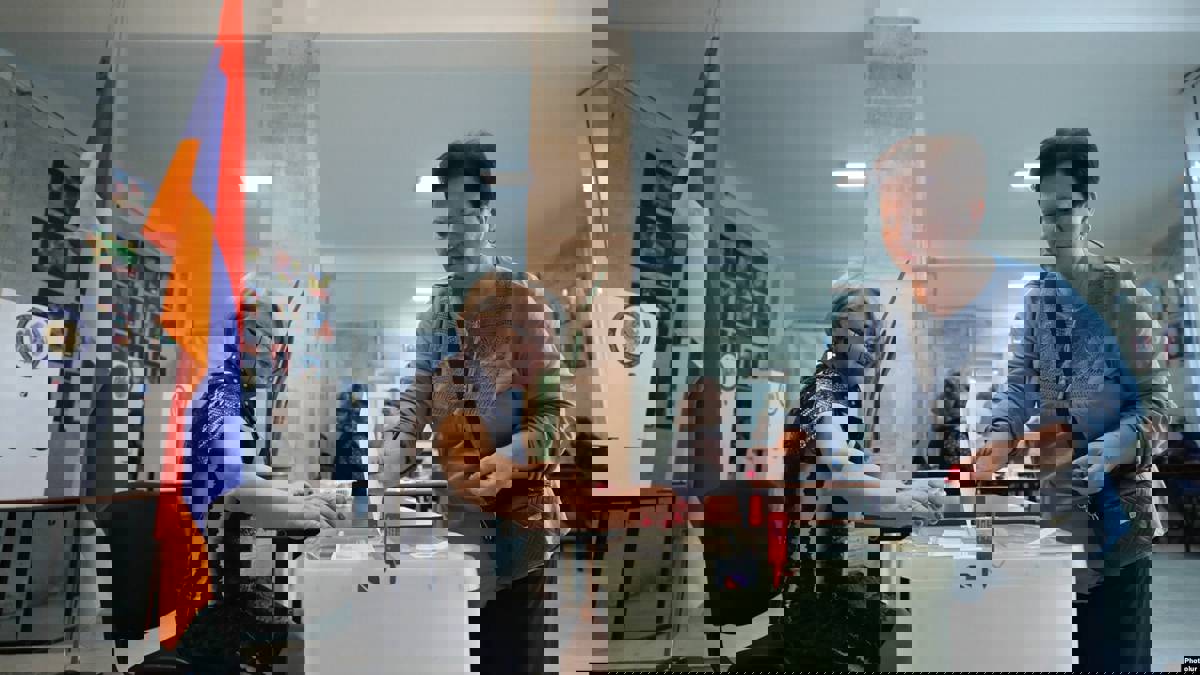
The main reason the Civil Contract Party obtained the parliamentary majority in the 2021 election was that the undecided and angry masses who broke away from the government boycotted the ballot box by not voting for the opposition either. The voter wanted neither the return of the "old regime" represented by Robert Kocharyan nor to give a new blank check to Nikol Pashinyan. As a result, while the opposition's ceiling vote remained at a certain limit, Pashinyan grew proportionally in the shrinking voter pool because he managed to bring his consolidated base to the ballot box.
As Armenia moves towards the June 2026 parliamentary elections, the polls reflected in the public offer a familiar picture at first glance: the ruling party is still the leading party, the opposition is fragmented, and the rate of undecided voters is high. This picture reminds many observers of the atmosphere prior to the 2021 elections; in that election, the rate of the undecided was also high, and ultimately, the Civil Contract Party led by Nikol Pashinyan achieved a much stronger victory than expected.
2021
However, this similarity can be misleading because the picture facing Armenian politics today is not a situation that can be explained merely by the competition between parties. Deeper down, there is a dynamic pointing to a crisis of political representation. In the picture drawn by the in-depth analyses conducted by the International Republican Institute's (IRI) February 2026 poll, the Armenian Election Study (ArmES), and EVN Report throughout the December 2025-February 2026 period, we clearly see that the Armenian voter is at a major crossroads. However, when the "stable majority" principle of the Armenian Electoral Code and the electoral threshold system are considered, we must also state how fragile and even impossible the theoretically constructed dreams of a 'broad-based coalition' look.
To understand today's large mass of undecided voters, we must first understand the illusion experienced in the traumatic atmosphere of the June 2021 elections. In this election held after the Second Karabakh War, the Civil Contract Party led by Pashinyan maintained its single-party rule in parliament by receiving 53.95 percent of the votes. From an external perspective, this result was interpreted as a rare consolidation success of a government that had lost a war, or as the undecided masses turning to the government at the last moment, saying "stability." Yet the turnout rate in the 2021 elections remained at quite a low level, at 49.37 percent. If we focus on the absolute number of votes entering the ballot box, compared to the approximately 884,000 votes Pashinyan received in the elections held after the 2018 Velvet Revolution, it had dropped to 688,000 in 2021. In other words, there was no undecided mass that made up its mind at the last moment and rushed to the government; on the contrary, the government had lost approximately 200,000 voters in three years.
The main reason the Civil Contract Party obtained the parliamentary majority was that this undecided and angry mass that broke away from the government boycotted the ballot box by not voting for the opposition either. The voter wanted neither the return of the "old regime" represented by Robert Kocharyan nor to give a new blank check to Nikol Pashinyan. As a result, while the opposition's ceiling vote remained at a certain limit, Pashinyan grew proportionally in the shrinking voter pool because he managed to bring his consolidated base to the ballot box.
Therefore, when understanding the 2021 outcome by considering both mechanisms together; it is understood that while a portion of the undecided turned to the Civil Contract Party at the last moment, a decisive portion did not go to the polls. As stated in the EVN/ArmES analysis, in a low-turnout environment, parties with strong core voters achieve proportionally higher results, and it turns out that the 53.95 percent obtained by the Civil Contract Party in 2021 was exactly the product of this dynamic.
What the polls say: There is a leading party, but no trust
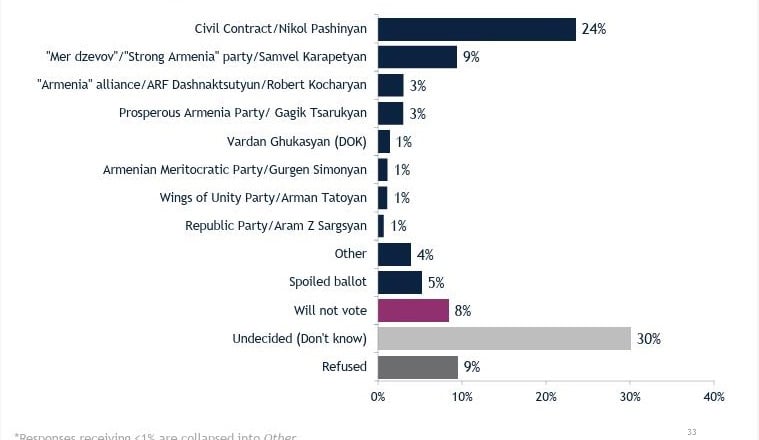
Looking at the responses to the question "Which party would you vote for if elections were held next Sunday?" in IRI's February 2026 poll, the Civil Contract Party receives around 24 percent support, Strong Armenia 9 percent, the Armenia Alliance 3 percent, and the Prosperous Armenia Party around 3 percent. According to the same table, the undecided is at 30 percent, and those who do not want to answer are at 9 percent. In other words, the total rate of voters who will not tell us what they will do at the ballot box reaches almost 40 percent.
There is a similar picture in the EVN/ArmES analysis. Civil Contract seems set to receive 26.1 percent, Strong Armenia 11.9 percent, the Prosperous Armenia Party 6 percent, and the Armenia Alliance around 3.3 percent. But just like in the IRI poll results, what is striking here is this: the "I don't know" and "I don't want to answer" categories together reach 36.7 percent. This means that more than a third of voters still stand somewhere outside of politics.
Both poll results say two things at the same time: Civil Contract is still the clear leading party, but trust in the entire political establishment is quite weak. In the IRI research, the most striking indicator of this emerges in the question "Who is the politician you trust the most?". In this question, the largest category, by a wide margin, is the "no one" option: 48 percent.
EVN/ArmES's data regarding the Prime Minister's approval ratings complete this picture. The total of those who say they "strongly disapprove" of Pashinyan, at 32 percent, is much higher than the 'somewhat disapprove' answer. This shows that approximately one-third of the general population is seriously consolidated against the government. On the other hand, the total approval rate hovers around 36 percent; a figure that perfectly matches Pashinyan's stable base support of around 35 percent, which has been seen in previous research as well. Moreover, the picture does not look very bright among the undecided either: 35.4 percent of undecided voters approve, while 33.5 percent disapprove. The 30 percent "I don't know" and "I don't want to answer" category highly likely represents the low-turnout voter who will not go to the ballot box.
The five colors of the undecided: The codes of cross-analysis
When we subject the IRI and EVN/ArmES data to cross-analysis and we try to understand where these voters who avoid naming a party stand through their responses to other questions, we can probably assume 5 groups.
Silent Pashinyanists:
Despite claiming to be undecided, they lie at the heart of the 47 percent optimistic group in the IRI poll who say, 'Armenia is going in the right direction.' They support the government's peace policies and the reforms in the army. They think Civil Contract is taking the country in the right direction, but they avoid speaking out due to economic pains. Out of fear of instability breaking down on election day, they will likely vote for Civil Contract again.
Third-wayers:
This mass, which we predict will be the true determiners of fate in 2026, are those who gave the answer "Unemployment (18 percent)" and "Cost of living (11 percent)" as the country's biggest problem in the IRI data. They believe the peace process will open the borders, they do not want to return to the old regime, but they are also not satisfied with the current government's economic management. In fact, the Armenian economy has shown strong macro-level growth in recent years. Double-digit growth in 2022, the expansion of the technology sector, and the capital inflow that followed the Russia-Ukraine war accelerated the economy. However, this growth has not reflected equally across all segments of society. While the technology and service economy has grown rapidly in Yerevan, the cost of living has increased in many regions, but incomes have not risen at the same pace. Therefore, how this mass will act and which party and/or leader can persuade this group to what extent becomes of enormous importance. It seems very likely that this group will directly impact the election results.
Resentful conservatives:
Consists of the traditional/conservative voter who expresses a high level of trust in the Armenian Apostolic Church (62 percent satisfied) and approaches the peace agreement with suspicion. In the IRI poll, the answer "Pressure on the clergy (7 percent)" given to the question regarding "the government's biggest failure in the last six months" stands out strikingly. At the same time, this mass thinks the state has broken away from historical memory. They are the group most prone to shift by reflex to the conservative/nationalist bloc (Armenia Alliance, etc.) at the ballot box; however, whether these parties can pass the threshold remains a major uncertainty.
Youth are angry at the system:
The digital generation in the 18-35 age bracket, who say they support Armenia's possible accession to the European Union by a rate of roughly 75 percent, but who believe the Pashinyan government has fallen short on accountability. According to EVN/ArmES data, 51.5 percent of undecided voters are of the opinion that the current government has not done enough to prosecute those responsible for the previous regimes. Because liberal parties/alliances that might influence this group will likely get stuck at the electoral threshold, it seems possible that they will remain without options at the ballot box and/or highly likely choose the path of boycotting.
Total boycotters:
The apolitical segment that has completely lost faith in politics, saying "my vote will change nothing in this country." This segment appears in the IRI poll with the answers "I don't trust any party or leader (20 percent)" and "my vote doesn't matter at all (13 percent)" to the question "Why won't you vote?". The fact that this group does not go to the ballot box will mathematically always serve the ruling party in maintaining its parliamentary majority.
Electoral threshold: The 4% party and 8% alliance wall
According to the Armenian electoral system, parties must pass a high threshold of 4 percent to enter parliament, while alliances formed by multiple parties coming together must pass 8 percent. At this point, a critical question arises: Do liberal or pro-Western forces other than Pashinyan have a chance of entering parliament?
Today's polls do not offer much hope in this regard. In the IRI data, actors with liberal rhetoric such as the Republic Party led by Aram Sargsyan, the Wings of Unity led by Arman Tatoyan, and the Armenian Meritocracy Party led by Gurgen Simonyan appear to be around 1 percent. If these small liberal parties enter the election alone, they will remain under the 4 percent threshold. If they want to unite and form a "Pro-Western Alliance" to survive, this time they will face the 8 percent alliance threshold, which is much harder to overcome. The EVN analysis also draws attention to this point, and apart from the Civil Contract Party, there appears to be no pro-Western actor capable of passing the threshold. So why can't they surpass 8 percent? Because in the IRI poll, almost 48 percent of voters say, "I do not trust any politician." That large mass of 51 percent who say they would vote 'Definitely Yes' in a possible EU membership referendum do not trust the actors of the system when it comes to domestic politics.
This deep-rooted distrust of the system makes it impossible for small parties to create a mass wave that would overcome the 8 percent threshold. Therefore, just as in 2021, the electoral threshold will work in 2026, and Pashinyan's party will highly likely remain alone as the sole "Western-oriented, liberal-democratic" axis in parliament. And this signifies a significant void in Armenian politics.
Strong Armenia and the opposition's new center
In today's polls, the strongest actor of the opposition appears to be Strong Armenia (Mer Tsevov). The EVN analysis clearly shows that this party has gathered a significant portion of the votes that went to the Armenia Alliance in 2021. In the EVN research, Strong Armenia is around 11.9 percent, the Prosperous Armenia Party is 6 percent, and the Armenia Alliance is 3.3 percent. When these three rates are combined, it equals the approximately 21 percent vote that the Armenia Alliance received in the 2021 elections. Meaning, the opposition currently in parliament has not disappeared; it has merely been redistributed.
The structure of Strong Armenia's voter base largely consists of the mass that voted for Kocharyan in 2021. This indicates that beyond purely economic rhetoric, the party is also fueled by codes of identity and nostalgia. Although party leader Samvel Karapetyan avoids using the vindictive language of the old regime, his business roots and relationship with Moscow reveal that this party harbors a serious geopolitical contradiction. It is a party with a strong pro-Russian orientation. On the other hand, according to the IRI poll results, it is also seen that 51 percent of its voters say, "The country is going in the wrong direction."
One of the most interesting parts of the February 2026 IRI poll involves questions regarding the declaration known as TRIPP (Trump's Route of Peace and Prosperity), signed between Armenia, Azerbaijan, and the USA in Washington in August 2025. The implementation of this declaration includes the construction of a road, railway, and other infrastructure passing through the Syunik region. According to the poll, 44 percent of the participants support TRIPP, while 47 percent oppose it. 5 percent state that they are hearing about the project for the first time. These figures reveal a fault line running right through the middle of society. Among supporters, economic growth (30 percent), the establishment of peace (19 percent), and overcoming the blockade (16 percent) stand out as primary expectations. Among opponents, security concerns (20 percent), the free entry of enemy country citizens (16 percent), and the fear of losing Syunik (12 percent) are decisive.
Similarly, the EVN/ArmES analysis confirms this: 37.2 percent of undecided voters find TRIPP beneficial, while 29.2 percent do not. The rate of those saying, "I don't know" and "I don't want to answer" is higher in the undecided group at 33.6 percent compared to the general sample; which shows how deep the ignorance or anxiety regarding this issue is.
TRIPP will create a decisive field of contention
From the perspective of voter preferences, a deep polarization is striking. While 61 percent of Civil Contract voters support TRIPP, 64 percent of Armenia Alliance voters and 69 percent of Strong Armenia voters oppose it. These numbers indicate that TRIPP will become one of the decisive battlegrounds of the election campaign.
In this context, the IRI poll reveals that there is a split surrounding the government's biggest success/failure in the last six months. While "securing the peace process (17 percent)", "diversification of foreign policy (9 percent)", and "modernization of the army (7 percent)" stand out among the government's main successes; "wrong foreign policy and diplomacy (10 percent)" leads the list of main failures. The fact that a single issue can be evaluated as both the primary success and the primary failure shows what a fragile and controversial political climate Armenia is in.
Western rhetoric - Russian capital
Let's assume that this 39 percent undecided voter base, which we mentioned in the first article, went to the ballot box instead of boycotting, punished the government with economic anger, and Civil Contract could not catch the threshold to become a single-party majority in parliament. The Constitution grants parties that enter parliament only a short 6-day coalition negotiation period to form a government.
If liberals with a relatively small vote potential get stuck at the 8 percent alliance threshold or the 4 percent party threshold and are not in parliament, Strong Armenia remains as the sole strong actor capable of forming a coalition with Pashinyan.
However, a massive geopolitical dilemma comes into the picture. In an equation where Armenia receives support from the European Peace Facility, develops strategic partnerships with the USA, and where 51 percent of its people (those who would say 'Definitely Yes' in an EU referendum) would like to join the European Union; it seems practically impossible for a Civil Contract trying to integrate with the West to sit in the same cabinet with a Strong Armenia that has deep-rooted ties with Moscow. Such a coalition would mean the mutual destruction of both sides at once.
The foreign policy data in the IRI poll concretely reveals this contradiction. 43 percent of voters see Russia, and 42 percent see the USA as Armenia's most important political partner. To the question "What should Armenia's foreign policy course be?", 49 percent answer "Exclusively pro-European and pro-Western or pro-Western while maintaining relations with Russia," while 33 percent say, "Exclusively pro-Russian or pro-Russian while maintaining relations with the West." When looked at by party, the gap deepens: 73 percent of Civil Contract voters want a pro-Western course, while 65 percent of Strong Armenia voters carry a pro-Russian tendency.
Therefore, the prospect of these two voter bases living in the shadow of a joint cabinet does not seem possible in practice, insofar as it contradicts the political map in the minds of the voters.
The ultimate solution to the constitutional crisis: The Second Round Referendum
The Armenian Electoral Code allows the implementation of the most radical mechanism, the second-round system, precisely so that such ideological and geopolitical deadlocks are not experienced. If a coalition cannot be formed within 6 days, the election is not canceled, and a second-round vote must be held 28 days later between the top two political parties (or alliances) that received the most votes.
In this scenario, in a race where all other parties except the top two are out of the game, the elections will transform from a parliamentary election into a referendum voting on the existential course of the country. If the picture remains for the second round as the current polls indicate (Civil Contract 24-29 percent, Strong Armenia 9-12 percent), the dynamics will change radically. The liberal/pro-Western voter who turned to small parties or did not go to the ballot box in the first round saying, "I trust none of them" will reluctantly return to Pashinyan in the second round out of fear of "Russian-backed forces taking over the state." On the other side, the base of Kocharyan and the Prosperous Armenia Party will unite around Strong Armenia out of hatred for Pashinyan.
However, we must remember that this was exactly the main reason for the low turnout/boycott in 2021. When faced with two bad options, the voter preferred not to go to the polls instead of choosing one. Although 68 percent of all participants answered, "I will definitely participate" to the IRI poll's question "How much do you intend to participate in the election?", this rate does not always match actual election day behavior. Therefore, if the possibility of a second round materializes in 2026 and this 39 percent undecided mass once again does not go to the polls; this situation of low voter turnout will benefit the ruling party, which has a loyal and mobilized base, and will ensure it guarantees its 54 percent parliamentary majority. In this sense, paradoxically, the boycott will not become the primary tool of the segments seeking to change the status quo, but rather the most effective force preserving the current balance.
Election or a referendum of trust?
When all this picture is put together, an interesting and somewhat gloomy conclusion emerges. Political debates mostly focus on the struggle between Pashinyan and the opposition parties. Yet the data seen in the polls tell another story: Almost half of the voters say they do not trust any politician.
Therefore, the biggest risk facing Pashinyan today is not merely the strengthening of the opposition. EVN/ArmES's forward-looking data on the economy also supports this signal. While the rate of those who think the economy will be better in the coming year is 35.3 percent, the rate of those who think it will be worse is 23.2 percent. Positive expectations have increased compared to the retrospective perception (32 percent); while negative expectations have visibly dropped (from 37.9 percent to 23.2 percent). This cautious optimism forms a base for the government; however, the dramatic rise in "I don't know" answers (from 7.3 percent to 27.9 percent) clearly reveals how fragile the voter's faith in the future is.
Referendum of trust
To the question "Has Armenia improved in the field of security?" in the IRI poll, the voter, considering the August 2025 Washington agreements and the subsequent developments, gives the answer "Satisfied with the Armed Forces" at between 72 and 73 percent; this rate indicates a solid level even for historical averages. This rate, which fell to the 40s in 2021, provides an important indicator of what kind of course it will follow during the process. On the other hand, in EVN/ArmES data, 50.7 percent of undecided voters are of the opinion that the security environment has improved; this rate is higher than the general sample and is a critical signal for the government.
The 2026 elections, therefore, may not just be a race for power. This election could also be a referendum of trust. The voter will decide not only between parties but also regarding whether they trust politics itself. The undecided, who cannot find the "third, clean, liberal" alternative (due to the 4 percent or 8 percent electoral thresholds), seem condemned once again to the lack of options imposed by mathematics, just as in 2021. Therefore, they will either reluctantly support the government's Western-oriented but economically painful normalization; or they will open the door to new actors relying on Russian capital under the name of pragmatism; or they will indirectly prolong the status quo's lifespan in parliament by boycotting the ballot box.
Perhaps the real outcome of these elections will not just be who wins, but the answer to the question of whether politics in Armenia can become convincing again and whether citizens can regain their trust in the political system. The answer to this question, however, will be read not from the votes counted on election day, but from the silent choice of the millions who do not go to the ballot box that day.


