


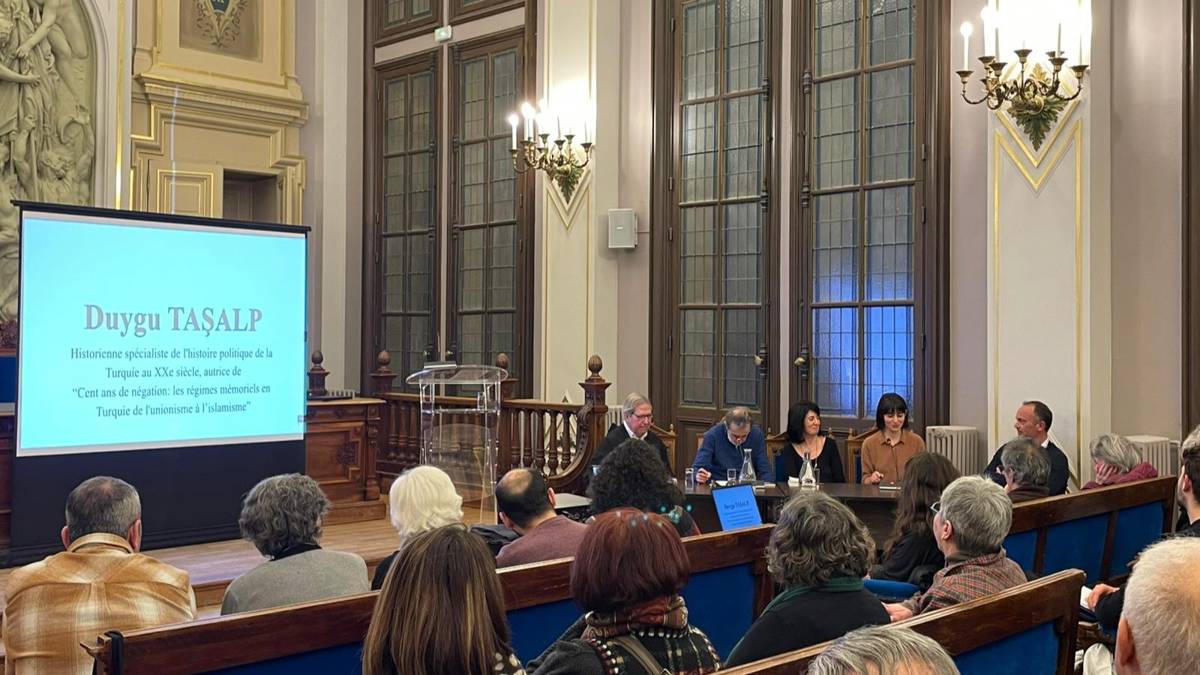
A special event was held in Paris on Wednesday evening, February 4th, in memory of Hrant Dink. Hosted in the Salle des Mariages (Wedding Hall) of the Paris 10th District Municipality, the event was organized through the joint efforts of various civil society organizations.
The axis of the discussions revolved around the personality and struggle of Hrant Dink, who was killed in a political assassination in front of the Agos newspaper office on January 19, 2007. The speakers emphasized that Dink’s legacy regarding the building of peace in the region stretching from Anatolia to the Caucasus continues to be a source of inspiration.
This traditional commemoration, which has been held for over a decade, focused this year on the themes of hope for peace and social conscience. The panel featured journalist and historian Burçin Gerçek, author of “Against the Flow: Those who Defied Orders, Saved, and Resisted during the Armenian Genocide”; author and publisher Ara Krikorian; Romain Fleury, director of the documentary “The Righteous Turks: A Very Long Silence”; and political historian Duygu Taşalp, author of “A Hundred Years of Denial.”
The event opened with the broadcast of the "balcony speech" delivered during this year’s main commemoration by Leda Mermer, deputy editor-in-chief of Agos and a colleague of Hrant Dink.
During the panel hosted by L’ACORT, the speakers explored the concept of “Righteousness” through Dink’s legacy and the contemporary repercussions of the Armenian Genocide.
Taşalp: “I Thought He Was a Bad Person”
One of the most striking moments of the panel came from Duygu Taşalp. She summarized how Hrant Dink was "othered" for an entire generation through her own personal history:
“When you are little, you know nothing about the genocide and you don’t talk about it. When Hrant Dink was killed, I thought he was a ‘bad person’ based on what we were taught.”
Taşalp pointed out that today, even the perpetrators of the genocide attempt to place themselves in the shoes of the “Righteous.” Noting that those who appear on paper to have helped do not always reflect the truth, she highlighted the manipulation of history: “If being righteous is a good thing, everyone wants to claim it; if you ask, every family has at least one ‘righteous’ ancestor.” According to Taşalp, resistance was not just about survival, but about defending the truth.
Krikorian: “The Subject I Could Not Discuss with My Family”
Author Ara Krikorian shared the deep silence of his family while explaining why he focused on this topic. Krikorian—whose mother and aunt were adopted by a Turkish family and whose two uncles were forced to change their religion—touched upon a subject he still cannot discuss with the relatives he sees: “I still meet with them, but there was one topic we could never talk about: the Genocide. Even in France, a silence prevailed regarding this issue.”
Stating that the existence of Turks he met in the art world who are ready to apologize and accept the past is encouraging, Krikorian wished for them to one day become the majority. He also posed a vital question regarding the future of Armenia: “Will Armenia remain surrounded by enemies, or will it find a path to peace with its neighbors—Turkey and Azerbaijan?”
Fleury: “The Harder It Was, the Better”
Romain Fleury, director of the documentary “The Righteous Turks: A Very Long Silence,” which brought his grandmother’s witness of the genocide to the screen, expressed the painful process with these words: “The more I struggled while making this film, the more real and better the result became.” Fleury’s work demonstrated how art serves as a space of resistance against forgetting.
The Concept of “The Righteous” Must Be Open to Debate
In the Q&A session, it was emphasized that the unity of peoples is possible through the efforts of the people themselves, not just states. Historian Burçin Gerçek responded to an audience question—“How has the concept of the Righteous changed since the genocide?”—with a conceptual critique:
“First of all, the term ‘The Righteous’ (and its usage) needs to be changed and redefined.”
Gerçek underlined that this concept should not turn into a tool for exoneration but should instead be part of a genuine confrontation with the past.


