

I feel almost hopelessly sad and confused while thinking about my story this week. It is, what the civilized world calls, the twenty-second century with such pride as if it is a sign of great human achievement, as if we have taken a great leap into a better future. But all I see around me is the same mediocrity and inhumanity that has been around for a long time, even before man came up with the idea of categorizing history into centuries. What does it mean that today more than a million people are given an ultimatum that they must leave their ancestral land within a day or two or face destruction? What is so honourable about such a twenty-second century if in another part of the world also some one hundred thousand people have to evacuate the land where their forefathers have lived for more than two millennia in order to escape bombardment? What still nurtures this supremacy complex in the mind of the powerful and makes the mighty right, if we are supposed to be going forward through the so-called centuries? I am sad because it seems as if everything around me is trying to weaken my faith in humanity.
But I am resilient. I also want to feel happy because I believe that with every human tragedy, there is also a gleam of hope, a bit of compassion and a piece of stubborn human perseverance that mark the aftermath. And I was proven right once again on my last trip to Armenia. Recently I was asked to go with Pakrat Estukyan, the editor of the Armenian pages of Agos, to cover the story of Armenian refugees from Artsakh. More than a hundred thousand of them, under the threat of war, had left their homes escaping into Armenia. I welcomed this task that I was given with great excitement. It had been such a long time since I had done a photo story of any kind, and here I was given five full days to cover the stories of refugees without worrying about lodging, food or transportation. Everything was arranged and all I had to do was work to my heart’s content. What more would a social-documentary photographer wish for?
My excitement was so great that I imagined myself working day and night roaming around in the camps, photographing the refugees in such a way so I could show their pain and longing for their land; show their hopes and aspirations towards an unknown future. I imagined all sorts of scenarios, images and compositions that I would encounter. I knew that I had not been there at the most tragic times when the border had been flooded with all those thousands of people in their hard marathon for safety. Still, my heart shivered at the thought of what I would see in the eyes of those refugees when I came face to face with them when in Armenia. There would be a lot to record and witness. Maybe I would even stay overnight with them to understand everything and not miss anything important. I even borrowed my friend’s Nikon just in case something happened to my worn-out camera; to do a good job and come back with a compassionate visual story on the refugees was my main concern.
So off I went and found nothing close to what I had imagined. I did not even encounter one refugee living on the streets of the many towns we went to. Not a single tent or container was anywhere to be seen. Yes, I met and photographed a lot of children and families that had crossed the border. But they were all living indoors in hotels, schools, homes and municipal buildings and shelters. How had it happened that within the span of three or four weeks, a hundred thousand refugees had gotten a temporary safe roof over their heads, provided with food and basic daily needs? It was a mind-boggling reality that we were faced with. There was talk about how they had been looked after as soon as they had crossed the border, the first aid stations, transportation and the organization for shelters: the tons of young volunteers who had come to help at the border crossing. I presume there was an expectation for such a human tragedy before the eventual exodus.
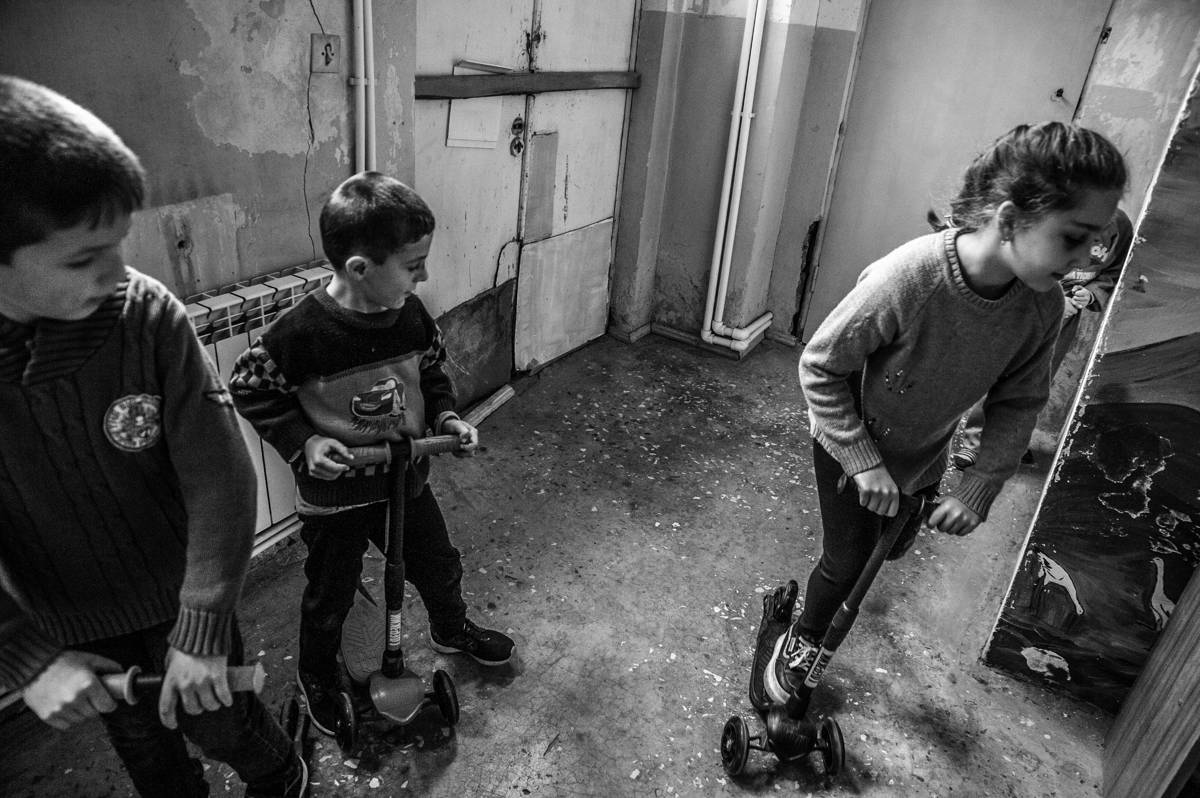
My five-day assignment covering the story of the refugees, turned out to be something so different from what I had prepared myself for. Most of my photos are like this one here. No tear-jerker, sentimental or front-cover sensational shots. What I saw, and shot, were refugee eyes that have witnessed a big human trauma, but with the conviction that life has to go on. One has to hope so that there is continuation and permanence. Yes, I did not come back with images that easily wrench the heart. Yet there is no regret of any sort in my feelings. I can even assure you that I am happy that I captured the story in the way I did. That’s why my story this week turns out not to be a hopeless outcry for the suffering of some homeless refugees. It is rather something like a homage to the amazing spirit of human compassion and camaraderie that I sensed while searching for the ghost refugee camps.


