


During a war, bodies and souls are transformed, willingly or not, and the passage of time seeps into them more quickly than is natural. Uncertainty, fear, and loss transform the individual from within, and the survival instinct comes to dominate all values. This latter has a sharper manifestation on the individual's daily life in countries composed of diverse and multi-layered communities, such as Lebanon.
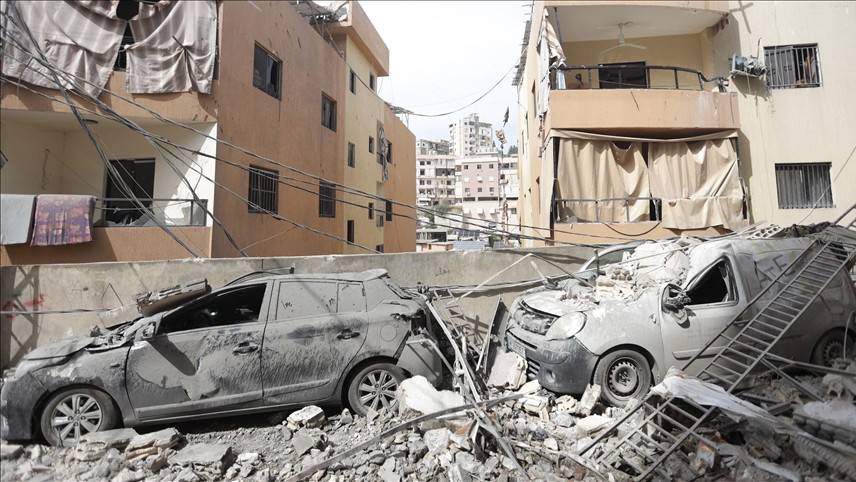
Lebanon is facing a new war, while the wounds of the previous one have yet to heal. In the course of about three weeks, more than one million people have been displaced, in other words, about 20 percent of the population, with many displaced for a second, even third or fourth time. More than 1,200 deaths and 3,500 injuries have been recorded, including members of medical staff, journalists, rescue workers, and humanitarian workers. Infrastructure has been destroyed, including hospitals, schools, bridges, and water and electricity supply systems. Some of the displaced are in shelters, while the rest are with acquaintances, in rented apartments, or on the street.
Israel is primarily brutally bombing southern Lebanon, the southern suburbs of Beirut, and the Bekaa region in the north. The remaining areas endure the insecurity sown by the war, collateral damage from targeted attacks, fear of resource depletion, distress from Israeli jets breaking the sound barrier, unemployment, and psychological distress.
In the absence of internal unity, the country's social life is in as much disarray as its political disagreements. Naturally, all humanitarian organizations across Lebanon are fully engaged in supplying aid to the citizens housed in shelters, yet the voices of those segments of Lebanese society who consider the country's entanglement in the Israel–United States versus Iran war as a blow to the country in itself are loud.
I follow the country's internal divisions and try to alternate between detaching myself from daily life and empathizing with the victims. A few nights ago, for the first time in my life, I experienced the "fight, flight, freeze" response when an Israeli fighter jet flew quite low for hours, abruptly jolting me from sleep. I found my body frozen, unable to move, curled up like a hedgehog. Only my brain and ears were working, and even they were focused solely on gauging how close the jet was to us. I don't remember falling back asleep, but the memory of my helplessness and being nailed in place is etched into my mind like a tattoo. Until that moment, "flight" had been my dominant response. The habit of fleeing to "safer" places, such as a shelter or a corridor, seems to have been passed down through my genes from my parents, who lived through the 1975–1990 war. Because of that, my reaction to every bombing or sonic boom would automatically send me to a corridor. But that night, my fear and uncertainty felt different; my desire to survive was unusually intense.
Yet amid it all, the spirit of fight/resistance remains, not as a reaction, but as a principle: to fight against/resist the hegemonic and colonialist agendas imposed on us.


