


A post I saw on social media about textiles and mending made me remember a word I hadn’t heard said in over 35 years. Because remembering is instantaneous, like a flash of lightning, you end up doubting what you remembered. But I had remembered the word, the way grandma used to say “rüpriz” (reprise in French) correctly; as a tailoring term borrowed from French, it could be confirmed by artificial intelligence.
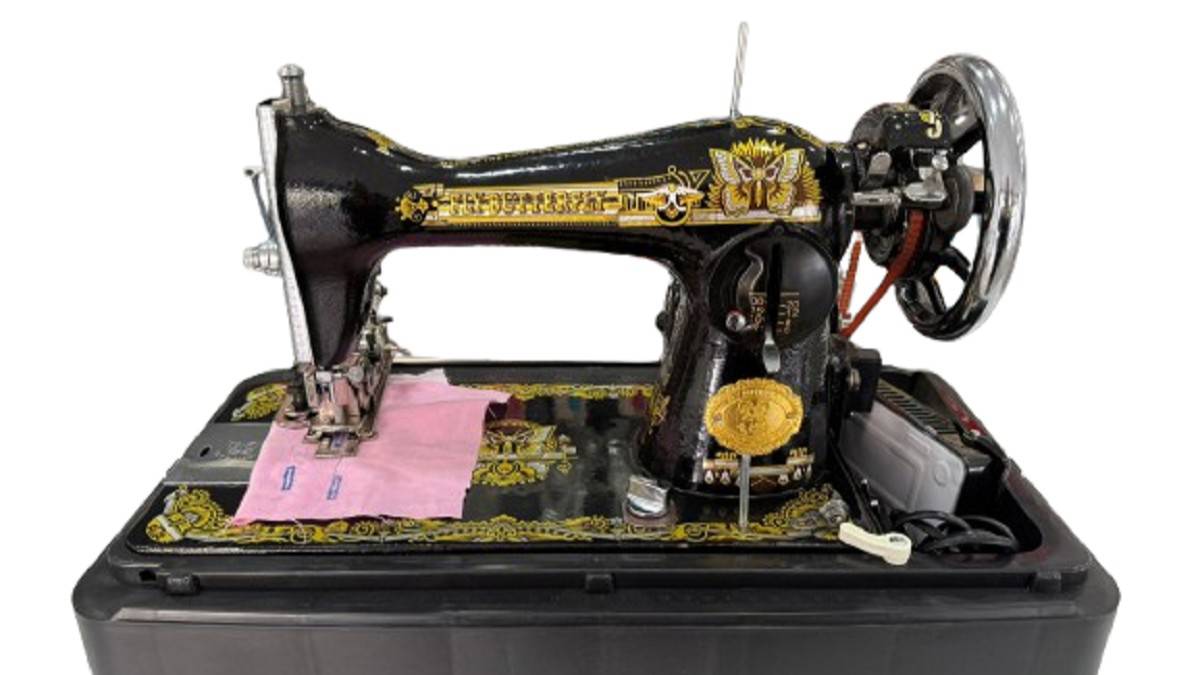
In my childhood, there was constant sewing at home. The days when my aunt Hermans set up her mechanical sewing machine, the house became a place of celebration. She would fit a whole series of clothes into a week and sew whatever I needed, for summer or winter. I knew then that this was a great privilege, but I understand it even better today. My aunt’s love language was conjuring something out of nothing by sewing and cooking. She didn’t have children.
My grandmother, on the other hand, did the patches, what she called “rüpriz”. In my childhood the sewing box was like a cup being carried from place to place, a little tool chest. My grandma’s job was to stitch up what was torn, close what was open, repair things; everything was patched—pants, shorts… and the socks were “reprised”. Reprise was almost a constant task because all our socks were always getting holes.Whether it matched the colors of the socks was one thing, but the ones in completely unrelated colors—those were the most unforgettable… What my grandma conjured out of nothing was us; the rest was stitching up tears, trying to close gaps, repairing.
Today, people who think and write about weaving teach us that processes like “rüpriz” and patching are forms of relating, a kind of love language. They remind us that the value given to cloth and fabric, the prolonging of time spent with them, is a sign of a loving relationship, of lived experience. Seen this way, what a great privilege it was that our lives began in the midst of women who knit, who patch, who earn their living by sewing, who make those around them happy by sewing.
These women developed a way of life and an economy aimed at preserving whatever they had in their hands. They possessed very few things they could hold on to, and protecting what they had meant protecting life. In neighborhoods like Samatya—kaghtagan districts where it was necessary for Armenian women to stand on their own—how many Armenian women were there who made their bread by sewing collars at home… A large part of my friends at the Samatya Sahakyan Nunyan High School, where I attended high school, were the children of the kaghtagan who came to Istanbul after the 1920s. The vast majority of the kaghtagan women in Samatya were producing livelihoods for both each other and their families by sewing collars at home within a textile labor network they built by supporting one another. Thread bound them both to each other and to life.
After all, historically, textiles were an Armenian profession. Cotton in Cilicia, silk in Bursa, Elazığ and many other places; across the entire geography where Armenians used to live weaving—spinning wool, dyeing it, preparing it to be woven—and the whole carpet-making sector were economic activities in which Armenians, women and men alike, worked before 1915. From Istanbul’s yarn factory to Arapgir’s master weavers, it was no coincidence that the great majority of textile workers came from an agrarian society.
Thread, weaving, knitting are also the universal language of Indigenous peoples. As we learn from Aylin Vartanyan’s article on Armenian lacework, Deborah Valoma’s and Elise Youssoufian’s work in California on Armenian lace and handicrafts relates not only to threads, but also to poetry, storytelling, and of course land-based production. What they include on their website about how their families’ presence in California intersects with California’s indigenous peoples speaks volumes: “We are grateful that our families found refuge in California—Elise’s family lived on the lands of the Tongva and Chumash peoples (Los Angeles), while Deborah’s family lived on the lands of the Yokuts (Fresno). Today, Elise and Deborah live on the unceded lands of the Lisjan (Ohlone) people on the east shore of the San Francisco Bay.”
Those who still have no village or land to live on continue to protect what they have with their hooks and knitting, to derive meaning from stitches they don’t yet know, in fact, without even realizing it, to reconnect with that same historical knowledge; because the language of love, in every circumstance, is to be able to mend and to make ties.


