


It is a very important thing to be a good listener. By good, I do not mean only to listen carefully. One has to follow what is being told till the end. We often make the mistake of stopping to listen once we hear the speaker saying something that negates or questions our convictions or other times when we hear something that ascertains what we suspect or fear. Sometimes it also happens that unintentionally we miss on what is being said simply because our mind is absorbed with some other personal thoughts. In all these situations, we end up missing the point of what we hear. That has its consequences and sometimes you might pay dearly for not having listened. This happens a lot in Turkish soap operas of which I have watched many. In quite a few of them they show some character listening secretly to people talking and as soon as they hear something awful or horrifying that concerns them, they rush away angrily and embark on a revenge plan that lasts till the end and destroys everybody around them. This end sometimes comes after two or three seasons and by that time we are destroyed from a predictable plot that has become boring!!
But Turkish soap operas are not what I wanted to write about. This last week my mind went back to my second year after we had moved to Beirut. Almost sixty years have passed and I started thinking about two memories from those days that relate to what I was saying about being a good listener. Take Heathcliff for example. He is the protagonist of Emily Bronte’s Wuthering Heights. In that second year, our curriculum for English class included concise/summerized versions of British literature classics. We were doing Wuthering Heights at one point. At the age of nine, I was so affected by that tragic love story. I don’t know if you have read the novel but it is mainly about love-gone-wrong because of a big misunderstanding. Heathcliff, a poor street orphan falls in love with Cathy, the daughter of the rich man who had taken him into his home.
For sixty years I have felt sad for Heathcliff and Cathy because they could not live the great love they deserved...a mutual love. And that is simply because Haeathcliff overhears a conversation in which Cathy tells of how imposssible marrying him would be because of his lower social status. He misses of course on the part where she tells of her great love for him despite his status because he rushes out angrily and disappears for many years. And they never unite again. For sixty years my heart has ached sadly because of the question, ‘what if Heathcliff had waited to hear the whole story and had found out Cathy’s profound love for him...?’ I think my lifelong softness towards star-crossed lovers began from reading that tragic chapter in Bronte’s novel.
The protagonist in the second memory about good listeners is no other, but me! This time it was in the Armenian literature hour. We were doing a short folktale about Paregentan. For a while I listened to the teacher and the other students reading excerpts from the story in our textbook but then for one reason or another, my mind flew somewhere outside the classroom windows. All I remember is that there was an old simple-minded couple and how someone had cheated the wife of some oil and flour bags and had disappeared, the husband on coming home had rushed after Paregentan. I never understood why would the husband run after paregentan to catch it. Since the teacher had told us that Paregentan was a holiday. And then, there was the bit about a horse having four legs and a man having two legs. How could someone run after a holiday? This mystery had stayed with me for all these decades…I had never bothered to read the story in all these years.
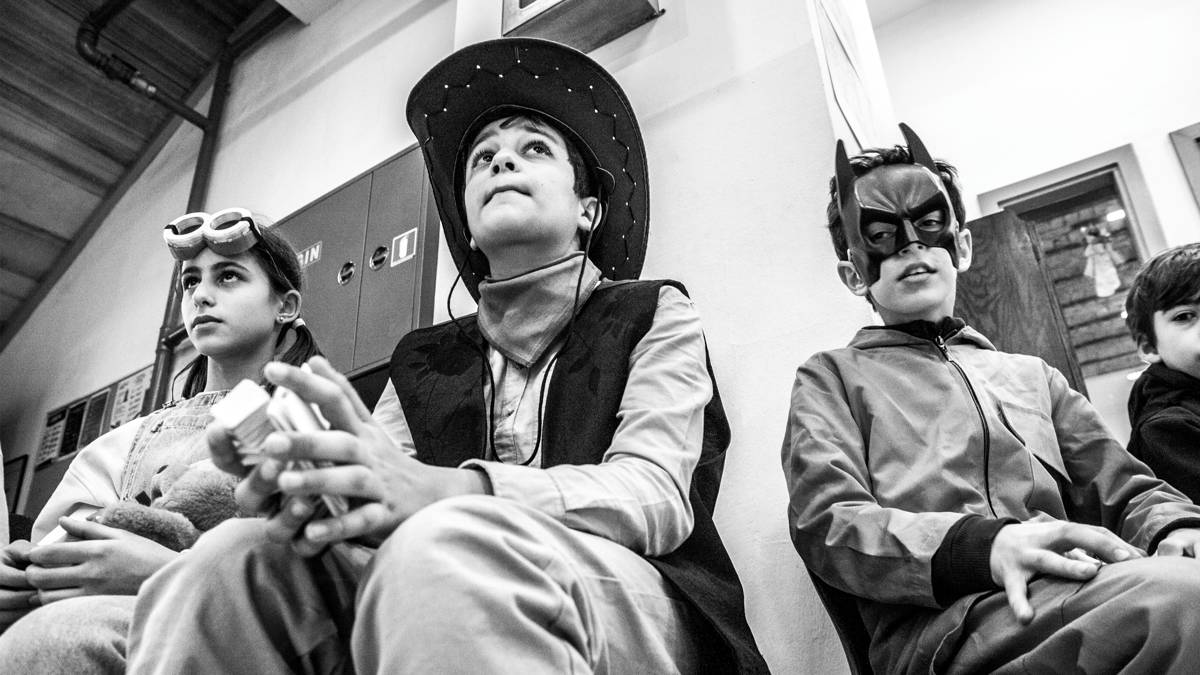
The other day I told my colleagues that I was going out to photograph the paregentan celebration at the Karagozyan school. Pakrat Estukyan, one of our editors tried to explain Paregentan to one of our non-Armenian colleagues, telling her it is a special day full of merry fun with costumes before the beginning of the seven-week-long pre-Easter fast. I jumped in and asked if he knew such and such story about Paregentan that talks about a horse with four legs and a man looking for Paregentan.
Pakrat told me the whole story and one bit of information that I had missed sixty years ago in the classroom because I had not listened carefully, made the whole story have sense. Apparently the wife in the story was so naive that she had thought a stranger passing by was Paregentan and had given him the oil and flour because her husband had told her that he had bought them for Paregentan. The stranger seeing her naivete, had pretended to be Paregentan. That’s why her husband was running after Paregentan, aka the stranger. He had rushed after him on horseback. But in the end, the stranger, the so-called Paregentan , had lied by telling the man the thief had gone by him a few minutes earlier. He also convinced the husband that he should chase after him on foot because his two legs were faster than the four legs of the horse. In the end, the stranger not only went off with oil and flour, but also with a horse. Talk about simple mindedness!


