


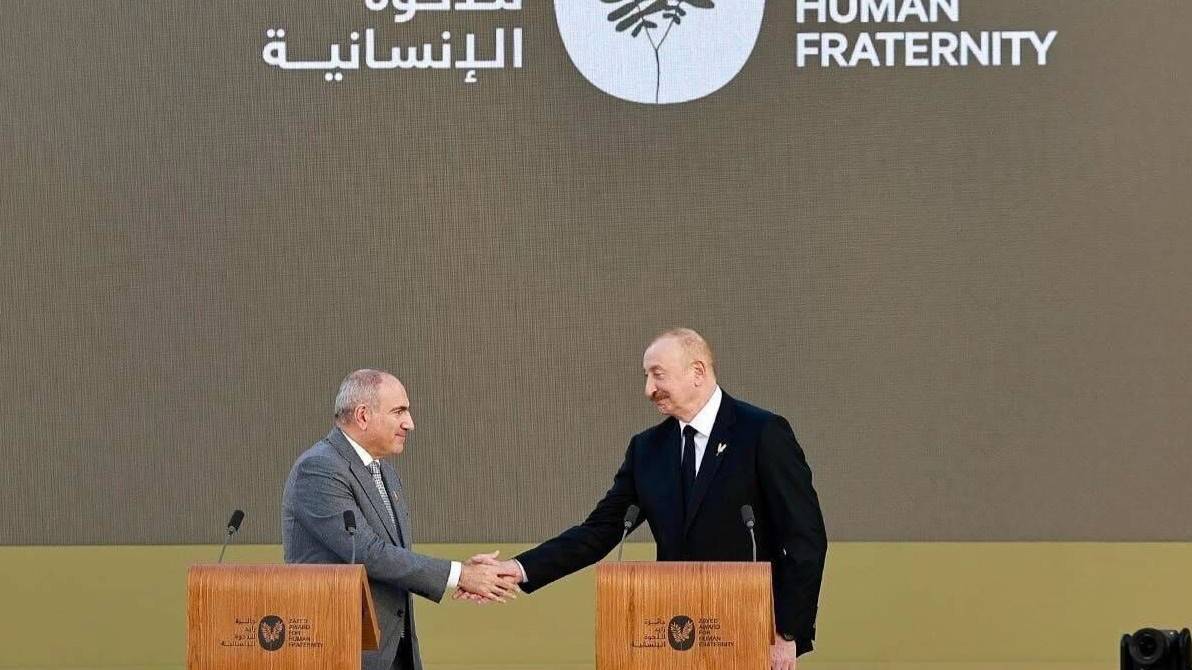
A new draft constitution has been prepared and announced in Armenia. As one might expect, there are heated debates in Armenia on this subject. Prime Minister Nikol Pashinyan is playing all his cards to secure the submission of the constitutional amendments to a referendum and their approval, including a promise not to run for office again if the new constitution is adopted.
Speaking in parliament on November 18, during a question-and-answer session about the constitution and making peace with neighboring countries, Pashinyan said something along the following lines, not word for word, but in substance:
“I don’t understand when we are going to emerge from this psychosis. Whenever the powers that want to rule us have wanted to confuse our minds, since the 1870s, they have said: ‘Turks, Turks, Turks.’”
By “psychosis,” he was referring to Armenians’ psychological state and feelings toward Turks. He made these remarks while explaining that it was only natural for a peace treaty to be signed with Aliyev, and that, in order to normalize relations with Turkey, Armenia needed to talk to the Turks, not to New Zealanders or Argentinians.
What Pashinyan said is true; moreover, although some segments of the Armenian opposition have reacted with outrage, these are simple, straightforward truths. Yes, Aliyev is a dictator, the head of an oppressive, authoritarian, one-man regime. Nevertheless, since he is currently the “ruler” of the Azerbaijani state, Armenia will inevitably have to sign a peace treaty with the state he leads, regardless of whether we like him personally or not. Armenia cannot wait for a regime change in Azerbaijan before establishing lasting peace! Likewise, it goes without saying that you cannot normalize relations with Turkey without talking to the Turks, negotiating with them, and finding common ground.
Pashinyan is also right when he says that the psychosis that has developed among Armenians toward Turks interferes with their ability to think and reason, and that foreign states have exploited this situation since the 1870s, using the problems between Armenians and Turks as an instrument of political manipulation. (It is worth noting that Hrant Dink said something similar in his article titled “The Armenian’s ‘Turk’”, which was deliberately distorted and used as a pretext on the path leading to his murder.)
Yes, what Pashinyan says is true. But if you say all these and stop there, particularly when it comes to the historical dimension, you might give the impression that the psychological state Armenians find themselves in is baseless, that it emerged out of nowhere, and that the problems between Armenians and Turks were created by foreign powers. That, however, is factually incorrect. As I have argued in various earlier articles, from roughly the 1850s onward, Armenians in the Ottoman Empire faced serious problems concerning their safety of life, property, and honor, and they could not have access to justice. Despite all their grievances and complaints, the petitions they submitted to the state, even before Armenian political parties and organizations existed, and the delegations they sent, all their efforts to seek justice and public security went unanswered. This situation remained unchanged for generations, notwithstanding a few brief periods when hopes were raised. Eventually, they were subjected to genocide and mass extermination.
This is the essence of the matter: its fundamental basis, main point of departure. Everything else is the outgrowth of this fact. This is what gave rise to the issue known as the Armenian Question or the Eastern Question, to the emergence of Armenian political parties and armed organizations, and to the circumstances that enabled foreign powers to exploit the situation. Unless you acknowledge this, everything else you say will remain shallow, even if you happen to be the Prime Minister of Armenia.
Yes, beginning in the late 1870s, Armenian institutions, parties, organizations, and certain prominent figures also “looked to foreign powers for help.” But they did not arrive at that point overnight. Armenians were facing a dead end: they could either resign themselves to their fate or try whatever means they believed might offer a solution. When the state of which they were subjects failed or refused to provide a solution, they also sought remedies abroad. Did this actually make things better, particularly for Armenians? To be honest, I find it difficult to answer that question in the affirmative. But it is not difficult to understand why those people sought ways out of the predicament in which they found themselves. The great powers of the time exploited this issue, but they were not the cause of it. Indeed, there was roughly a 15-to-20-year interval between the first emergence of the problem and the great powers’ active involvement in it. (Anticipating some possible objections, let me add the following clarification: the Armenians I am referring to here were primarily those living in the provinces and rural areas—peasants, small-scale producers, small shopkeepers, and artisans. As a sociological normality, these groups constituted the overwhelming majority of the Armenian population. The circumstances of relatively affluent Armenians living in cosmopolitan cities such as Istanbul and Izmir cannot be taken as representative of these groups.)
In short, the Armenians were the victims of this history; they were the ones who suffered injustice. This does not mean that, throughout this entire history, no Armenian group, party, or organization ever did anything wrong, or that no Armenian ever committed inhumane acts. On the contrary, if you narrow your focus in time and space within this 70-year history, you will find numerous examples of atrocities committed by this or that one Armenian group. Nevertheless, these incidents do not alter the overall character of the historical picture, which I have outlined above in very broad terms.
As I have stated in my earlier articles, I generally consider the approach and direction Pashinyan is pursuing to be correct, and I see them as a conclusion of rationality for Armenia. This is because, for Armenia to achieve lasting stability and, consequently, economic development, it must sign a peace treaty with Azerbaijan and normalize relations with Turkey. (Whether Aliyev can be trusted is debatable, but in any case, for Armenia, having such an agreement is better than not having one.) However, just as it is wrong to view history as an open account to be settled through revenge, there is no need to present history in a distorted or incomplete way for the sake of your present-day political objectives, even if those objectives happen to be right.


