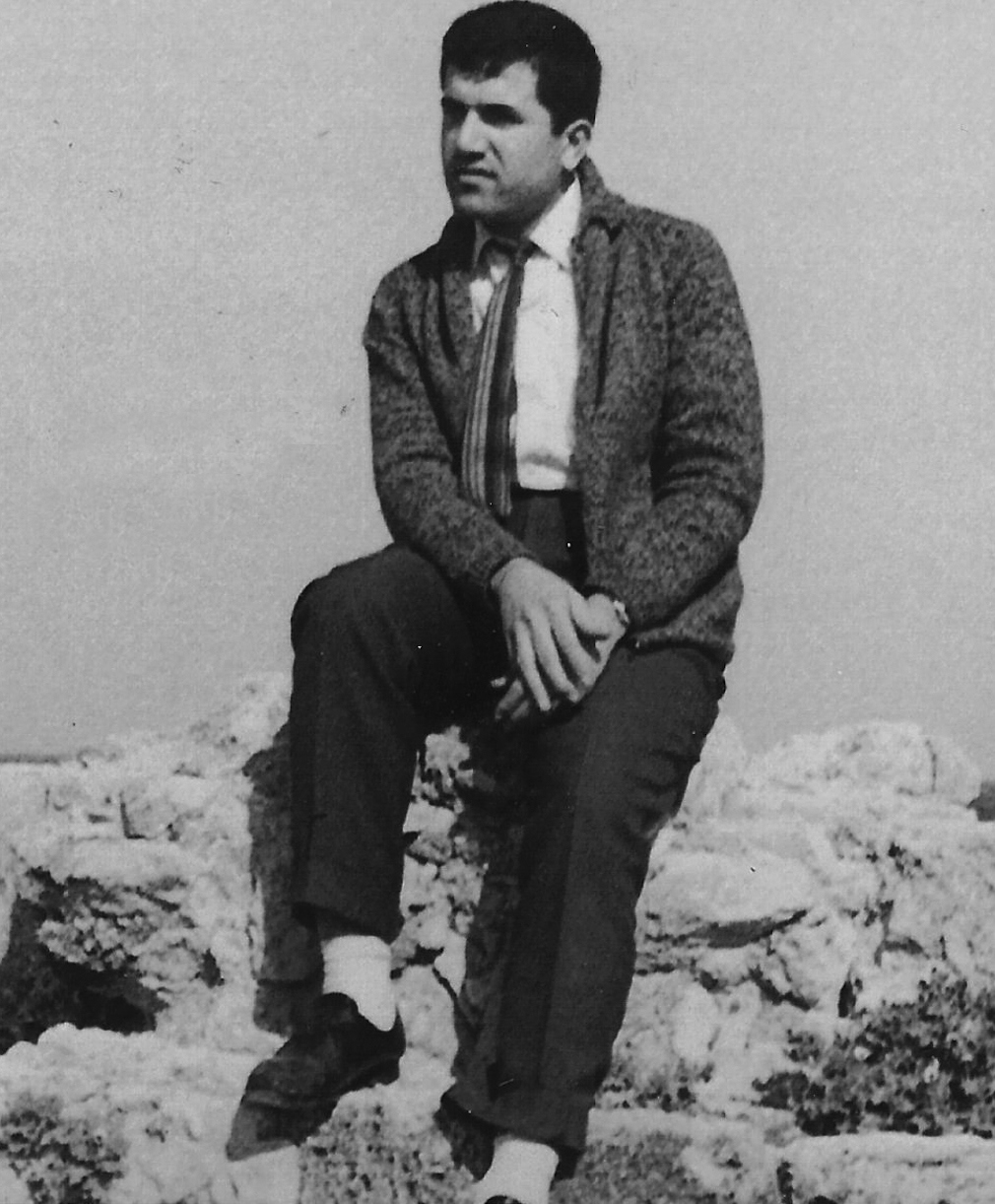
When intellectuals pass away, we often lament the interruption of their work yet to be accomplished, without considering that perhaps they have given us far more than the limits of human capacity allow. I believe Dr. Armenag Yeghiayan was one of those individuals who dedicated an entire lifetime, and more, to the Armenian language, and through it, to us.
A dentist by profession, Dr. Armenag Yeghiayan was also an educator, linguist, literary scholar, and author of textbooks. My own formation in the Armenian language and literature began through the "Dziadzan" (Rainbow) textbooks he prepared. Before I came to know him personally, he was, for me, the little boy pictured on the cover of the "Dziadzan," trying to reach the seven balloons released into the sky. This changed the day my parents took me to his clinic, located in his family home in the "Cilicia" neighborhood. The image of the little boy was replaced by that of the "dentist with shelves full of books," for the volumes lining his clinic's waiting room made a greater impression on my childhood imagination than his own appearance.
 In fact, Armenag Yeghiayan prepared these textbooks voluntarily, without any remuneration, and, I believe, through sheer perseverance. In a volume dedicated to the 95th anniversary of Hamazkayin, he recounts the arduous process: how, in 1983, as a member of both the Educational Council of the Armenian Prelacy of Lebanon and the Central Committee of the Hamazkayin Educational and Cultural Association, he joined the "United Textbook Committee" operating under their auspices. However, he eventually carried out the work independently, connecting with two prominent educators, Krikor Shahinian and Haroutiun Kurkjian, to begin the endeavor. Yeghiayan notes that all Armenian elementary schools in Lebanon (except for Hripsimiantz School), as well as schools in Greece, Paris, Marseilles, Canada, Detroit, Los Angeles, Kuwait, Egypt, and Australia, used this textbook, which also had its own workbook and teachers' guide. As his daughter Heghnar recalls, her father said the textbook was printed "like bread."
Years later, when I became an Armenian Studies student at Haigazian University and delved deeper into the world of Armenology, I found myself amid conflicts that had arisen among scholars. As a result, I was often confused by what I had learned — should I discard or reinforce it? — as one expert would invariably challenge another's grammatical rule, claiming his own was correct. I matured in this atmosphere until I could distance myself from the contention. Consequently, I often hesitated after writing, doubting certain grammatical rules. I would resolve these doubts by consulting esteemed writers and grammarians, among them Armenag Yeghiayan, who would willingly and promptly clarify my inquiries, always tracing his explanations to their sources. Soon, I too was added to his correspondence list and received his linguistic notes addressed to public writers. My joy was boundless when, years ago, Yeghiayan's "Guide to Western Armenian" was published. I use it as one might use an online search tool to check a grammar rule in another language.
Dr. Armenag also followed our work at the Parrhesia Collective, responding to all our queries with encouragement, insightful notes, and great generosity. Those who knew him understand that Armenag Yeghiayan was truly generous in imparting his knowledge of the mother tongue, always ensuring his answers were rooted in the source, i.e. Classical Armenian, while acknowledging that language is in constant flux. Thus, he accepted that changes could be adopted, provided they did not distort the foundational roots.
The Parrhesiapar column feels too confined for a proper tribute to Yeghiayan. There is much to say, and gratitude for his legacy is endless. Nearly forty days have passed since he left us, but the ocean of knowledge he bequeathed is far vaster than the span of his years, so he will remain with us still.
May you rest in peace, dear Armenag Yeghiayan.


