


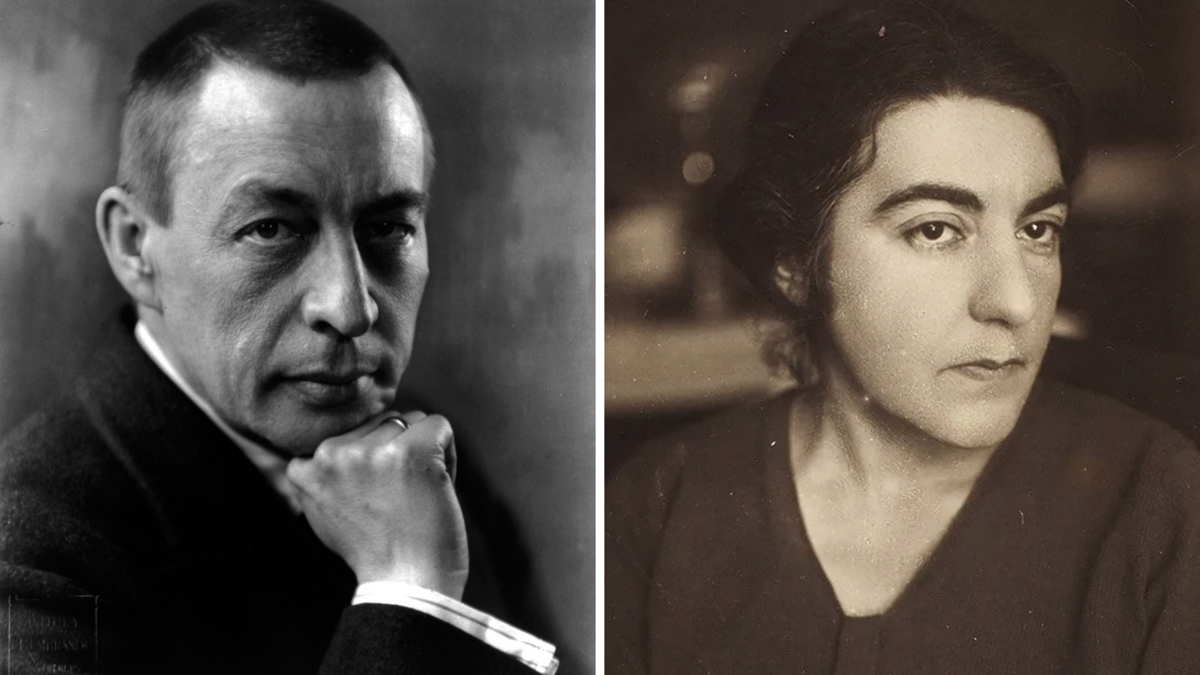
When Sergei Rachmaninoff is mentioned, most of us think of Russian Romanticism. Great bells, dark chords, an endless melancholy... Yet few people know that one of the most intriguing figures to touch the composer's inner world was an Armenian writer: Marietta Shaginyan.
Born in Moscow in 1888, Shaginyan was a poet, writer, and intellectual from an Armenian family. From a young age, she moved within literary and musical circles. She was as interested in music as she was in poetry. Her name started to become more widely known more and more in the artistic circles of the time. She would later become one of the prominent writers of the Soviet period, but during the years when she met Rachmaninoff, she was primarily recognized for her poetry and her strong intellectual personality.
Her correspondence with Rachmaninoff began in 1912. Shaginyan signed her letters with the pseudonym “Re.” Over time, this correspondence went beyond the bounds of ordinary admiration and continued for approximately five years. The fact that Rachmaninoff sometimes addressed her simply as “Re” suggests that their relationship possessed a more distinctive character than a conventional acquaintance between an artist and an admirer.
Looking back today, it becomes clear that Shaginyan’s place in Rachmaninoff’s life cannot be explained merely by describing her as a fan or a pen pal. The composer valued her opinions on contemporary poetry, asked for her thoughts on new poems, and took her suggestions into consideration. This shows that Shaginyan was not only a young writer interested in Rachmaninoff’s music but also one of the figures who nourished his poetic imagination.
Shaginyan’s influence on Rachmaninoff is particularly evident in the romances he composed for voice and piano. The composer asked this young writer, whose judgment on contemporary poetry he trusted, to recommend texts for him to set to music. Today, it is believed that Shaginyan played a significant role in shaping the poetic atmosphere of the Op. 34 and Op. 38 romances.

One of the most striking aspects of their relationship is revealed through their mutual dedications. Rachmaninoff dedicated “The Muse / Muza” (Op. 34, No. 1) to Shaginyan. Shaginyan, in turn, dedicated her poetry collection Orientalia, published in 1913, to Rachmaninoff. This exchange, one through music, the other through poetry, is among the most elegant expressions of the bond between the two artists.
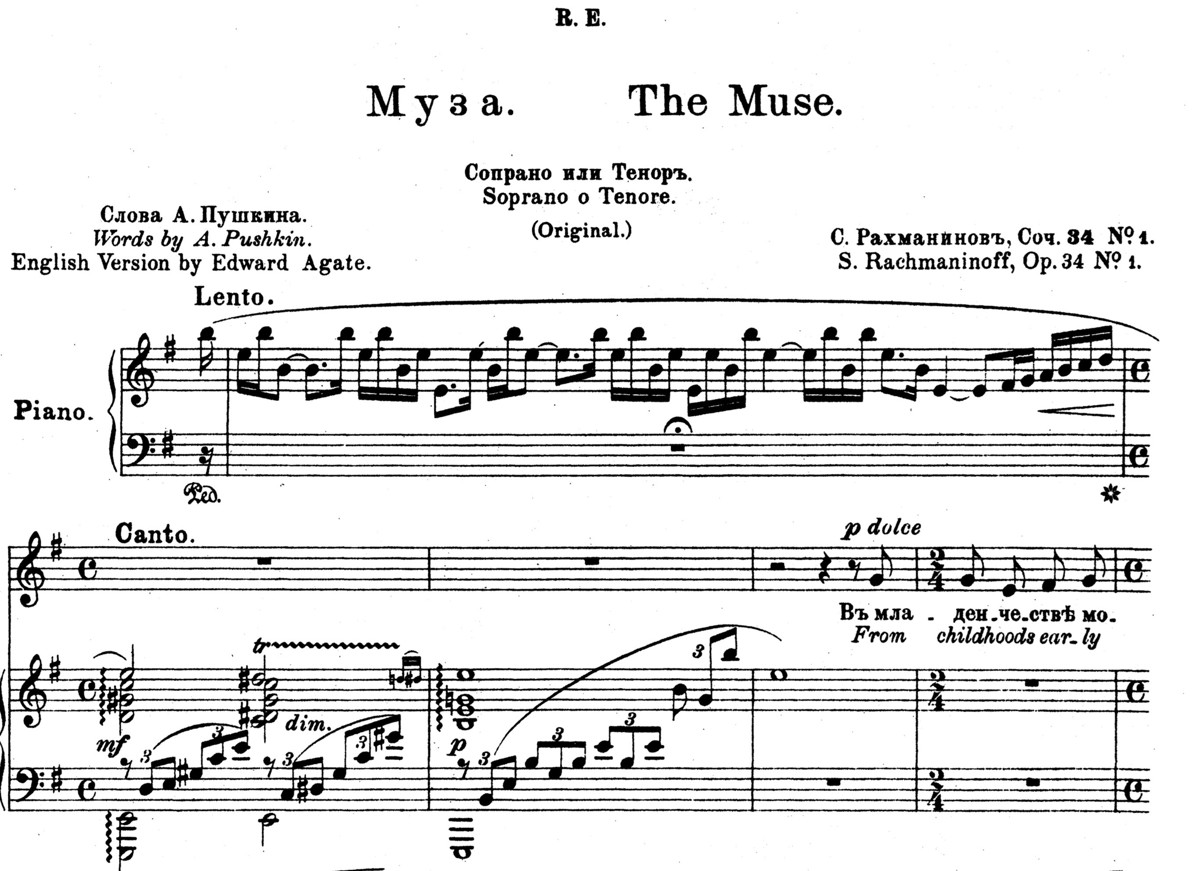
In fact, these mutual dedications also offer clues as to how these two artists viewed one another. Rachmaninoff’s dedication of “Muza” to Shaginyan hardly seems accidental. Likewise, Shaginyan’s dedication of one of her most important early poetry collections to Rachmaninoff was more than a gesture of courtesy. On both sides, one senses mutual respect and influence.
Orientalia is one of the books that established Shaginyan’s reputation. Yet it is not merely a Symbolist collection built upon exotic images of the East. In this book, Shaginyan also approaches her own cultural memory. In her poem “To Armenia,” the profound hymns of Armenian churches, longing for a distant homeland, and the fragrances of the East intertwine. Some critics of the period wrote that the Eastern imagery in the collection arose not from superficial exoticism but from Shaginyan’s deep connection to her Armenian identity.
This point is particularly important. The East in Shaginyan’s poetry is not an East observed from the outside. Nor is it an exotic backdrop constructed through a traveler’s curiosity. The atmosphere felt in these poems emerges instead from a sense of closeness to a world to which one belongs. Perhaps for this reason, Orientalia was read in its time not only as an aesthetic choice but also as a cultural statement.
“Whoever you are, come inside, O traveler...
The evening is misty, the scent of nard sweet...”
Marietta Shaginyan, Orientalia, “Full Moon”
Shaginyan was not the only Armenian figure in Rachmaninoff’s life. The composer would later set a poem by Avetik Isahakyan as a romance as well (Op. 38, No. 1).
Today, Rachmaninoff’s music is heard all over the world, and we still regard him as one of the last great representatives of Russian Romanticism. Yet along the edges of this vast musical world, it is sometimes possible to encounter unexpected figures. Marietta Shaginyan is one of them. For while Rachmaninoff’s music continues to live on, somewhere within that world the signature “Re” still remains.


