


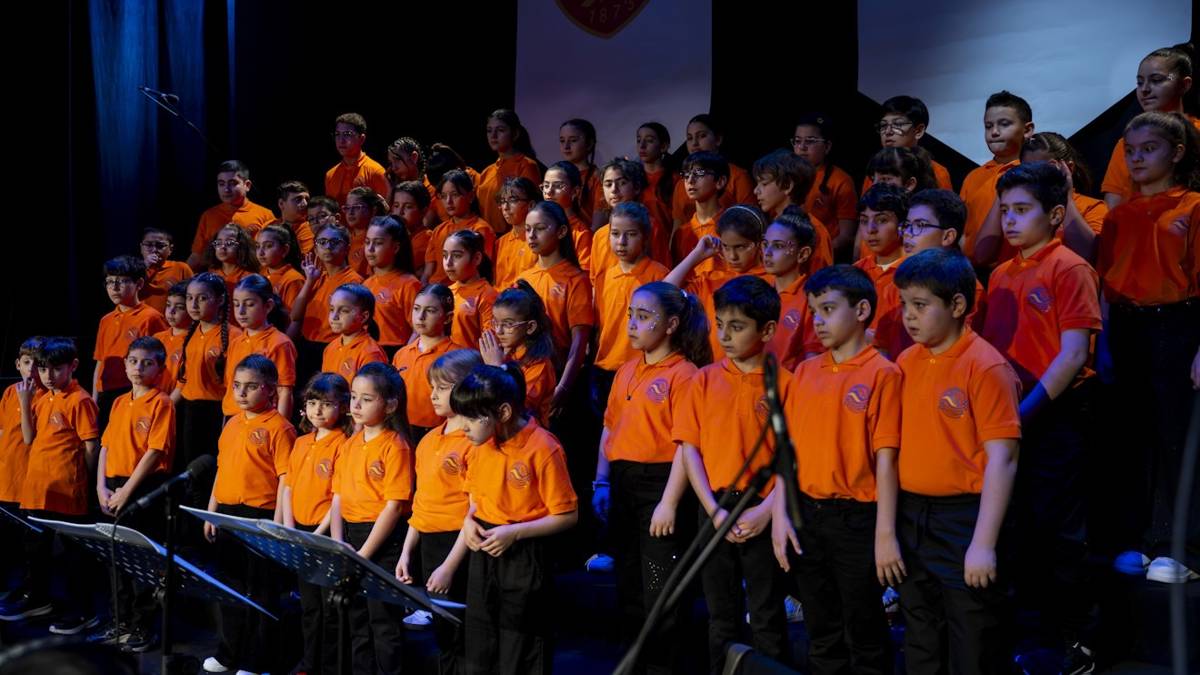
When I think about Armenian choirs in Istanbul, I often find myself thinking of Gomidas.
The fact that Gomidas Vartabed, who came to Istanbul in 1910, established the 300-member Kusan Choir here feels almost unimaginable today. Three hundred people… Three hundred voices coming together in the same city, around the same language, driven by the same excitement for music.
Looking back from today, one cannot help but ask: What has changed since those days?
It feels incomplete to answer that question simply by saying, “The population has decreased.” Of course, the population has decreased; we cannot ignore that. There are fewer children, fewer young people, and the natural nurturing force of Armenian schools has weakened. But the issue is not simply how many of us are left. I think the real issue is how we bring the people who remain together.
In the past, the choir was part of the natural flow of life. The church, school, community association, neighborhood, and family were more closely connected. A child heard Armenian songs at school, listened to the choir at church, made friends at the community association, and their family was also part of that environment. The choir was not merely a place where rehearsals took place; it was one of the ways of belonging to a community.
Today, that path no longer works as spontaneously as it once did.
Families live at different ends of the city. Children attend different schools. Weekends are divided between classes, courses, exams, traffic, and exhaustion. For many children, Armenian is no longer a language that naturally flows through the home; it has become something they encounter in particular settings — at school, in songs, at ceremonies, or when older people speak. As a result, participating in an Armenian-language choir is no longer simply about making music. It contains language, memory, belonging, and commitment.
That is why we struggle when we try to run today's choirs under yesterday's conditions.
As someone who has worked with children, young people, and choirs for many years, I see one thing very clearly: the people are still there. The children are still there. The young people are still there. But the path that brings them into the choir is no longer as open as it once was. We need to rebuild that path.
This is where the role of the choir conductor becomes especially important. Sometimes conducting is thought of purely as a musical task: you study the notes, divide the voices, prepare the piece, and give a concert. Of course, musical knowledge is at the foundation of this work, but today musical knowledge alone is not enough. Today's choir conductor is also, in a sense, the person who brings people together. The person who builds a connection with children, excites young people, persuades families, gets an institution moving, searches for repertoire, develops projects, and keeps the energy of the rehearsal room alive.
When there is the right approach, the right energy, and a relationship built on trust, people come. I have personally witnessed 50 or 60 children coming together in places where people had said, “There are no children.” So the issue is not always absence; sometimes it is about creating the language, the path, and the structure that will reach those children.
But this burden should not be placed solely on the conductor's shoulders. A strong conductor can revive a choir, but if that energy is not supported by an institutional structure, it will not last. The conductor leaves, and the work stops. The sheet music disappears. The repertoire is forgotten. Photographs remain on someone's phone. A concert takes place, and then its memory is not preserved. A few years later, we find ourselves asking the same questions again: Who will conduct? What will we sing? How will we bring the children together? How will we reach the families?
I think we need to break this cycle now:
The first step is to stop treating children's choirs as temporary events. A children's choir is not merely a charming group that appears on stage at the end of the year; it is, in its own right, a serious educational and cultural space. A child is not simply learning songs there. They are learning to listen, to wait, to move together, to become curious about an Armenian word, to develop stage discipline, and to be part of a community. If we want strong youth and adult choirs in the future, we need to take children's choirs seriously today.
The second step is to develop a shared approach to repertoire. It is not sustainable for every conductor to search for music on their own every season, arrange pieces, and try to find works suitable for children. We need a pool of Armenian-language repertoire — separate material for children, young people, and adult choirs; material progressing from easy to difficult; repertoire that has been tested and is supported by recordings and pronunciation examples. This would make the conductors' work easier while also creating a shared musical memory among the choirs.
The third step is to take the question of archives seriously. When a concert ends, it should not be only the applause that remains. The program, repertoire, sheet music, recordings, posters, lists of singers, and even small notes from the rehearsal process should be preserved. Memory does not form by itself; it remains when it is intentionally kept.
The fourth step is to put families and transportation at the center of the process. Today, whether a child can come to choir depends on more than the child's own desire. The family's schedule, transportation options, rehearsal time, sense of security, circle of friends... all of these factors are part of the decision. Before saying, “There is no interest,” we need to ask, “How will this child get here?”
The fifth step is to train conductors. This may be one of the most important issues of all. For the choir tradition to continue, we need not only good singers but also new conductors. But it is not enough for these conductors to know music. They also need to learn how to work with children, communicate with young people, work with institutions, think about repertoire, and build communities.
And finally, we need to rethink the question of “cultural belonging and the bond of love.”
Belonging and love are deeply precious. In fact, without them, nothing can happen. But institutions can no longer function on these feelings alone, and neither can choirs. Love needs to be accompanied by planning, an archive, repertoire, transportation, a policy for children, consistent support. In saying these things, I do not want to make absolute judgments; every institution has different circumstances, and every choir has a different story. But what I see in the field is this: A choir does not survive on its own. It survives when there are people who invest their effort in it. It grows when there is a system capable of carrying that effort forward. And it becomes part of the future when children and young people are given a genuine space within it.
Perhaps the question we need to ask today is not, “How many were we in the past?” Of course, it is important to know this; the journey from Gomidas's 300-member choir to the present tells us a great deal. But I believe today's real questions are these:
How will we bring together the voices we still have today? How will we keep children connected? How will we give young people responsibility? How will we support conductors? And how will we create a memory so that the effort behind a concert does not disappear afterward?
The name Meg Note makes me think about this: A single note may seem small on its own. But when it meets other notes, in the right place and with the right breath, it becomes music.
Perhaps this is exactly what the issue is for our choirs, too.
The voice is still there.
Now we need to build the vision, the effort, and the path that will bring those voices together again.


