

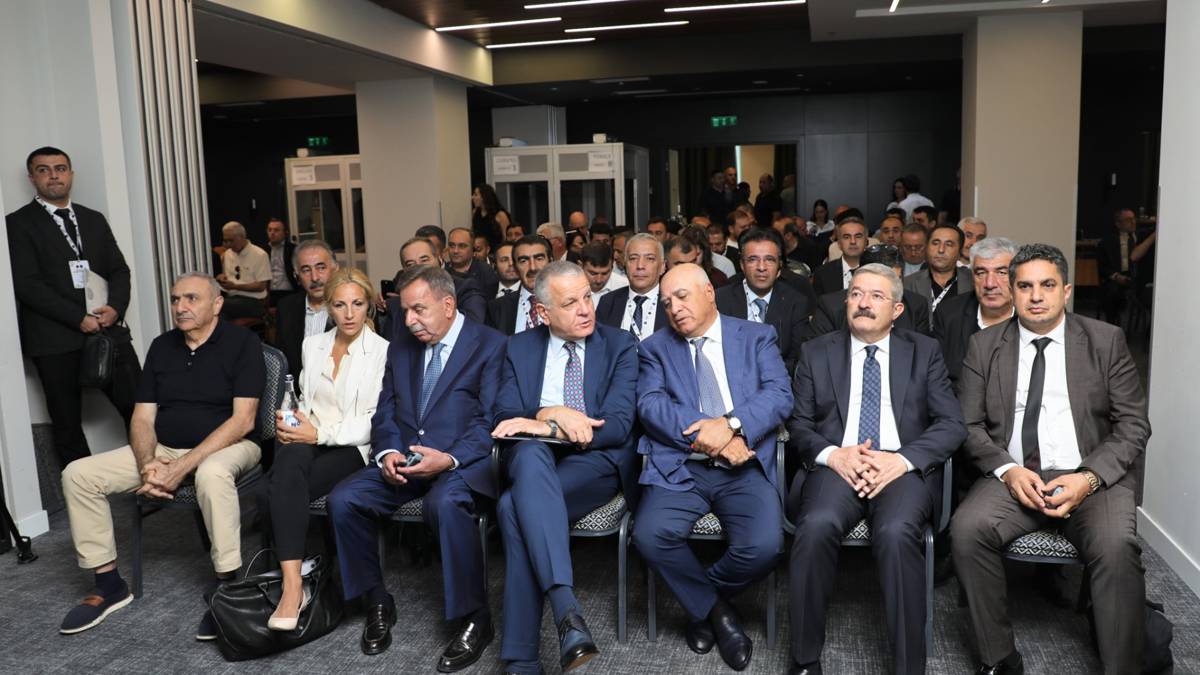
The forum that brought together the business communities of Armenia and Turkey was held in Yerevan on September 3 and 4. The Armenia-Turkey Business Forum was organized by the Union of Manufacturers and Businessmen of Armenia as part of the EU-funded project “Support to the Armenia-Turkey Normalization Process: Strengthening Cross-Border Ties.”
Speaking at the forum, Necdet Takva, Chairman of the Board of Directors of the Van Chamber of Commerce and Industry, said:
“Following the normalization process, we consider it a strategic necessity to establish an appropriate representative office in Van in order to manage and coordinate the developing economic relations and commercial issues on the ground. As the Van Chamber of Commerce and Industry, we are ready to allocate space in our building for the establishment of such a representative office and to take the initiative in this regard.”
Takva said:
“We are here to represent and expand the interests and economic opportunities of our city and our businesspeople. Today, as the delegation of the Van Chamber of Commerce and Industry, we are in Yerevan, at the heart of thousands of years of shared history, an ancient geography, and our shared neighborhood.”
The President of Van CCI stated:
“Geography is destiny. However, turning this destiny into mutual prosperity, cross-border trade, and lasting regional peace depends on us, on our shared will.”
Takva noted that even during years when the Armenia-Turkey border was closed and official channels of communication were limited, civil society and business representatives continued to build channels of communication and trade diplomacy between the two societies.
Takva emphasized:
“Of course, during periods when border gates were closed and official communication channels were occasionally blocked, there were private actors who, even in the most difficult times, kept the region’s channels of communication open and built bridges of civil and commercial diplomacy between the two societies. One of them was a group of representatives of the Armenian business community, who made great efforts to bring businesspeople from the two countries together around the same trade table. Another important institution is the Economic Policy Research Foundation of Turkey (TEPAV), which has done significant work in establishing the academic foundations of economic relations and trade diplomacy. Without civil society representatives and businesspeople who have been working on both sides for years, we would not have the strong and hopeful atmosphere we have today.”
Trade is the real force
Referring to the normalization process in Armenia-Turkey relations, Takva drew attention to developments pertaining to meetings between the special envoys of the two countries, direct air cargo transportation, and the technical infrastructure of the border gates.
“Diplomacy can open the way, but the real force that makes this permanent and brings prosperity to both societies is trade,” Takva said, emphasizing that, due to its geographical location, Van stands out as one of the closest and most suitable hubs for Turkey to connect with Armenia and, through Armenia, with broader regional markets.
Takva noted that if the border gates were opened to trade, the road distance between Van and Yerevan could be approximately 290 kilometers, with the journey taking roughly three to four hours. He continued:
“In that case, the days-long, circuitous transportation routes through Georgia or Iran, as well as the additional re-export costs, could be eliminated.”
He also identified the complementary nature of the two countries’ production capacities as one of the promising areas for Armenia-Turkey economic relations.
According to Takva, construction materials, construction chemicals, plastic and packaging products, high-quality furniture, and processed industrial products manufactured in the Van Organized Industrial Zone could meet part of the existing demand in Armenia. At the same time, he noted that Armenia has strong positions in metallurgy, textiles, and several other sectors, which could provide a basis for direct cooperation.
Not just trade, but partnership
Takva recommended that Armenian and Turkish businesspeople consider not limiting themselves to commercial relations but also explore the possibility of establishing joint production ventures and partnerships.
Takva said:
“There is also a Eurasian market of 180 million people here. We did not come here merely as traders. We also want our manufacturers to establish partnerships. By organizing production in the free economic zones offered by Armenia and providing the necessary local added value, it is possible to benefit from the opportunities provided by Armenia’s membership in the Eurasian Economic Union and gain access to a market of approximately 180 million people.”
Takva presented two strategic and institutional proposals for developing Armenia-Turkey economic relations. The first concerns establishing a mechanism for diplomatic representation and the local coordination of economic and commercial issues. The second concerns making cooperation between the two countries institutionalized and continuous within the framework of cultural and commercial diplomacy.
He emphasized that closed borders not only prevent the movement and transportation of goods but also restrict communication and mutual understanding between people.
The President of Van CCI said:
“Closed borders do not only restrict the movement of vehicles and goods. They also restrict the channels of communication that exist in people’s minds. We are here today to open those closed channels and to combine production and economic opportunities with the warmth of human relations.”
Referring also to remarks by Ambassador Vassilis Maragos, Head of the Delegation of the European Union to Armenia, Takva suggested that the European Union provide greater support to institutions in Turkey that are working to develop Armenia-Turkey cooperation.


