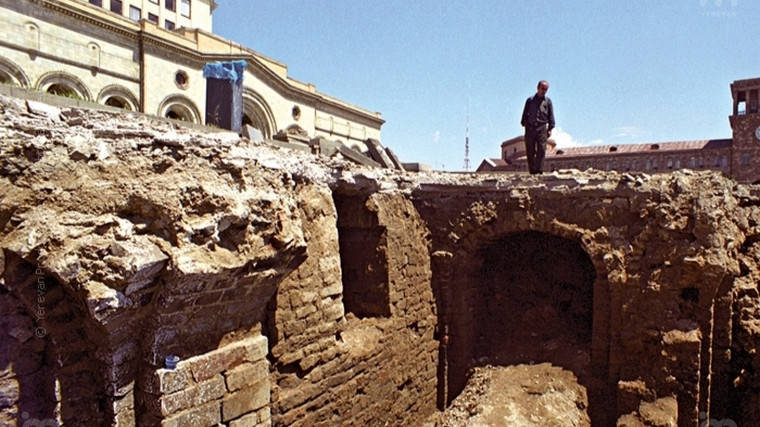


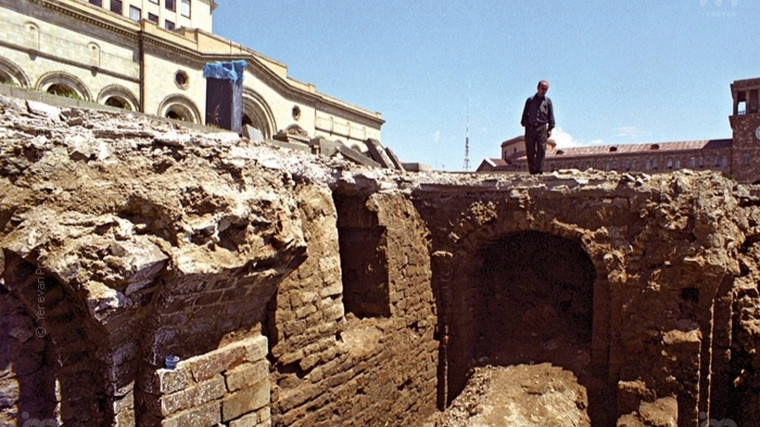
In the early 1990s, underground structures were discovered during renovation works in central Yerevan. However, because it was not possible to suspend the construction work for an extended period, it was decided to preserve the remains in place and cover them over. They could be excavated again in the future, revealing an underground city beneath the center of Yerevan.
In addition, at a site very close by, opposite the Moscow Cinema, construction work uncovered what is believed to be the grave of a nobleman dating to the Timurid period, along with various artifacts.
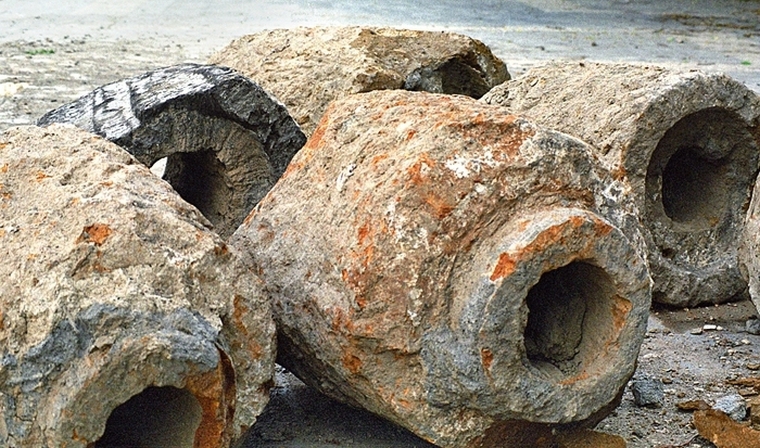
The discovery took place in 2003. After the top layer of asphalt was removed from Yerevan's main square, 17th century residential structures, remnants of stone walls, ceramic jars, clay water pipes, and black and red roof tiles emerged beneath it, astonishing construction workers.
Grigor Gharakhanyan, Head of the Department of Medieval Studies at the Institute of Archaeology and Ethnography of the National Academy of Sciences, together with Aghavni Jamkochyan and Frina Babayan, conducted archaeological investigations at the site. According to the archaeologists, these were the remains of buildings destroyed in the earthquake of 1679.
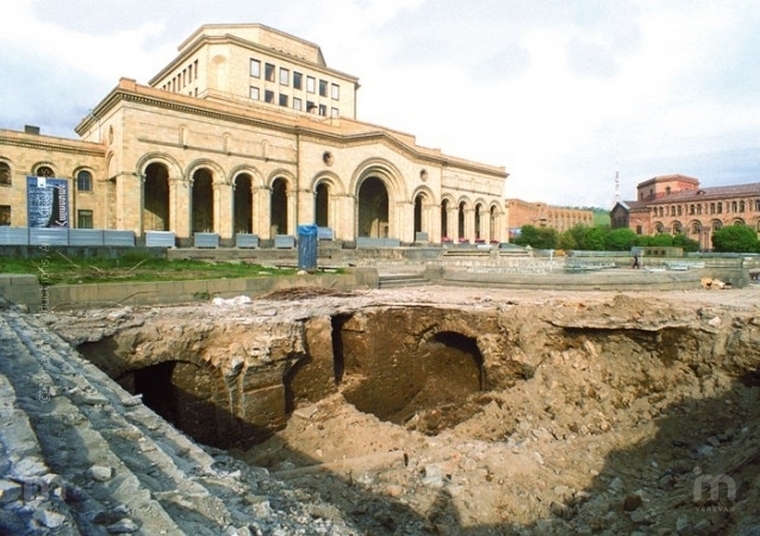
Buildings Destroyed in the Earthquake of 1679
Located directly beneath the Republic Square, this old city, built of black and red tuff stone, stretches beneath Abovyan and Amiryan streets to the old Kond district. Archaeologist Aghavni Jamkochyan said, "The excavations show that the roofs of the buildings collapsed during the earthquake of the 17th century."
In the 17th century, Yerevan was home not only to Armenians but also to Turkish and Persian Muslims. According to the archaeologist, the old city was covered over in the early 20th century, before construction began on Republic Square designed by architect Alexander Tamanyan and remained forgotten until 2003. Jamkochyan, one of the experts who examined the remains unearthed during the renovation of Republic Square, said that the excavations revealed rooms 4.5 meters high connected by internal arches. The foundations of the buildings were so solid that, after the earthquake, people continued living in the surviving lower floors. Based on the archaeological evidence, researchers concluded that the underground structures were part of the 17th century buildings depicted in panoramic drawings of Yerevan by the French travelers Jean-Baptiste Tavernier and Jean Chardin.
A step by Pashinyan
Because Armenia's previous governments lacked the funds to carry out archaeological research, the discovery was covered up. The site was paved over. Armenia's current government appears ready to reveal the treasure to the public and turn the historic site into a tourist attraction. In recent years, Prime Minister Nikol Pashinyan announced on his Facebook page that work would begin to uncover the historic layer beneath Republic Square in Old Yerevan and convert part of it into a museum, adding, "As a result, Republic Square will become a much more beautiful place."
"We must know what our memory is"
According to ethnographer Lusine Khalatyan, Armenia's cultural diversity must first be thoroughly studied, and this heritage should be embraced by the Armenian people before the site is opened to tourists. Speaking previously to CivilNet, she said: "What I would do is open this Pandora's box and dig deeper, because we, as the people of Yerevan, must understand our heritage, confront our past, and know what our memory is."
These findings show that 17th and 18th century Yerevan was not merely an ordinary town but also an important center of trade and commerce. However, it has not been possible to carry out a full and comprehensive study of this historical treasure.
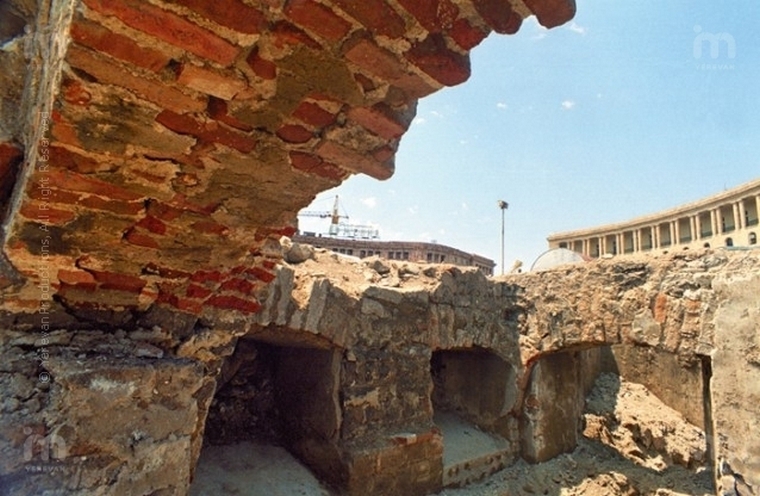
Meanwhile, Yerevan's former chief architect Narek Sargsyan commented on the structures unearthed during the excavations: "First of all, these are not monuments but the basements of demolished houses on old Astafyan Street (today's Abovyan Street), the first planned street of Armenia's capital. Secondly, they were not destroyed; they were simply covered with sand for future generations." According to Sargsyan, one of the objectives of the new design project for the square is to transform part of these underground monuments—under the guise of restoration—into a commercial center connected with Hyusisayin Poghota (Northern Avenue).
At present, there is no active project to revive old Yerevan. What will ultimately be preserved for future generations also remains uncertain.