

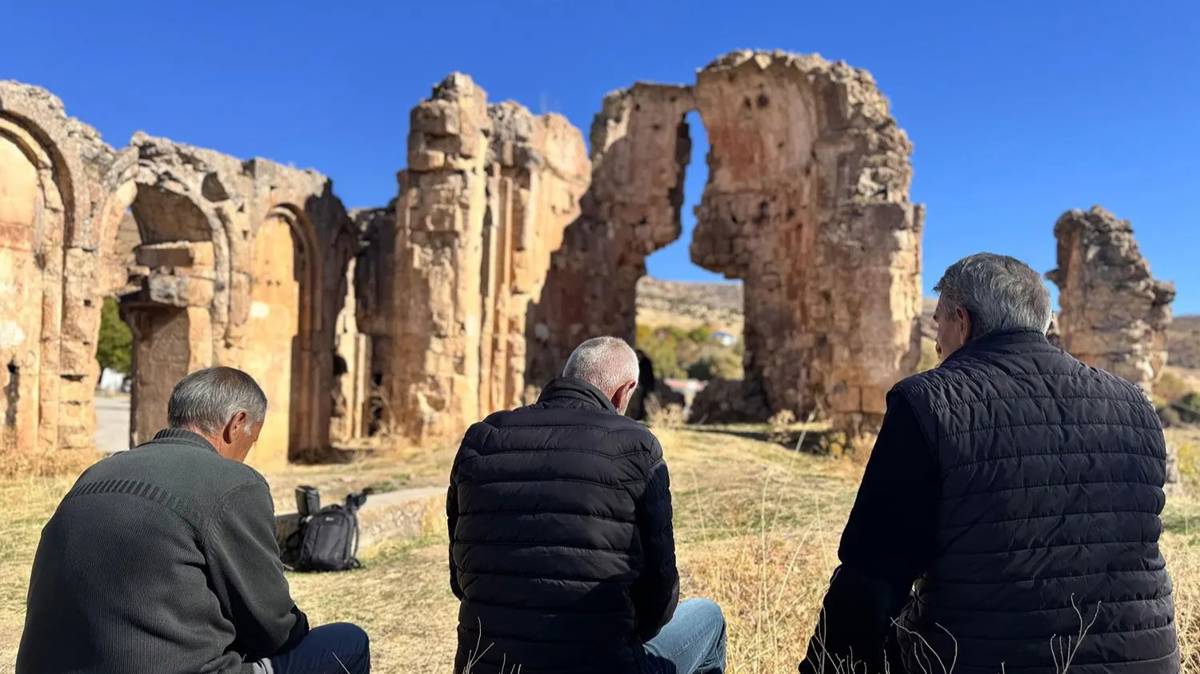
The historic Ergen Church, located in Ergen village of Dersim’s Hozat district, is known as an important structure that the Armenian community used as a place of worship in the past. Today, however, the church is in danger of collapse due to excavations by treasure hunters and neglect.
Noteworthy for its stone architecture, arched entrance gate, and wall reliefs, the church carries Dersim’s multicultural past to the present day. However, the structure, which has not been restored for years, is rapidly deteriorating due to natural conditions and excavations by treasure hunters.
The stones of the structure, estimated to have been built in the 19th century, have either been destroyed, stolen, or scribbled with names. Reminding that the church, which stands in a neglected state, was declared a protected site in 2012 but has not yet been taken under protection, village residents want the church to be protected against the destruction caused by treasure hunters and to be restored.
According to news from Rudaw, the villagers want the Armenian Ergen Church to be brought under protection, restored, and brought into both faith and cultural tourism. Hayri Yıldız, one of the villagers, drew attention to the state's indifference, saying, “They should protect it, they should take care of it. As a village, we must take care of this place. The government's perspective is already clear, but it is not taking care of it. We must not allow treasure hunters to enter here. If this place is protected, people will come from Europe, Yerevan, Russia. Our village will come alive.” Another village resident, Mehmet Oğuz, emphasized the importance of cultural heritage with the words, “It is a historic church, a historic faith, a value. It is necessary to protect these values, otherwise they vanish. In fact, we are destroying ourselves and we are not aware of it.”
In the village of Ergan
In an article he wrote for Agos on June 1, 2012, Rober Koptaş shared his impressions of a journey to the region with a fairly large group attending a festival organized in honor of the historic fountains in Habab, the village of Fethiye Çetin’s grandmother Heranuş/Seher:
"What I felt in Harput, which we could barely see because of the rain, and even more so in the village of Ergen (Ergan) in Dersim, was a profound sense of ah—something so deep that I cannot put it into words. Leaving Hozat behind and slowly making our way along winding roads, we arrived at the village of Ergan. With its single-story houses, shy inhabitants, and chickens scattering in front of us, it was an ordinary Anatolian village. After walking through the streets, greeting the people who watched us with curiosity from between the houses, we suddenly found ourselves standing before the Yergayn Inguzik Surp Harutyun Church. At that moment, I froze involuntarily, and immediately afterward, two tears rolled down my cheeks. I was emotional there, but without becoming overly sentimental here, let me offer a few lines of information about this village and its church:
The Armenian name of the village of Ergen, Yergan Inguzik, means 'tall walnut tree' in Armenian. The monastery in the village is known as Surp Harutyun. Levon Lüleciyan of Dersim provides the following information about the monastery: 'Even in ruins, this Vank, renowned as the finest stone structure in Dersim, remained majestic and impressive. Its surviving wall was built of finely cut stone; it bore carved ornaments, images, wheat-ear motifs, and Armenian inscriptions. On the inner side of the wall there was also a cuneiform inscription, from which it was understood that the Vank had been built in the year 975.'
Like other monasteries of its time, Yergan Inguzik served as a center for the development of Armenian education and culture during the Middle Ages, and many manuscripts were produced there.
Even who knows how many years after its destruction, this Surp Harutyun monastery, with its surviving walls, was still so magnificent and so unlike the condition of the village around it that the loneliness and abandonment of that stone structure filled one with deep sorrow, even beneath the bright golden sun whose warmth seemed to invite people to joy.
In the middle of the church was the grave of the village's last surviving Armenian, who had spent much of his life trying to protect the ruin from treasure hunters. In accordance with his final wish, the villagers buried him there. When treasure hunters began disturbing even this poor man's remains, they found a solution by pouring concrete over his grave. A concrete tomb beneath the open sky, standing in the middle of a church whose roof had collapsed, whose walls had crumbled, and which had become overgrown with wild plants... I wonder what you would have thought?
Similar emotions returned at the other places we visited as well—in the unnamed churches of Mazgirt, in Habab, and in Palu..."


