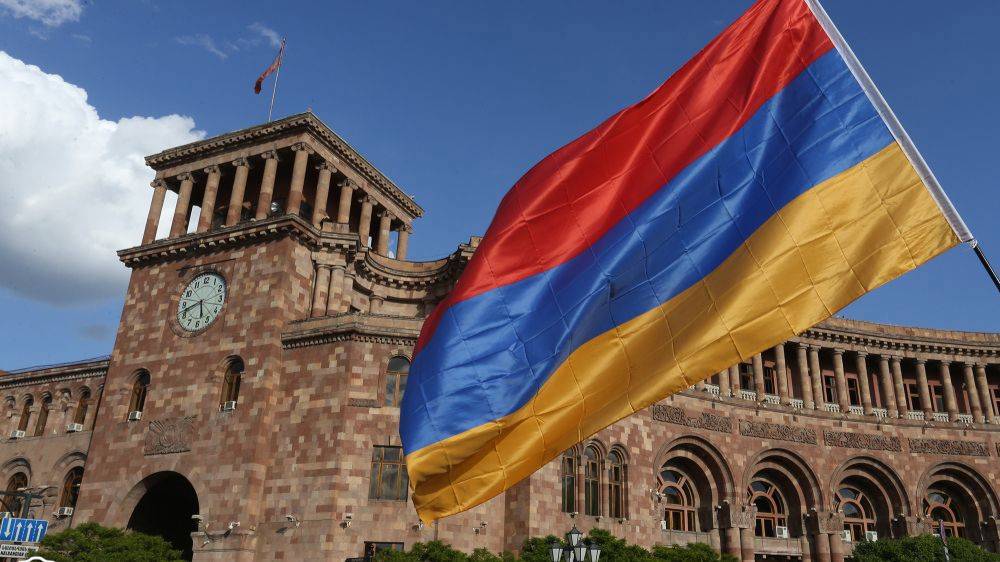


Armenian government’s 2026–2031 program, approved on Tuesday, August 25, by 63 votes in favor and 24 against, consists of a roughly 90-page list of promises. Average annual growth of 6 percent, 125,000 new jobs, 2,500 kilometers of roads, artificial intelligence capacity equivalent to 100,000 GPUs, three satellites… But the real significance of the text lies not in the numbers. This program means that the idea of “Real Armenia” is, for the first time, moving beyond being a party ideology and becoming the state’s working definition.
Indeed, in the very first pages, the government declares that this ideology received popular approval in the June 7 elections and defines 29,743 square kilometers as the state’s sole legitimate geographic reference. I ended the article I wrote last year on the party congress program with the question, “Is Real Armenia an ideology, or the name of a difficult test?” We now know part of the answer. Pashinyan sees it not as an election slogan, but as the founding doctrine of the Fourth Republic.
The most coherent aspect of the program is also here. Foreign policy, security, economy, education, citizenship, and artificial intelligence are not disconnected sections; they are parts of the same vision of the state. The security section says that “peace is the only effective and reliable guarantee of security,” while the army is described as a “reserve instrument” to be brought into play when diplomacy fails. More importantly, it is explicitly stated that the Armed Forces cannot be used beyond recognized borders except for international peacekeeping missions. It would be difficult to find a clearer expression of the rupture in the state’s thinking after Karabakh.
What does the “Turkey” section contain?
The same logic applies both externally and internally. The emphasis is not on a “Russia or the West” dichotomy, but on a “balanced and balancing” model. Visa liberalization with the EU, TRIPP with the United States, and a “transforming partnership” with Russia are addressed within the same framework. Turkey section is more concrete than ever before. Diplomatic relations, the opening of the border, at least two modern crossing points, and the reconnection of transport, energy, and digital infrastructure are explicitly set out. Sovereignty is now measured not only by the ability to protect borders, but also by the capacity to generate energy, process data, sell goods, and reach different markets. In my article last year, I wrote, “If there are rails on the one side of the Crossroads of Peace, there will be data on the other”; the program has turned this analogy almost into official policy.
Citizenship tied to “residence”
The program describes not only the economy and security, but also the emotional relationship between citizens and the state. It says education should create a “state-centered sociopsychology”, and that citizens should love and trust the state. Continuing the line that began in the previous party program, patriotism is taken out of the realm of bombast and reduced to paying taxes, trusting institutions, and generating prosperity. Citizenship, meanwhile, is tied to ethnic origin less than to residence and to Armenia being the person’s “center of vital interests,” which also applies to someone coming from the diaspora.
Catholicos election
One of the most striking sections is the heading “spiritual security.” The government is turning the reform of the Armenian Apostolic Church into state policy. It lays out a process ranging from the removal of the church’s de facto head to a new statute and the election of a new Catholicos. However, objecting to the politicization of the Church is one thing; having the state write into its program who will become the head of the Church is another.
The same question applies to the new Constitution. The program defines the Constitution as the common political contract of the people and says that the draft will be opened to broad public and expert debate. While this is the right approach, the text is also cautious because in the Parliament 70 votes are required to put a new constitutional draft to referendum. It does not say, “Referendum will be held”; it says, “steps will be taken to put it to referendum.” The real issue, however, is that if you declare the election results as the “popular approval of the Real Armenia ideology” on the very first page of your program, it is fair to ask how open-ended the debate you are going to initiate can actually be.
And besides the text there is a reality that should not be forgotten. While the program was being approved by 63 votes in favor and 24 against, former President Robert Kocharyan was at the Anti-Corruption Committee, while his elder son Sedrak has been detained for two months. The detention came the day after his other son, Levon Kocharyan, had a confrontation with Pashinyan in Parliament during the program debate. In this form, the program passed through a Parliament that itself is not yet fully settled.
Nevertheless, I see the 2026–2031 program as the most comprehensive design of the state of the Pashinyan era. Its goals are measurable and provide a clear answer to what postwar Armenia wants to become. But precisely because of this comprehensiveness, its test will be a difficult one. If “Real Armenia” remains Armenia of the merely ruling power, the Fourth Republic will become a name for just an era. If it can create a common state in which the opposition, the Church, the diaspora, and those who did not vote for the ruling party can also live, then we can truly begin to speak of a new Republic.