


For a long time, a bibliographical study, sitting on my desk, started to gather dust. As I kept saying, “I’ll get to it today or tomorrow,” we arrived at the year 2026, referred to as the “Peace Process.” Thinking that there was no point in postponing it any longer, I tried to summarize it as quickly as possible.
The study, 190 pages long, was published in Yerevan in 1980 under the collective editorship of H. Parseghyan, A. Khachaduryan, and Y. Ghazarosyan. Its title is Hay Barperagan Mamuli Krderi Masin (Kurds in Armenian Periodical Publications, Bibliography 1850-1920). Its preface was written by Garlen Chachani, who served for many years as head of the Kurdish Writers’ Section of the Writers’ Union of Armenia. After briefly discussing the history of periodicals in Armenian language, Chachani compiled writings concerning the social, economic, political, and cultural situation of Kurds in different provinces of Anatolia, the activities of Kurdish aghas and sheikhs, internal conflicts, the land question, the Yazidis, Kurdish-Armenian relations, and many other subjects.

Those periodicals clearly feature Armenian-Kurdish cultural ties, the socio-economic condition of the Kurds, their culture, folklore, and many other subjects. One can say that no people having a tradition of rich literature and printed press wrote about the Kurds as extensively as the Armenian press did. These publications contain many subjects, including the creation of the Kurdish alphabet, the printing of Kurdish primer in Armenian scripts, and joint education in Armenian schools for the education of Kurdish children.
Armenian, Turkish, and Kurdish workers lived together under harsh socio-economic conditions. This undoubtedly left its mark on various aspects of the political destiny and spiritual life of these peoples. Chachani’s compilation contains a considerable number of reports and commentaries indicating that as the oppression and exploitation by Turkish pashas and Kurdish aghas and beys increased, the friendship between Armenian and Kurdish workers grew stronger and they began to act together.
The bibliography contains 1,302 different titles concerning Kurds in the periodicals Azadamard (Struggle for Freedom—Istanbul), Artsakank (Echo), Troshag (Flag—Geneva, Paris), Hınchag (Bell—London), Arshaluys Araradyan (Dawn of Ararat—Izmir), Puzantion (Byzantium—Istanbul), Hantes Amsorya (Monthly Journal—Austria), Horizon, Masis (Mount Ararat—Istanbul), Meghu Hayasdani (Bee of Armenia—Tiflis), Mshag (Cultivator—Tiflis), Nor Tar (New Age—Tiflis), and Daraz (Style/Form—Tiflis), published between 1850 and 1920.
Translating all the information contained under these headings and including its entire content is beyond the scope of this study. Therefore, we have prepared a selection from the titles appearing in these publications. By locating and reading the publications relating to each title, and specifying the date and issue number, we have tried to provide a brief summary of their contents, even if only two lines, and to devote more space to one or two reports and commentaries. We begin this selection, which we will publish as a series, with the newspaper Azadamard.
Selections from the Azadamard newspaper
Published in Istanbul between 1909-1914 and 1918-1921, it was a daily newspaper consisting of four pages and measuring 65x48 cm. Its editors were Rupen Zartaryan and Hagop Cololyan (Siruni). Many intellectuals contributed to the newspaper. At different times it was published under the names Arachamard (Pioneering Struggle), Pakin (Altar), Putania (Bithynia), Aztag (Factor/Influence), Meghu (Bee), Shant (Lightning), Cagadamard (Battle), Artaramard (Just Struggle), and Ariamard (Brave Struggle).
Azadamard was the official organ of the Dashnaktsutyun Party. This party had branches or representatives in many provinces, sanjaks, districts, and even villages where Kurds and Armenians lived in large numbers. For this reason, exactly 162 reports, articles, and commentaries concerning Kurds were published in various issues of Azadamard between 1909 and 1914. The reports and their brief contents are as follows:
1909, No:4-5
Rupen Zartaryan’s article entitled “Bahanch” (Demand/Need).
Also a review of a novel in Kurdish. In addition, a report on the struggle of the Kurds of Dersim against Turkish harassment.
1909, No:6
Reports concerning the social and political situation of the Kurds in Harput Province, Armenian-Kurdish relations, and the Turkish government’s policies in this regard.
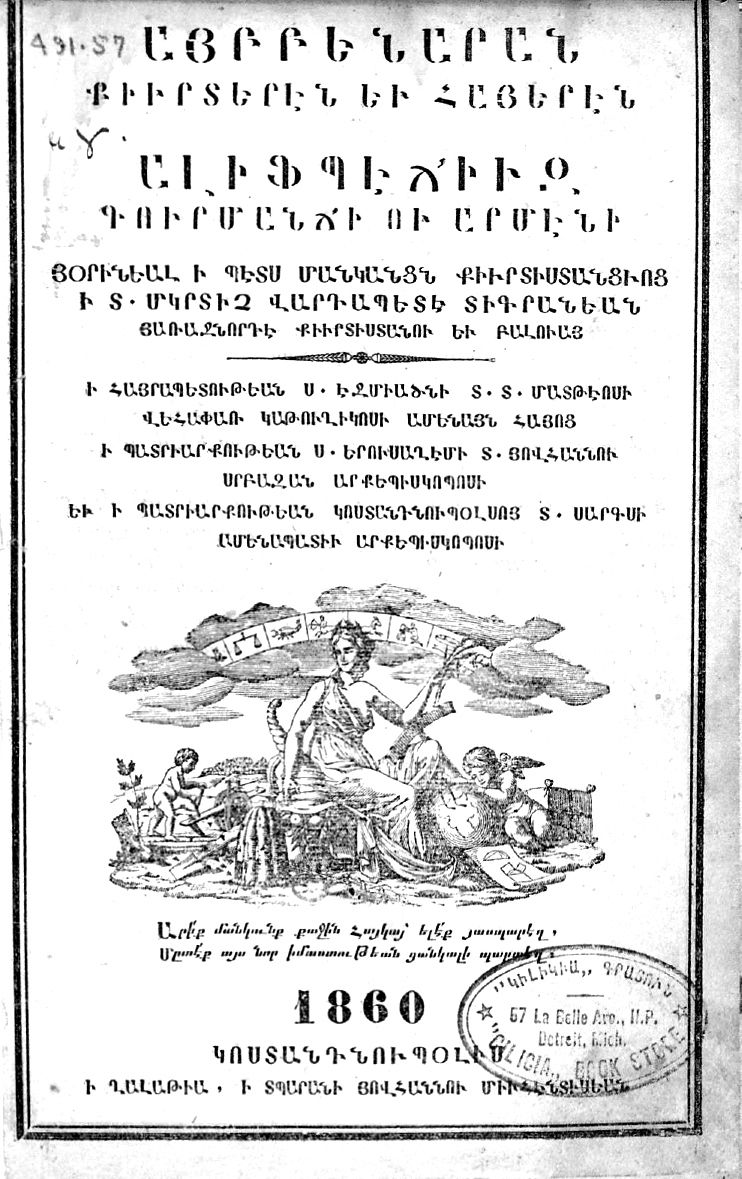
1909, No:18-19
A historical study of the Yazidis’ origin, lands, population, way of life, and beliefs/worship. A report on Armenian-Kurdish friendship relations.
1909, No:18
A report on Armenian-Kurdish relations in the Hınıs region.
1909, No:20
A letter from Harput concerning Kurdish-Armenian relations in the region. Also reports on Kurdish movements in Dersim.
1909, No:21
Reports on the lineage relations of the Kurds in Kighi and the internal disputes of Agha Haydar, Agha Mehmet, and Agha Halil.
1909, No:21
An article about the Yazidis signed by A. Terziyan. Information about the region inhabited by the Yazidis, their population, way of life, lineage, and friendly relations with Armenians.
1909, No:26
A letter from Van signed by A. Misag. Information about Kurdish-Armenian relations in Van Province and the Turkish government’s policies on this matter.
1909, No:28
A verification article on the population of the Yazidis, signed by H. Shahbazyan. Information about the Yazidis and the places where they lived.
1909, No:40
An article entitled “The Confessions of a Kurd, About a Conspiracy Plot.” Ahmed Fazi provides information to the Armenians of Silvan about a conspiracy by several Kurdish tribal leaders preparing to attack Armenian villages.
1909, No:51
An article on writing and literature among the Kurds, signed S. H. Also reports on Armenian-Kurdish bonds of friendship and the preparation, under the leadership of the Dashnak Party, of the first Kurdish primer in Kurmanji written using Armenian scripts.
1909, No:58
News: The famous Kurdish chief Genco-Papari continues his raids. The Kurdish chief’s activities in Sasun and the conflict among Kurdish lineages/tribes.
1909, No:77
Reports on Kurdish-Armenian relations in Bitlis Province and conflicts among Kurdish tribes.
1909, No:77
A letter from Iran signed Aziz: information about Kurdish conflicts on the Iranian border and Kurdish-Russian relations.
1909, No:88
Brief news from Van signed by A. Menag: Kurdish-Armenian relations and the activities of Kurdish tribal leaders in Van.
1909, No:101
A letter from Van: friendly Kurdish-Armenian relations in Van and the Turkish government’s efforts to disturb these relations.
1909, No:112
A letter from Bulanık: Armenian-Kurdish relations and the activities of the Kurdish aghas Fati and Tizakh in Bitlis.
1910, No:182
An unsigned article entitled “Behind the Mountains”: Kurdish-Armenian friendship relations and a call by one of the Armenian political parties to Kurdish workers to struggle together.
Also reports entitled “Kurds Are Arming,” “Meeting of the Kurdish Chiefs of Sasun,” and “Arming of the Kurds and a Call for Struggle Against Turkish Plunder.”
(TO BE CONTINUED)
Kurdish Schools: Istanbul or the Provinces?
(Azadamard, 1910, No:190, an extensive summary of an unsigned analysis published in Armenian)
Some Kurdish intellectuals opened a school in Istanbul for Kurdish children under the name Constitutional School (Meşrutiyet Mektebi).
The idea is good and promising. Until now, it had been the government, the Hamidian administration, that was concerned with educating Kurdish children; now, however, Kurdish individuals and an association established for educational purposes are taking the lead in this endeavor.
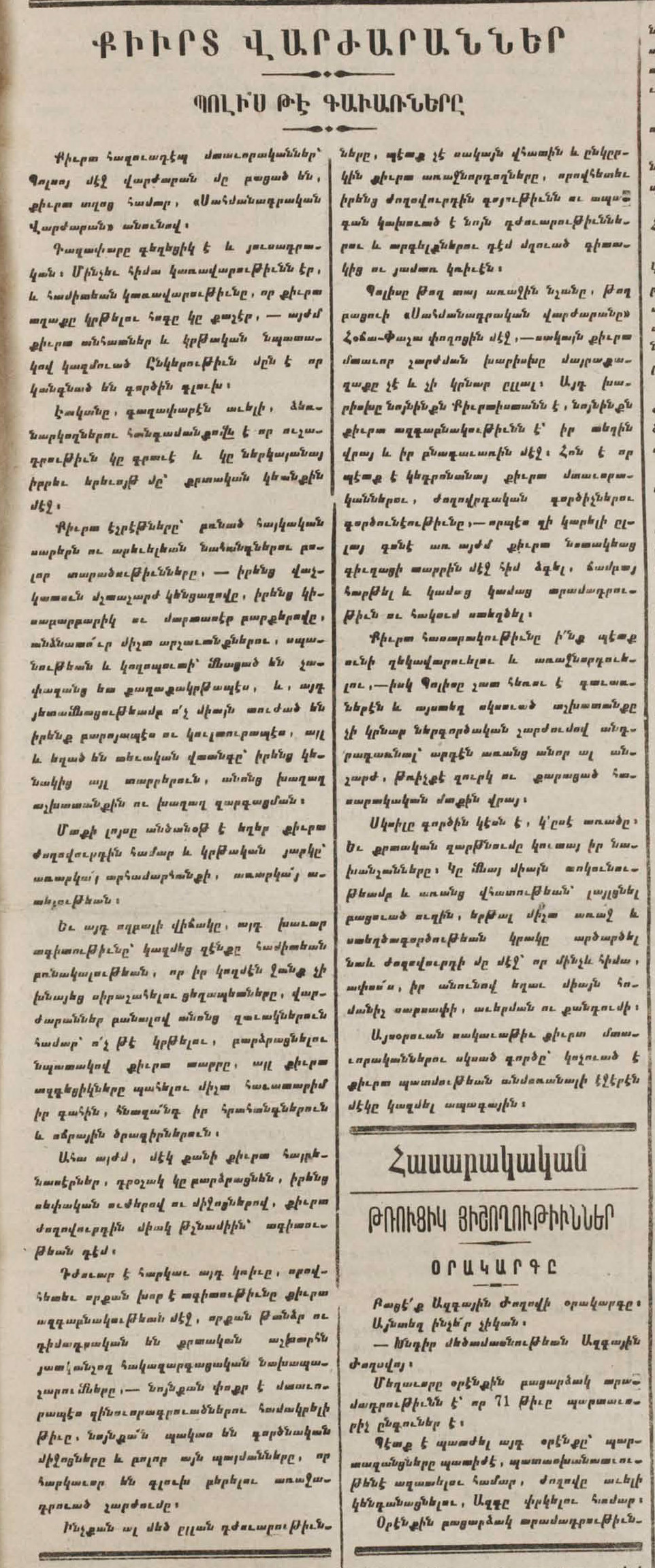
Rather than the idea itself, the character of those undertaking this initiative attracts attention and emerges as a noteworthy phenomenon in Kurdish life.
Kurdish tribes that have occupied all the lands of the eastern provinces inhabited by Armenians have lagged behind civilization because of their nomadic, constantly mobile way of life and their warrior traditions, continually giving themselves over to raids. Thus, they not only morally and culturally harm themselves, but also pose a danger to the other elements with whom they live together, to peaceful aspirations and peaceful development of their neighbors.
The light of the mind has remained unknown to the Kurdish people, while the nest of education has become an object of contempt.
This situation became a weapon in the hands of the Hamidian dictatorship. That administration spared no effort to win the favor of tribal leaders; it opened schools for their children, but not in order to educate and elevate the Kurdish element. Rather, it opened them to keep influential Kurds forever loyal to its throne and obedient to its instructions and criminal plans.
Now, several Kurdish patriots, with their own strength and resources, are raising the banner against ignorance, the Kurdish people’s sole enemy.
Undoubtedly, this struggle is difficult; for the more intense and resistant the anti-development prejudices dominating the Kurdish world are, the fewer are those who intellectually participate in this struggle in an admirable manner. The practical means and all the conditions necessary to bring this proposed movement to success are likewise lacking.
However great the difficulties may be... Kurdish leaders must not lose heart or take a step backward; because the existence and future of their people depend on a conscious and determined struggle waged against these same difficulties and obstacles.
Let Istanbul give the first signal, let the “Constitutional School” open on Hocapaşa Street; but the anchor of the Kurdish intellectual movement is not, and cannot be, the capital. That anchor is Kurdistan itself, the Kurdish population being in its own place and in its own region. The activities of Kurdish intellectuals and men of the people should be concentrated there, so that, at least for the time being, a foundation can be laid among the settled Kurdish peasantry, a path can be opened, and gradually an inclination and desire can be created.
“Kurdish Awakening Is Giving Its First Signs”
Kurdish society itself needs to be governed and guided; yet Istanbul is very far from the provinces, and work begun here cannot find an echo in the form of an effective movement upon social thought, which is already inert, devoid of initiative, and petrified.
“Beginning is half of the work,” says the proverb. The Kurdish awakening is also giving its first signs. Now all that is needed is to broaden, without weariness and with perseverance, the path that has been opened.
The work begun by the small number of Kurdish intellectuals of today might be one of the unforgettable pages of Kurdish history in the future.


