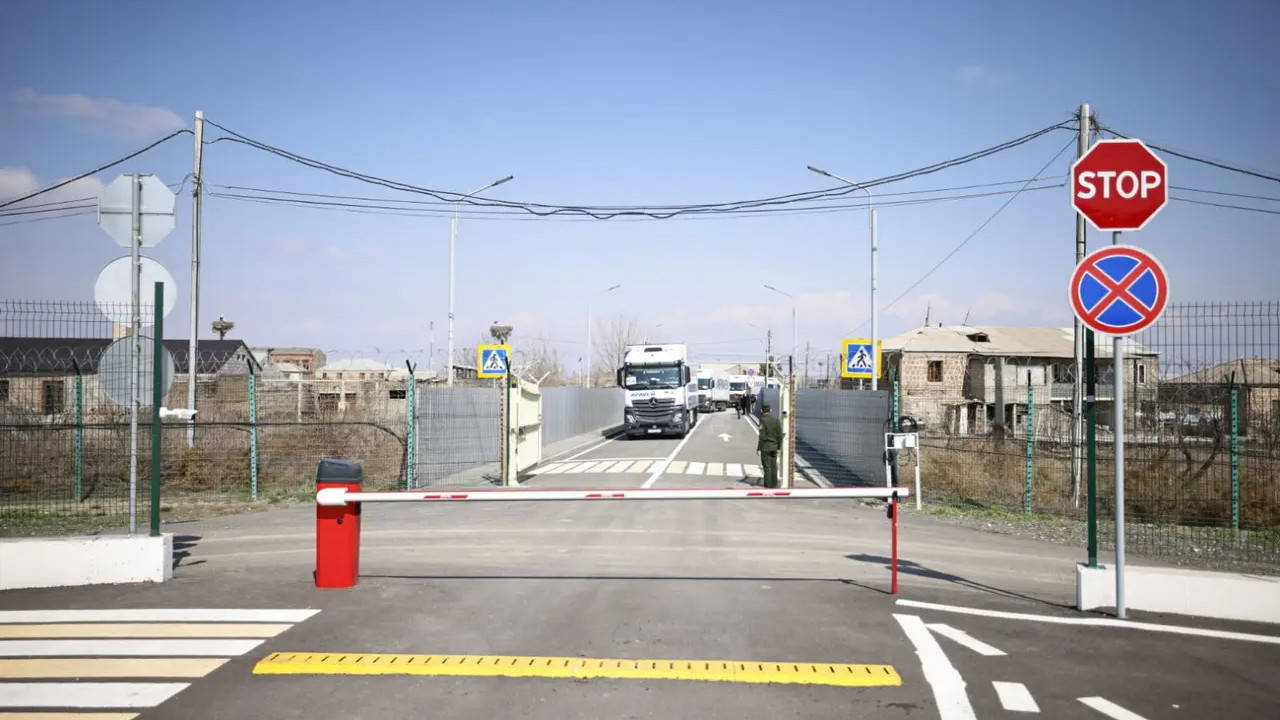


Most commentators were saying that the Turkey-Armenia border would open after the elections in Armenia, but that didn't happen. Instead, we've seen small steps. What is Turkey waiting for before opening the Alican, or Margara, border crossing, which has remained closed for 30 years?
I did not think it would open after the elections. Instead, small steps have been taken in parallel with changes in regional geopolitics. In other words, for every negative step Russia has taken, Turkey has responded with a new step. For example, when Russia banned Armenian products, Turkey allowed direct trade with Armenia. Or when Russia said, "You need to leave the Eurasian Economic Union," Turkey decided that Armenia could be listed as the country of origin in trade. Turkey found well-planned, incremental steps. Now, however, I would say the election results have complicated matters somewhat.

Why did make it more complicated?
Because the current government in Armenia did not secure the majority needed to amend the constitution. We know that the ruling party wants constitutional amendments, not only because Azerbaijan demands them, but also because there are domestic expectations for such changes. But these election results make that impossible. That is, of course, a problem. Neither Turkey nor Azerbaijan has yet fully assessed what comes next. I think Turkey will return to this issue once its own domestic agenda has cooled down somewhat.
The first impression we have received from Azerbaijan is: "We will normalize relations, but we will not sign the peace agreement until the constitution is amended." Turkey also appears to have tied the opening of the border to this. The emerging picture is that Turkey may keep the border closed while continuing the normalization process. We will have a better sense in fall whether things will proceed this way. Once Turkey's domestic agenda becomes calmer, its new position will likely become clear. It is not possible today to say on what timetable the border might open. But we can at least say that it is unlikely to happen before fall.
What would Turkey lose by opening the Armenian border?
If you consider Turkey alone, it loses nothing. However, during the previous Turkey-Armenia normalization process, there was a very negative period in relations with Azerbaijan. At that time, then-Prime Minister Erdoğan went to the Azerbaijani parliament and made a speech in which he gave a promise: "The border with Armenia will not be opened until the occupation of Karabakh ends."
On the other hand, Azerbaijan is strategically very important for Turkey. Energy connections, security cooperation in the Caucasus, its relationship with Israel, and so on. Turkey will not want to damage the relationship again or provoke a negative reaction. Moreover, it appears that Turkey simply does not see an urgent need to open the border.
Secondly, we know that Turkey has always operated within very delicate balances in the Caucasus. Under no circumstances would it want to confront Russia or take steps that directly target Russia. In other words: "Why is Armenia trying to move closer to the European Union? Why is it trying to distance itself from Russia? And should we facilitate that?" I am sure these questions are on the minds of Turkey's decision-makers. Under these circumstances, saying "let's give it a little more time" seems to be the easier and less costly option.
In Turkey's statement following the elections, it said: "We expect Armenia to take bolder steps." A country that is already trying to amend its constitution at Azerbaijan's request—what is it expected to do more? What else is Azerbaijan waiting for?
Ultimately, the draft agreement that was initialed in Washington had already been agreed upon between Azerbaijan and Armenia much earlier and had even been made public. The Washington event was largely a show designed to draw Trump into the Caucasus. Otherwise, both countries had already stated several times that they had reached agreement on the text and would sign it when the time was right.
In fact, Azerbaijan's position has not changed from the very beginning: "This is the text, but I will wait for the constitution to be amended before signing it." There has been no change in that position. Looking at the arguments within Armenia, however, there is concern that "if we give them this as well, what else will they ask for?" Of course, politics offers no guarantees. Azerbaijanis remain insistent on this point. At the moment, we have nothing except trust to rely on.
Moreover, the peace agreement itself is not all that important. In practical terms, there is already a ceasefire. Both countries have demonstrated a commitment not to go to war. They have established conditions for peace. Trade cooperation has begun and continues to deepen. Azerbaijan is supplying Armenia with natural gas after Russia cut supplies, while Armenia has offered the railway controlled by Russia to the Kazakhs—which was probably arranged by the Azerbaijanis. In other words, cooperation is developing even in unexpected areas. All of this is happening without a formal peace agreement. That also shows us that this period of uncertainty can be managed for some time. Politicians, however, tend to prefer uncertainty if it can be managed. In political science, this is called "constructive ambiguity." From a political perspective, it is not necessarily viewed negatively.
While relations with Turkey and Azerbaijan are improving to some extent, Armenia's relations with Russia are becoming more strained. Russia appears to be resorting to economic and political coercion. Where is this story heading?
Previous governments in Armenia wanted to move forward together with Russia. Pashinyan, now elected for the third time, has instead chosen to position Armenia alongside the West rather than Russia. But Armenia is a small country, and when your neighbor is Russia, that choice is not the only determining factor. We have seen the example of Ukraine, and before that Russia also went to war with Georgia over a similar issue.
Of course, this does not mean that Russia will go to war directly with Armenia, but the situation needs to be managed carefully. Russia does not want countries that have been so close to it to move entirely into the opposing camp. Since Russia is currently preoccupied with Ukraine, there is room for Armenia, or for Pashinyan, to maneuver. But we do not yet know the exact limits of that room. Azerbaijan is playing a similar game. They do not want to move as close to the West as Armenia does, but neither do they want to be that close to Russia. They seem to have carved out such a space for themselves. Armenia, too, will have to create that space gradually through trial and error.
The relationship between Armenia and Russia is highly intertwined. I do not think the economic dimension will be as problematic as some think. Untying that complex relationship and re-Armenization the infrastructure will take both time and considerable effort. Armenia faces a difficult period in that regard. Because the most difficult phase is always the transition itself. It will undoubtedly be difficult, but it will happen.