



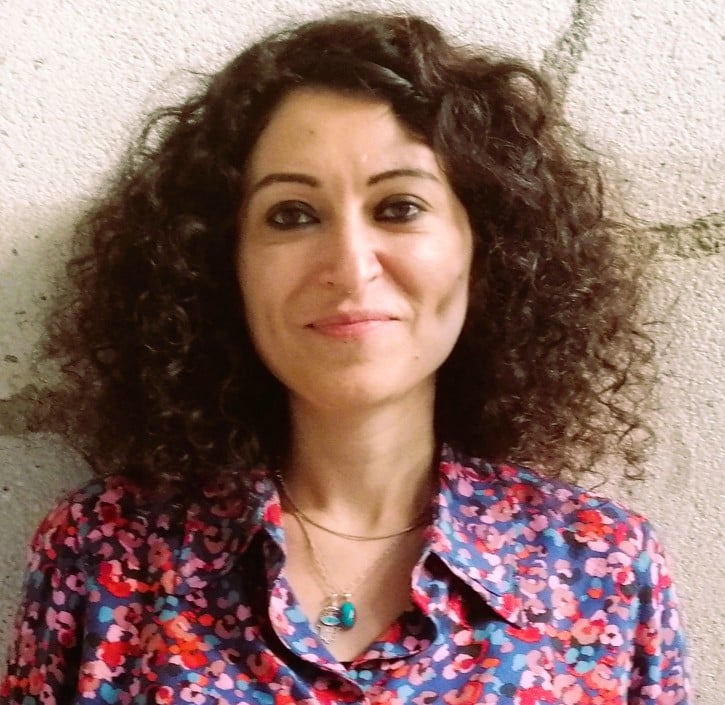
The first hearing in the case brought against sociologist Güllistan Yarkın under the article 301 of Turkish Penal Code (TCK) over her doctoral dissertation, which she completed at Sociology Department of Binghamton University in 2017, was held at the Ankara 92nd Court of First Instance on October 6.
At the hearing, defense attorneys Jiyan Tosun and Jiyan Kaya stated that their client has been continuing her academic work abroad and requested her acquittal and the lifting of the arrest warrant. The attorneys argued that her dissertation is academic work and that bringing a case under TCK 301 violates freedom of expression and academic freedom. The court ruled to maintain the arrest warrant against Yarkın, who is currently working as a visiting researcher at the University of Hamburg, to reconsider the decision if her address in Germany is provided, and to adjourn the hearing until January 14, 2027.
The indictment, prepared as a result of the investigation launched by the Ankara Chief Public Prosecutor’s Office after denouncement by the Presidency of the Interuniversity Council, also includes Yarkın’s academic analyses of the Armenian Genocide and its denial among the statements cited as grounds for the charges.
The reference to the Armenian Genocide was also cited as grounds
In 2018, Yarkın applied to the Interuniversity Council (ÜAK) for the equivalency of her doctoral dissertation, completed at Binghamton University in the United States in 2017. Yarkın says that she received no response to her application for two years and that her petitions submitted during this period in her own name also went unanswered. She says she learned that her application had been rejected through a petition submitted by her lawyer.
The application for equivalency was rejected in 2020 on the grounds that the dissertation contained terrorist organization propaganda and included expressions such as “Dersim Genocide,” “Armenian genocide,” “massacres against non-Muslims,” and “the AKP Government’s colonial policies in the region.”
The Interuniversity Council called it “terrorist propaganda”; prosecutor’s office issued a non-prosecution decision
In its decision, the Interuniversity Council argued that statements concerning the PKK in the dissertation and listed individually could constitute an offense under TCK 301 and amounted to propaganda for a terrorist organization. The Interuniversity Council referred Yarkın’s dissertation to the prosecutor’s office.
Following the investigation, the Ankara Chief Public Prosecutor’s Office prepared an indictment against Yarkın under TCK 301 on August 17, 2026. The prosecutor’s office, however, issued a non-prosecution decision with regard to the allegation of terrorist propaganda.
29 passages cited
In the six-page indictment prepared by the Press Crimes Investigation Bureau of the Ankara Chief Public Prosecutor’s Office, 29 passages from Yarkın’s dissertation cited as the basis for the allegations were directly quoted and listed individually. Four of these passages are related to the Armenian Genocide and historical violence against Armenians. Statements from the dissertation, which was written in English, were translated into Turkish and included in the indictment.
Some of the statements in Yarkın’s doctoral dissertation cited in the indictment as grounds for the charges argue that the war between 1914 and 1918 and the extraordinary circumstances it created gave the Committee of Union and Progress the opportunity to implement policies of ethnic cleansing and genocide against Armenians, and the Committee of Union and Progress ordered state forces to massacre and deport all Armenians living in the Ottoman Empire, and in accordance with these orders, more than one million Armenians living in Ottoman territories were subjected to genocide. She also states that Turkish state denies the colonization of Northern Kurdistan, the existence of the Kurds, Kurdistan, the Kurdish language, and the Armenian Genocide. She adds that although non-Muslim groups in the country got citizenship and minority rights, they were subjected to racism, dispossession, or assimilation during the early years of the Republic.
“The state wants to control the process of knowledge production”
Speaking to Agos, Yarkın said that her dissertation is primarily a sociological study of a neighborhood, explaining that she investigated how racism against Kurds manifested itself in everyday life in a working-class district of Istanbul and how Kurds dealt with it. Yarkın said that her dissertation also has a historical section and that she traces the subject back to the Ottoman period in order to conduct a historical analysis of racism against Kurds. Yarkın said that she treats the Armenian Genocide as genocide in her dissertation, and stated, “Another academic might say, ‘You cannot define this as genocide.’ Someone else might say, ‘It didn’t happen,’ and can say that academically. The issue here is this: the state is intervening.”
Yarkın said that the state wants to control the process of knowledge production and wants knowledge to be produced within the framework of the official ideology it prefers, adding, “Because it wants the process of knowledge production to develop under state control, it subjects it to a process of prosecution and punishment.” She also said that they do not want the knowledge produced at universities about Armenians, Kurds, and crimes committed by the state to be discussed in academic circles.
Yarkın said, “It shows that they absolutely do not want the issue of the Armenian Genocide to be discussed within Turkey’s university system, or to be discussed as genocide. In other words, this issue is not only about the Kurdish question; it is also very important in terms of Armenian studies.” She also said that what has happened is a serious problem in terms of academic freedoms, stating, “From the standpoint of academic freedom, this is a scandal. What we have here is a university institution reporting a dissertation that was written on the grounds of terrorist propaganda; the prosecutor’s office investigates it but ultimately decides that there was no terrorist propaganda and issues a non-prosecution decision. Despite this, this process is still taking place. That is the real issue.”
She had previously been acquitted under 301
Yarkın had previously also been prosecuted under TCK 301. A case was brought against the Human Rights Association (İHD) Co-Chair Attorney Eren Keskin and Güllistan Yarkın, a member of the İHD Commission Against Racism and Discrimination, on the grounds that they used the term genocide at an Armenian Genocide commemoration organized by the Human Rights Association (İHD) in 2021 on April 24. The case ended with the acquittal of Yarkın and Keskin.
Courts had ruled previously: not a crime
There are precedents in Turkish courts in which it has previously been ruled that referring to the Armenian genocide is not a crime. For example, on July 2, 2024, journalists Haluk Kalafat and Elif Akgül were acquitted in a case in which they were tried on charges of “publicly insulting the Turkish nation (TCK 301/1)” over six news reports published by bianet in 2015, 2018, and 2019.
In 2018, three members of the Human Rights Association were detained for carrying banners referring to the Armenian genocide at the association’s unpermitted press statement on April 24. The prosecutor’s office issued a decision of non-prosecution and stated that the word “genocide” should be considered within the scope of freedom of thought.
Another example. On April 24, 2017, the Diyarbakır Bar Association issued a press statement titled “April 24/Great Catastrophe: We Share the Pain of the Armenian People,” and on April 24, 2018, it issued a press statement titled “We Share the Unrelenting Pain of the Armenian People.” A case was brought against 10 members of the bar association’s executive board, including then-bar president Ahmet Özmen and subsequent bar president Nahit Eren, because the statements used the term genocide. Following the defenses, the court acquitted all the defendants on the grounds that the legal elements of the offense had not been established. The Diyarbakır Bar Association had previously also faced legal proceedings over its statements concerning the Armenian genocide, and those cases had resulted in acquittals.


