


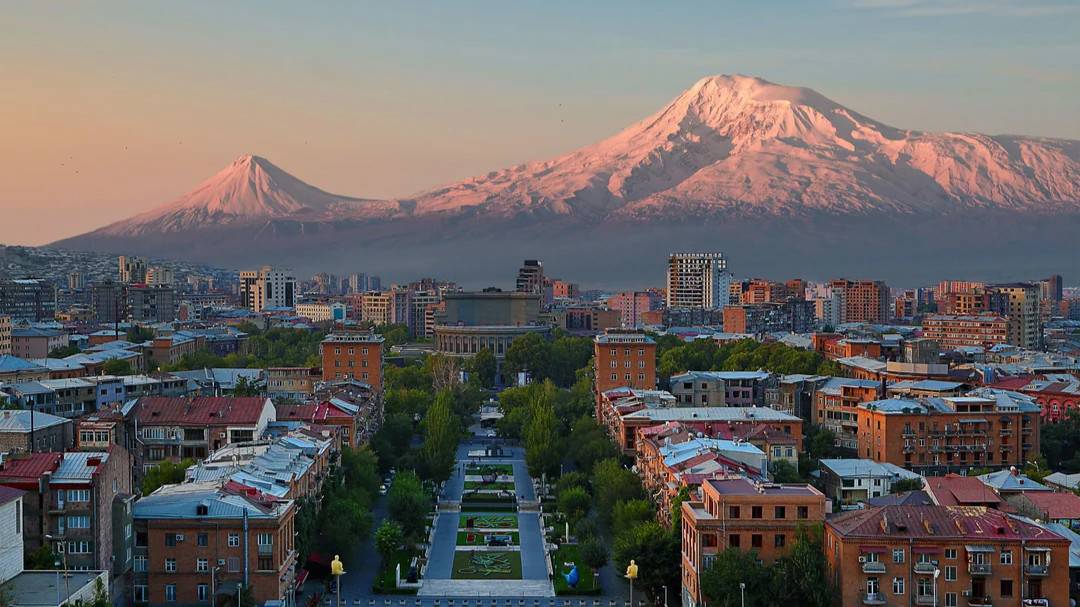
Armenia’s new draft constitution has been made public. The new draft proposes a fundamental change to the country’s founding document, completely removing the reference to the 1990 Declaration of Independence. This choice, which redefines Armenia’s historical frame of reference and reflects the search for regional peace and normalization, aims to overcome a critical legal obstacle in relations with Baku and Ankara.
What has changed?
The current preamble identifies the “Armenian people” as its subject and states that it is based on the fundamental principles and national objectives of the state set out in the Declaration of Independence. The new preamble, by contrast, begins with the words, “We, the people of the Republic of Armenia,” and is based on the determination to establish a peaceful and secure state within its “internationally recognized territory” and pass it on to future generations.
Article 1 identifies the people as the founder of the state, while Article 3 defines this people as the entirety of its citizens. In this way, the historical Armenian nation is distinguished from the political community that holds sovereignty.
Article 8 defines the objective of foreign policy as “good-neighborly relations, mutual benefit and peace with all states,” on the basis of international law. Article 9, meanwhile, defines the mission of the armed forces as protecting territorial integrity and the inviolability of the borders.
If we recall that, in his April 24 message this year, Pashinyan said that they should not look for a homeland beyond the 29,743 square kilometers of internationally recognized territory, this preamble represents the constitutional expression of the idea of “Real Armenia.”
What does this mean for Baku and Ankara?
At the heart of Baku’s objection was the fact that the Declaration relied on a 1989 resolution proclaiming the “reunification” of Nagorno-Karabakh with Armenia. In a letter sent to the United Nations in 1994, Azerbaijan described this as “direct evidence of continuity.” The draft breaks this chain.
For Turkey, the preamble has implications on two levels. Article 11 of the Declaration supported efforts to secure recognition of the genocide committed in 1915 “in Ottoman Turkey and Western Armenia.” With the reference removed, the constitutional link to this article is also severed; the word “genocide” does not appear anywhere in the draft.
In addition, the constitutional description of the state emblem featuring Mount Ararat (Mount Ağrı) is removed. The emblem itself will not change for now, but a law approved by referendum will henceforth be sufficient to change it.
The more consequential issue for Turkey, however, is the indirect connection. As long as Ankara does not separate normalization with Armenia from the peace process being conducted with Azerbaijan, Baku’s constitutional condition also affects the Turkey-Armenia border. In this way, the constitutional referendum becomes a variable influencing the timetable for opening the border. Ultimately, the opening of Turkey’s border is also tied to the ballot box in Yerevan.
The road to the ballot box: 70 votes
Although the timetable has not been fully announced, the process consists of four stages: public debate, submission to parliament following government approval, parliamentary deliberation, and a referendum.
Under Article 202 of the current constitution, taking a new draft constitution to a referendum requires at least two-thirds of the total number of members of parliament, which equals to 70 votes in the 105-seat parliament. Civil Contract, however, holds only 64 seats. Although the right to initiate the process is granted to the government, or at least one-third of MPs, or 200,000 citizens with voting rights, none of these initiatives automatically removes the requirement for 70 votes.
At the referendum itself, a majority of those voting must support the proposal, and at least one-quarter of registered voters, approximately 627,000 people, must vote “yes.” That is equivalent to approximately 86 percent of the votes received by Civil Contract on June 7.
Although the opposition has described the draft as “Aliyev’s constitution,” an important detail is being overlooked. The draft does not repeal the Declaration of Independence; it merely removes the reference to it from the constitution. The constitutional link to which Baku objects is severed, but the Declaration itself remains in place as a historical document.
Nevertheless, the opposition has announced that it will block the referendum process in parliament. Pashinyan, declaring that “I am staking all my political, human and moral credibility on this issue,” made an offer to break the deadlock: if the opposition supports holding a referendum, the prime minister will resign if the public voted “no,” and will not run for prime ministry in the next election if the public voted “yes.” The opposition rejected the offer.
In this situation, if the opposition refuses to support the proposal in parliament, as they have said they will, the government’s room for maneuver will narrow. Four options would then remain before the government: Securing the two-thirds majority by persuading MPs who are willing to act independently of their parties’ parliamentary group decisions; making concessions to the text in order to win over part of the opposition; launching a campaign to collect 200,000 signatures, thereby increasing the political cost of the opposition voting “no” in parliament; calling an early election in an attempt to produce a new parliamentary balance capable of delivering the required two-thirds majority.
However, even this last option offers no guarantee: the ruling party, which secured 64 seats with approximately half of the vote in the last election, is not assured of reaching 70 seats in an early election.
Armenia now faces not only the challenge of convincing Baku, but also that of building a domestic political consensus capable of bringing the constitutional amendment before the public.
The sentence holding up peace may have been deleted from the draft, but securing the majority required to remove it from the constitutional text remains an entirely separate challenge.


