

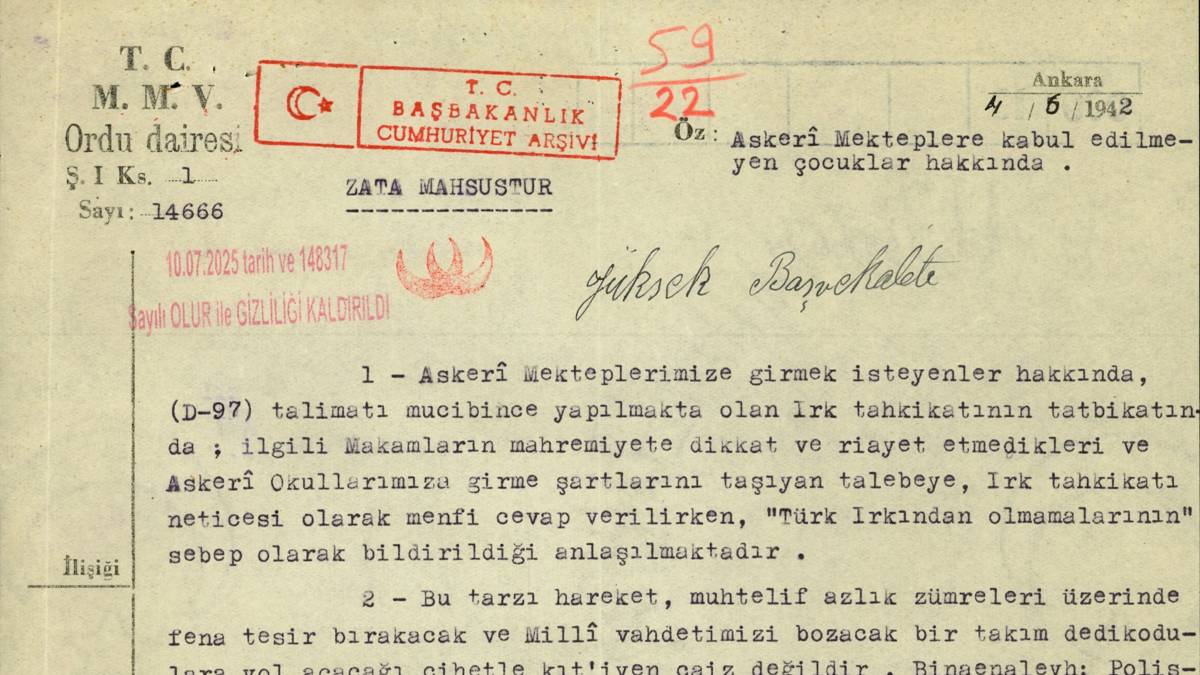
The document reads as follows:
"1- In the implementation of the racial investigations conducted, pursuant to Directive (D-97), concerning those seeking admission to our Military Schools, it has been observed that the relevant authorities have failed to maintain the necessary confidentiality. Furthermore, when applicants who otherwise meet the admission requirements are rejected as a result of these racial investigations, they are reportedly being informed that the reason is that they are “not of the Turkish race.”
2- This line of conduct is absolutely unacceptable, as it will leave a bad impression on various minority groups and lead to rumors that could disrupt our national unity. Therefore, I strictly request that all Civil and Military investigation and vetting authorities, from the police upward, conduct the necessary investigations with the utmost confidentiality and fairness. In the event that a negative response must ultimately be given by branches and schools to those who do not meet the entry requirements as a result of the race investigation, utmost care and diligence must be taken not to leave a bad impression on them by showing soft medical and administrative reasons—such as the school's capacity being full—and by not mentioning race. I respectfully submit and request that this instruction be circulated accordingly.
3- For information, this has been submitted to the Prime Ministry and the General Staff; to the Ministry of the Interior (for transmission of the necessary orders to civil investigative authorities); and has been sent to Military District Commander units, the Inspectorate of Military High Schools, and the Command of the Military Academy.
In the upper-left corner of the document, dated June 4, 1942, there is a note reading: "DECLASSIFIED by APPROVAL dated July 10, 2025, and numbered 148317."
The document, coded D-97 and kept secret for 84 years, was brought to light by researcher Sait Çetinoğlu and Prof. Dr. Taner Akçam. We asked Prof. Dr. Taner Akçam about the historical significance of this directive for the history of Turkey.
In your article titled "The D-97 Directive," published on Medyascope on May 31, you uncovered an important document from 1942. This topic closely concerns the minorities in this country—or rather, the communities that have been marginalized into minorities. What is the Ministry of National Defense actually saying here?
The Minister of National Defense is saying: "We are admitting students to the Military Academies by conducting a 'RACE INVESTIGATION' in accordance with Directive D-97. However, do not tell the people we reject, 'You were not accepted because you are not of the Turkish race.' Tell lies, invent excuses." Here, we see a crucial characteristic of the Turkish Apartheid regime: its "secretive and insidious" nature. In my opinion, this "insidiousness" is the greatest problem. This is a regime that lacks the courage and honesty to defend its actions by saying, "Yes, we are doing this." Perhaps this is what distinguishes us most from South Africa and Israel.
This document not only officially reveals why minorities could not enter military schools; it also shows that authorities were instructed to invent alternative explanations. Yet both the state and minorities already knew the real reason. Why do you think the state felt the need for such “sensitivity”?
This is a very important question, and rather than giving an immediate answer, I prefer to reflect on it deeply. What comes to my mind is the "accumulated knowledge" built up especially since the 19th century. This knowledge created a mindset of "being aware of one's own weakness." Throughout the 19th and early 20th centuries, during the collapse of the empire, Ottoman administrators accumulated significant experience. That experience dictated: "If we carry out our policies against minorities openly and publicly, it will draw the reaction of the West, and they will intervene." Even during periods of the greatest mass violence, meaning periods when the atrocities were happening right out in the open, the "fear of intervention" was paramount. They acted with extreme meticulousness to "prevent the West from finding an opportunity to intervene."
We know from the example of Abdulhamid II that he rejected the requests of Armenians who wanted to convert to Islam to escape massacres. He refused these requests saying, "The Westerners will say, 'You are forcing Armenians to change their religion,' and they will intervene." Instead, they could blame the massacres on local structures and the Armenians themselves under the pretext of "the government was trying to prevent the violence."
This culture continued into the Republic. As a result, a bizarre culture of being 'insidious' and 'shrewdly manipulative' emerged. We even began to perceive this 'slyness' and 'insidiousness' as being clever or intelligent. What I am describing is just one reason. Undoubtedly, there are other, more severe reasons. There cannot be a single explanation for these cultural codes, which I find highly troubling and problematic. We need to talk about them seriously.
As you mentioned in your article, years ago Agos newspaper revealed that the state secretly coded minority communities in this country using a "lineage code" (soy kodu). When we factor in this new document, what kind of picture emerges?
With the 1920s, a racist regime was established in Turkey. A culture and tradition emerged that viewed the collapse and disintegration of the Ottoman Empire as the work of Christians, thereby deeming Christians untrustworthy. The system was essentially built on ensuring that Ottoman Christian citizens were kept out if they were outside the borders and driven out if they were inside. I am not the one saying this. The Directorate of Population Administration under the Ministry of Internal Affairs stated this in a report it prepared in 1933. They explicitly said, "We are establishing a Republic based on the Turkish race." And they stated, "We enacted the 1927 Population Law in order to establish this race-based Republic." They eventually included Kurds and Alevis alongside Christians. Consequently, an Apartheid regime was established that did not consider a significant portion of its own citizens as equal.
But let us emphasize again: they did all of this secretly. They did it insidiously. Remember the response they gave to the information uncovered by Agos: "Yes, there was such a policy, but we ended it." What was it that being carried out? Which decree, which directive was it? Perhaps it was directive D-1. And then, what did you end? Where did you remove it? Where is the documentation for this? Where is the announcement in the Official Gazette? Everything is built upon a bizarre 'lie,' a bizarre self-deception, a bizarre phoniness... It is deeply saddening, deeply...
You will remember that there is currently only one Armenian district governor (kaymakam) in Turkey. How should we interpret his appointment? In other words, if D-97 had not existed, could many qualified young people like him have entered state institutions, or is it precisely because of D-97 that we are talking about just one person today?
If D-97 had not existed, there would be many high-ranking Armenian, Greek, Syriac, and Kurdish officers in the military today. D-97 is only related to the military. This implies that there are 97 other directives or decrees out there. Perhaps the number exceeds 100. We can infer that they control other professions in a similar fashion through these kinds of decrees.
If these decrees did not exist, there would be numerous prosecutors, judges, and high-ranking state bureaucrats from these backgrounds. The critical point is this: there is no system operating based purely on legal conventions! In other words, as 'hostility,' 'hatred,' and 'distrust' exist, certain groups may be blocked from certain positions due to 'mindsets' and 'habits' even when the law allows it. But in our case, it is the exact opposite. A legal system has been explicitly constructed via laws, directives, and official notices.
We can look at the example of the Armenian district governor more broadly. We know similar examples are frequently cited for Kurds. We often hear the phrase, "Turgut Özal [the eight president of Turkey between 1989-1993] was Kurdish." I think this should be labeled as a "showcase policy." In 16th-century Virginia, where slavery and racism formed the bedrock of the state, there were Black slave owners. Therefore, we need to drop this "showcase" debate and accept that the system operates on a racial foundation.
The phrase "it will leave a bad impression on various minority groups" appears in D-97. Who exactly is meant by minority here? For instance, although they do not fit the official definition of a minority, are Kurds, Alevis, etc., included in this?
The expression used in the document is “azlık” which can be translated into English as “small groups”. I added two letters in brackets and turned it into “azınlık” which means minority for easier understanding. What terribly saddens me is the phrase "will leave a bad impression." This shows they knew that what they were doing was wrong and indefensible. From the available documents, we can easily deduce that what they meant by 'small groups' also encompassed Kurds and Alevis as we possess official documents, albeit limited, covering the period between 1929 and 1933. They classified the country's population as Turks and non-Turks. They demanded that those who were non-Turks be specifically profiled and marked in the population registries. Furthermore, when looking at today's practices, we know that the term 'small groups' encompasses anyone outside of those who are Turkish and Sunni (Hanafi) Muslim.
Finally, shouldn't the current and past governments offer an explanation on this matter?
Absolutely, they can no longer say "we didn't know, we weren't aware." They know, and they are forced to take a stance! Otherwise, they will amount to nothing more than ordinary officials of a state organized on racial principles.


