


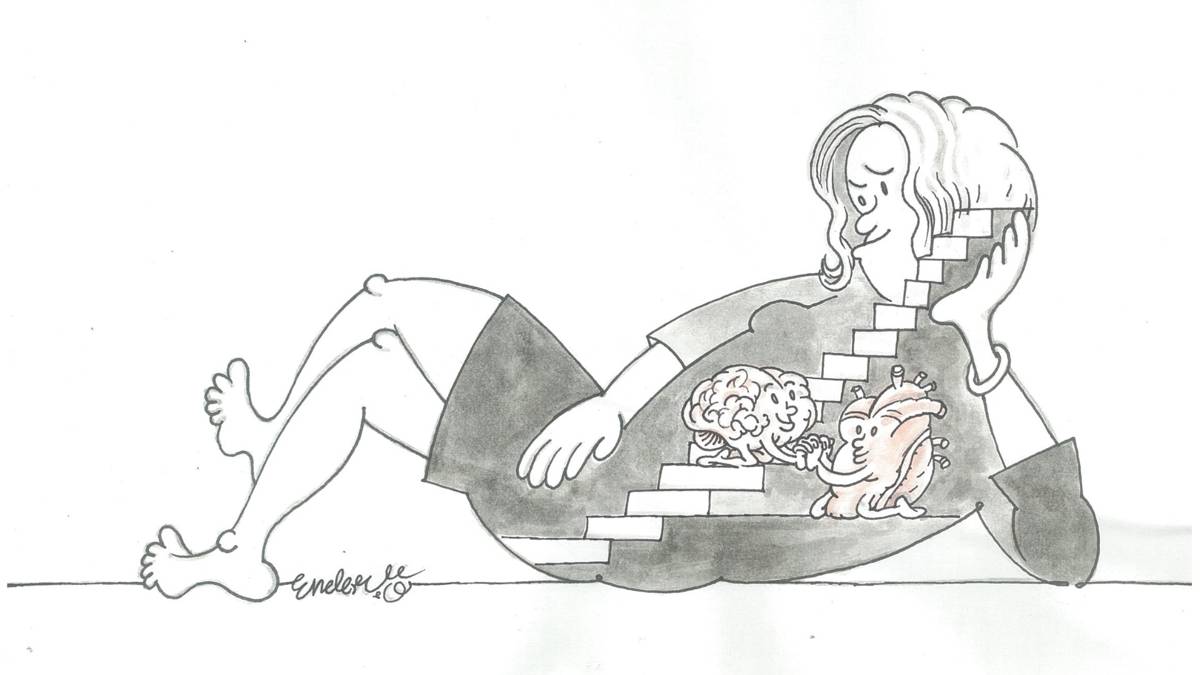
I never imagined my memory would betray me. I used to think people forgot names simply because they grew older. Old phone numbers, the addresses of childhood homes, poems once known by heart, or the surnames of elementary school classmates... No one feels ashamed of forgetting those things. But I forgot something else. I forgot the things I believed I should never forget.
I forgot the name of a child, for instance. A mother's scream. The day that smoke lingers over a public square... Sometimes people forget pain. Worse still, they forget that they have forgotten it.
The warmth of sorrows entrusted to us
Over the course of my forty-one years, I have witnessed countless disasters in this region and in other corners of the world. Earthquakes, wars, bombed cities, people forced onto the roads of exile, destroyed homes, and children wrapped in white shrouds...
Then there are the sorrows entrusted to me although I have never lived them myself. Events I never witnessed with my own eyes, events that were never broadcast live. They did not reach me through a screen; they seeped into me through a grandmother's unfinished sentence, a trembling hand, a silence that suddenly descended over a dinner table, or a memory told through swallowed tears. Perhaps that is why they remain so vivid. Because they were entrusted not to a database, but from one person's memory to another person's conscience.
Memory's survival reflex
There was a time when I believed every sorrow etched itself into us forever, that we would never truly forget anything that had shaken us to our core. I thought memory was humanity's most faithful refuge. I was mistaken. Because memory is not always faithful; sometimes it is simply trying to survive.
The human mind quietly places burdens it can no longer carry onto the back shelves. As new sorrows arrive, it pushes the old ones a little farther away. It may never deny any of them, but neither can it keep looking at them for as long as they deserve. This is not betrayal; it is memory's way of staying alive. Perhaps forgetting is the oldest reflex the mind has developed to protect us. Yet it is also what slowly changes us.
The speed of circulating sorrows
There was a time when, after a catastrophe, people mourned for months, even years. Today, even mourning has a shorter lifespan. Today not only the number but also circulation speed of disasters has been increasing. Before one screen goes dark, another lights up; before the smoke clears from one city, the sky darkens over another. Before one mother's scream has faded, another mother's lament begins, and before we stop grieving one tragedy, we find ourselves in the middle of the next. Sorrows no longer come one after another; they pile on top of each other. And each new sorrow covers the one before it a little more.
For the first time in human history, we live in an age where nothing is truly lost. Photographs are never erased, videos never disappear, billions of images are stored in the cloud. Yet for that very reason, we are no longer able to carry anything ourselves. We are steadily handing over the burden of memory to digital archives.
Photographs piled on top of one another
In recent years, I have started playing a strange game with myself. Sometimes, for no reason at all, I test my own memory. I say "Roboski" to myself; snow appears before my eyes, mules appear, children appear... But the year does not. Then I try to picture the Ankara Train Station bombing: shoes left behind on the ground, smoke, eyes searching desperately for one another... Who were those people?
Just then, Gaza appears: children wrapped in white shrouds... Without question, those who suffer these horrors directly endure the greatest devastation. But witnessing that horror from behind a screen, powerless to do anything, must also be one of the heaviest punishments inflicted on people of this century. Helplessness turns into a catastrophe that quietly gnaws away at the conscience.
Then a photograph from an earthquake slips into my mind: the tiny hand reaching out from beneath the rubble, refusing to let go of its mother's hand... Immediately afterward comes the mud-covered face of Omayra Sánchez, from years ago. I realize that time and place have begun to blur into one another.
In the dark room of my memory, all these sorrows have become photographs piled on top of one another. I recognize every one of them; each once kept me awake at night. But now I have to stop and think before I can separate their dates from their names.
The name of a single person
Sometimes, too, I step away from the crowd of collective tragedies and seek refuge in the silence of a single human being.
Throughout the Karabakh War, every evening I watched new lists scrolling across the television screen. Who was gone? Who had been found, and who was still missing? In those days, I memorized the names of people I had never met. War was not only being fought on the front lines; it was unfolding on phone screens, in silent kitchens, in the breath of families trapped between hope and despair. I made a point of remembering one particular name, repeating it to myself every day so I would not forget it. Even today, I sometimes say that name silently to myself. I will not write it here. Let it remain with me. Perhaps the most honest way to remember someone is not to invoke their name before everyone else, but to carry them quietly within yourself.
But recently, I realized something... That name no longer comes to my mind as easily as it once did. I have to stop. I have to become still. It is as if I am searching for an old door inside my memory; only after I find it, open it, and step inside does the name finally appear. My sorrow has not diminished. My love has not faded. Only my memory has grown tired.
Questions of conscience
When I cannot remember a detail that comes to me in the middle of the night, I no longer turn to the depths of my memory. Instead, I seek refuge in the cold glow of a search engine. Within milliseconds, dates, times, court rulings, and death tolls spill across my screen. And each time I do, something tightens inside me as I stare at that cold display.
Because what I type into the search bar are not really questions of information; they are questions of conscience. No one can carry every sorrow with equal vividness. The human mind was never made for that. The problem is not forgetting... The problem is yielding a person's scream over to search results and not even realizing that you have forgotten it. Because people can try to pull themselves together again only as long as they are aware of what they lose.
Perhaps forgetting is one of the limits of being human. But forgetting that you have forgotten... That is where it is no longer only our memory that diminishes. Our conscience quietly shifts as well. And perhaps what changes people is not the pain they live through, but the pain they can no longer remember.


