


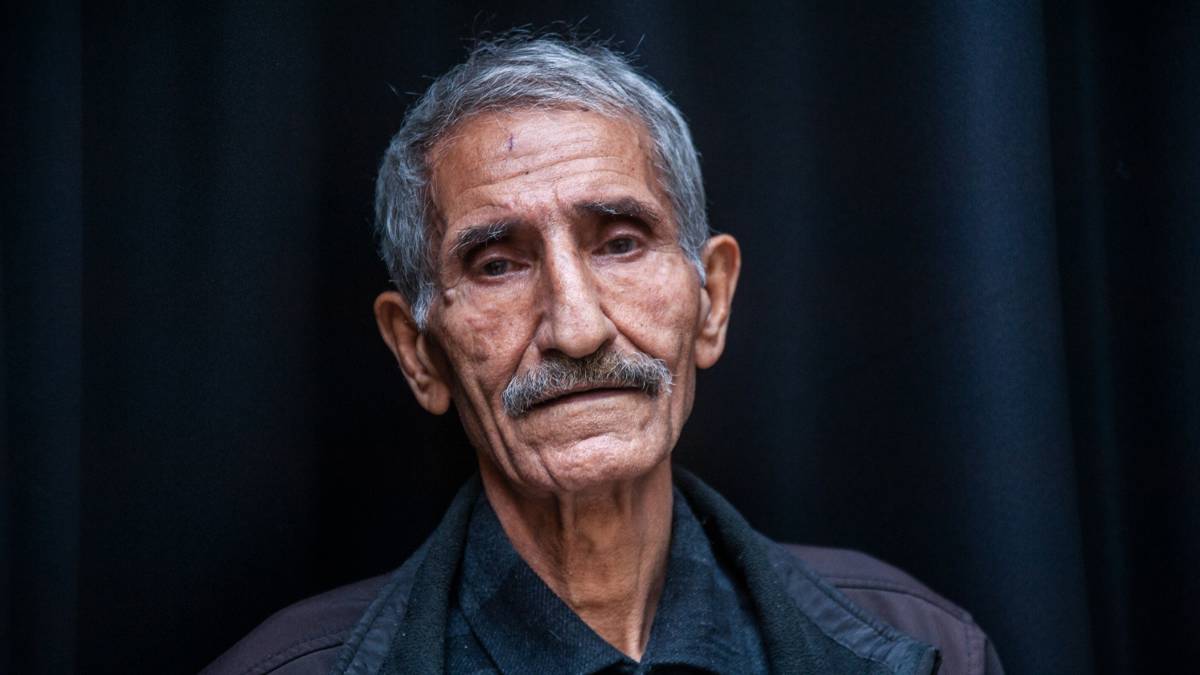
I am talking about Mr. Asadur, the protagonist of the documentary " Asadur: Search for the Lost Identity" who for many years distributed the Agos newspaper in Malatya. Now in his 80s and having moved to live with relatives in Istanbul, we hosted Mr. Asadur—that is, Hüsamettin Kurultay—at Agos shortly after the documentary’s first screening on December 7 and heard his story from his own lips. This is a history perhaps shared by many Islamized Armenians in Anatolia, but it also contains an unrequited love story. Let us begin.
Born in 1944 in Malatya Ordüzü under the name Hüsamettin Kurultay, Mr. Asadur is the second of five children of Mrs. Ashkhen (Ayşe) and Mr. Vaiz. In 1915, his grandfather Hasan Bey, then 14-15 years old, and his 5-6-year-old brother Hamo were sent into exile from Bezirgan toward Malatya. However, Hamo’s small body could not endure the journey and he passed away on the road. Grandfather Hasan met an Islamized Armenian named Hacı Ağa in Gale Village and stayed with him. Later, he married Mrs. Elif, who was also an Islamized Armenian. From this marriage, Mr. Asadur’s father, Mr. Vaiz, and his uncle, Mr. Muhammed, were born.
His father, Vaiz Kurultay, was among the founders of the Democrat Party in the province, alongside names like Hasan Çuhacı and Hamit Fendoğlu. Although Mr. Vaiz and his friends began active duty when the Democrat Party came to power in 1950, Mr. Vaiz resigned from the party due to some disagreements. He began publishing the Koca VaizNewspaper, which was issued sometimes once a month and sometimes every fifteen days. Printed at Hüseyin Karataş’s Gayret Printing House, the newspaper’s life lasted only a year or two. Mr. Asadur remembers that the headline "When will the apocalypse break?" was talked about for a long time.
Let’s come to Emoş Nene (Grandmother Emoş). Emine Aydın, the daughter of Kurdish Bey İbrahim Aydın—also known as Emoş Nene—is a very important and special person in Mr. Asadur’s life. In 1915, when she was 13-14 years old, Emoş Nene gathered autumn cucumbers one day and loaded them onto donkeys. While returning home, she saw a convoy drinking water that had accumulated in the hoofprints of horses. She immediately pierced the sacks, allowing the cucumbers to spill downhill to reach them; the militiamen showered her with bullets, but she survived.
Emoş Nene would sometimes say to Ashkhen, namely Ayşe Hanım, "Get up, let’s go to your “bacılık” (sister-of-the-soul)," referring to Aunt Lusin and Uncle Ohannes. They lived as Armenians and Christians; they would visit each other back and forth. However, in his childhood, there were times when Mr. Asadur threw stones at Armenians and called them "gavur" (infidels). As soon as he heard the word "dönük" (Islamized Armenian) at school, he ran home and asked his mother. Ashkhen, namely Ayşe Hanım, tried to brush it off, saying "Maybe your uncle knows," and closed the subject.
Emoş Nene takes the family into her registry
When Mr. Asadur and his siblings were young, Emoş Nene registered their mother Ashkhen (Ayşe) and the children under her own household registry, raising them as her own children and grandchildren. Her intention was to leave her inheritance to them. Due to some bureaucratic reasons, she was unable to include Mr. Vaiz in her registry.
“Don't tell anyone for 25 years”
Uncle Mamoş, after extracting a promise not to tell anyone for 25 years, explained that the great-grandfather, Asadur Efendi, was a monk living in Harput and that his family had been killed. He even mentioned that his grandmother had a brother studying at the American College who went abroad, but they couldn't find him because they didn't even know his name. Out of fear that harm would come to his relatives and loved ones, Mr. Asadur kept the promise he made to his uncle. Until his grandfather Asadur, whose name he was even afraid to mention, appeared in his dream and asked, "I am your grandfather. Why aren't you keeping my name alive, “kuzum” (my child)?"
Meeting the socialist circles
Years pass, and Hüsamettin Kurultay—that is, Asadur—grows up. Mr. Asadur, who wanted to drop out of school when he first heard the word "dönük," first got into the Istanbul University Faculty of Law but gave up when he saw the thickness of the books. Then he transferred to the Ankara Faculty of Turkish Language and Literature but, thinking he would struggle there too, moved to the Faculty of Geography upon the guidance of his friends.
He describes those days as follows:
"I am of the '68 generation. In my youth, I moved with the socialists. For a period, I was a follower of Perinçek, and later I initiated the attempt to found the Socialist Labor Party," says Mr. Asadur. In those years, he still bore the name Hüsamettin, but one day in the school canteen, he met Gün Zileli, who had come to hang posters. When Zileli said, "Hey, your name is too long, let it be Hüsam," he gained a new and shorter name. İbrahim Kaypakkaya, Cengiz Çandar, Oral Çalışlar, Hüseyin from Dersim—everyone knew him as Hüsam. He explains that he escaped the March 12 Coup because he was only known as Hüsam.
Upon receiving the answer “I will not marry”...
Let’s come to the unrequited love story. While in middle school in Malatya, Mr. Asadur fell in love with a girl whose name we keep confidential—an Armenian girl named M. She was from the Catholic Armenians. Because her father was a very important master craftsman, they were not exiled. At that time, M. was in all his prayers—whether he was performing namaz or when the teacher asked a question at school. "Her soul and her person were very beautiful; she was very smart, she was my precious one," he says, describing his unattainable love. M. finished school before Mr. Asadur and later became a pharmacist. Years later, Mr. Asadur began teaching in Gerger. He went home for the February break of his first year. His mother Ashkhen asked, "Son, you will marry M., won't you?" He replied "As you wish," but his heart was racing. However, M. said, "I will not marry." Mr. Asadur’s world was destroyed, but he did not ask why. But as it turned out, M. never married. "She chose to live like a nun," he repeats.
Becoming friends with his unattainable love
They became very good friends. During the periods when M. practiced pharmacy in Istanbul, Mr. Asadur visited her frequently. Let’s hear about his visit on January 19, 2007, from Mr. Asadur: "When Hrant was killed, everyone was going to the spot where he was shot to leave flowers and light candles. I went to her pharmacy and asked why she didn't go there. She looked at me as if I were narrow-minded. It turned out she had already left her flowers, said her prayer, and returned."
Sadly, M. passed away recently. This is an indescribable pain for Mr. Asadur. Having learned how to make liqueur from M., who served it with coffee during his visits, Mr. Asadur still makes liqueur in her memory.
And now we come to Hüsamettin Kurultay changing the religion section on his identity card from Islam to Christian. I was wondering: why would a person who has long known their identity feel the need for such a change after waiting all these years?
If only they could be in the same cemetery?
While M. was still alive but struggling with illnesses, Mr. Asadur went to see Aram Ateşyan during the years he was the Patriarchal Vicar. He said he wanted to become a Christian but wanted to remain affiliated with the Armenian Catholic Church. When Archbishop Aram naturally told him he should apply to the Armenian Catholic Church, he began attending the Armenian Catholic Church in Samatya. And in those very days, he went to the Fatih Civil Registry Office and changed the religion section of his ID to Christian. In those years, his family tree had become clear. But there is one problem: Mr. Asadur has still not been able to be baptized. And his name on the registry is still Hüsamettin.
These days, Mr. Asadur, who is trying to convey his desire to become a member of the Armenian Catholic Church to the clergy, says, "I am ill; my wish is to be buried as a Christian in the Şişli Armenian Catholic Cemetery, like M." Clearly, even if not side-by-side with M., he wants to be buried in the same cemetery.
I couldn't help but think when our conversation ended: "Once again in the desire to find the crack in the water, take up your cross and walk, Asadur; I hope your wish is crowned with your baptism before you fall to the earth."


