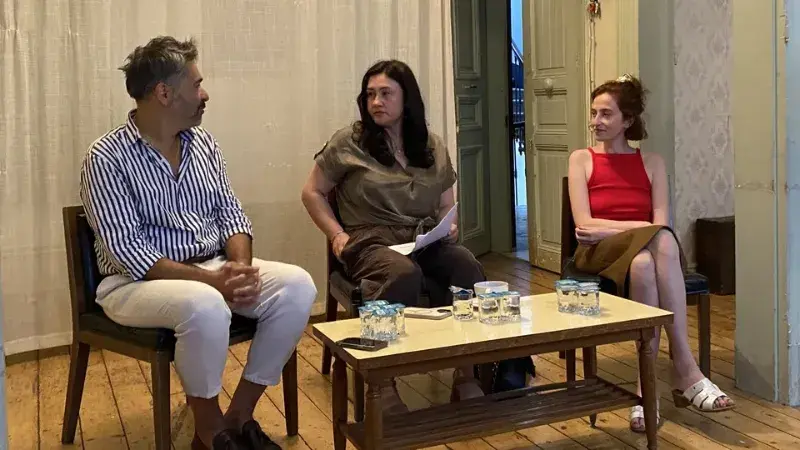


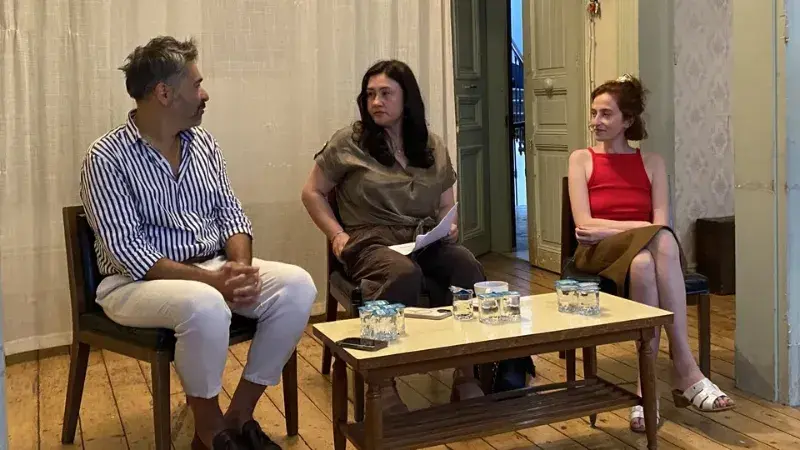
An event titled “Minority Publishing and Media in Turkey: The Testimony of Aras, istos, and Avlaremoz” was held on Saturday, June 6, at the istos office in Beyoğlu.
The discussion focused on the significance of multicultural publishing from past to present, the challenges encountered, and the place these institutions occupy in collective memory. Speakers included Betül Bakırcı, editor-in-chief of Aras Publishing; Süheyla Yıldız, co-founder of Avlaremoz and an academic; and Seçkin Erdi, publishing editor at istos.
Representatives from Aras Publishing, which introduces Armenian literature and culture to readers; istos Publishing, which has revived the Greek publishing tradition; and the Avlaremoz platform, which focuses on minority rights and combating antisemitism, particularly concerning the Jewish community, shared their experiences. The event was organized as part of Avlaremoz’s 10th anniversary.
One of the speakers, Avlaremoz co-founder and academic Süheyla Yıldız, spoke about Avlaremoz’s publishing policy against antisemitism and its contemporary significance. Yıldız explained:
“Avlaremoz is a platform founded by a few young people, with participation increasing and decreasing over time. It took on the mission of ‘speaking out’ against the silence of previous generations. It is a minority youth movement that also includes Muslims. Nor Zartonk, which emerged through the organization of Armenian youth influenced by identity movements, inspired Avlaremoz. It is one of the few surviving examples of Jewish media.”
Avlaremoz’s Struggle Against Antisemitism
Yıldız recalled remarks made by President Recep Tayyip Erdoğan during a television program in 2014: “People called me Georgian; excuse my language, they even called me Armenian, which is much worse. I am Turkish.” Noting that Avlaremoz has a section called “Excuse Me, Antisemite,” Yıldız said:
“In our country too, Jews are seen as being behind every evil. Public awareness is weak. Jews are held responsible for every action of Israel. Using the word ‘Jew’ as an insult is also common in right-wing media. In this sense, Avlaremoz’s struggle is very meaningful.”
Yıldız added that Avlaremoz is no longer limited to issues concerning only the Jewish community but has also begun to address broader social and political problems as well as the concerns of different minority communities in Turkey. She said, “These antisemitic discourses are enough to keep Avlaremoz alive,” and continued:
“In an advertisement Bosch released for Mother’s Day this year, the concept of a dog mother became a topic of controversy and caused discomfort. In this context, Yeni Şafak published articles targeting Jews, with headlines such as ‘Why Don’t Jews Want the Turkish Population to Increase?’ There has been a period in which publications heavily criticizing Israel were produced without questioning its existence.”
She continued:
“The genocide attempt against Palestine affects Avlaremoz. Avlaremoz emphasizes the reality of genocide, and this has led to reactions within the community. It is clear that Avlaremoz has focused on the Holocaust for years. It is a tragedy toward which sensitivity remains very low in our country. Over time, Avlaremoz’s publications on anti-antisemitism have begun to attract attention.”
“Aras and Agos Established a Line of Remembrance”
Betül Bakırcı, editor-in-chief of Aras Publishing, also spoke about the importance of Armenian-language publishing.
“After 1915, cultural production was also ignored. Aras was founded in 1993, and Agos in 1996 under the leadership of Hrant Dink and Yetvart Tomasyan. There is a living language and culture. By writing in Armenian, Zaven Biberyan established a line of remembrance. Aras and Agos build that connection through literature and publishing.”
“Armenian Literature Makes the Invisible Visible”
Bakırcı stated that they present the works of Armenian writers and artists living in Turkey to readers:
“There are still books at Aras that continue to be widely read. Later, this publishing calendar expanded. Aras tried to make visible those who had been overlooked. After Biberyan, the books of Zabel Yesayan were published. Recently, we broadened our strategy and launched a series dedicated to Armenian women writers. We work with a very small team. Aras is a bilingual publishing house. We also attach great importance to children’s publications in Armenian language. Aras strives to produce high-quality publications. It has always been more than just a publishing house. It is a school and a tradition in itself. When I first came to Aras, this was what I saw. Books are published with great care, and it also serves as a school for editing. We are trying to maintain that as best we can.”
“If We Don’t Do It, That Work Will Not Exist”
Seçkin Erdi, publishing editor at istos, began by saying, “I reject the term ‘minority publishing.’” Stating that publishing has become increasingly difficult, Erdi said:
“We have a stance on forgotten books whose time has never come. We value the publication of a sentence, a poem, or a stance that otherwise would not find a place for itself. Aras, istos, and Avlaremoz occupy an important place in Turkey’s cultural climate. Because if we do not do it, that work will not exist. When they call us ‘minority publisher,’ we become part of racialization processes or their reproduction. Yet, at the same time, we are compelled to do this. Because we are trying to keep the societies, cultures, and beliefs that were destroyed alive today.”
Erdi noted that the existence of istos began in the aftermath of the murder of Hrant Dink, one of the founders of Agos newspaper:
“The light that enabled istos to establish itself was the existence of Aras. Aras’ presence gives strength to istos. We are publishers for the broader society, not ‘minority publishers’. The act of dissemination is not limited to books. We have a choir, workshops, a stage, and a dance group. Although we are commercial institutions, fortunately books open up new dialogues, and other spaces for dialogue emerge through istos. Our effort is directed toward keeping memory alive today and ensuring that new memories, new productions, and new steps toward the future can be heard. We want to see people who wish to take part in this cultural complexity and richness.”
Following the presentations, a question-and-answer session was held. During this section, participants discussed what it means to be “few” in the context of minority publishing. They asked the speakers about the importance of cultural production and how “smallness” could grow.
Betül Bakırcı stated that minority publishers would grow through solidarity:
“As long as producers and those who follow them are here today, we will continue somehow. Even when we are no longer here, someone else will surely take our place. This field will survive through continued production.”
Seçkin Erdi concluded with the message:
“If we stop, we fall. That is why we should not stop."