

One of the things that has annoyed me most in Yerevan lately is ordering food. No, I’m not complaining about the food or the deliverers; the problem is entirely different. For the past few years, every time my phone rings, the same scene, the same linguistic helplessness plays out again. I answer the unfamiliar number on the screen, and that same uniform, determined voice comes from the other end: “Здравствуйте…” (Zdrastuyte / Hello)
Up to this point, everything is fine, but what comes next is a complete black hole for me. The other person speaks at length in Russian, while I spend an equally long time not understanding. Which entrance of the apartment building to use, which doorbell to press, whether to turn right or left… As all of this is spoken in fast, fluent Russian, as an Armenian from Turkey who has never learned the language, all I can helplessly do on the phone is to say, “Sorry, English?” English doesn’t work either, and sometimes the other person doesn’t know Armenian, either. Then we both end up sitting silently at either end of the phone; in those moments, even the silence on the phone weighs heavily on you. Once you place an order, you find yourself eagerly waiting not only to see when the food will arrive but also wondering in which language you will open the door.
Yerevan’s new soundscape
One of the things that has changed most rapidly in Yerevan in recent years is the sound of its streets. When I first moved to this city, all the deliverers were local Armenians, and language was easily resolved in the familiar warmth of the home environment. Now, the city is almost shedding its skin with people arriving from all over the world. Diaspora Armenians arriving through reverse migration from Lebanon, Syria, Iran, France and Canada are turning Yerevan into a vibrant, promising center. The distinctive sound of Western Armenian is being added to the Eastern Armenian heard on the streets.
But this revitalization has a hidden common denominator: almost none of these newcomers are likely to know Russian! As the city’s soundscape expands, linguistic walls are rising just as quickly. And this transformation is not limited to the diaspora either; for a while, almost all the deliverers seemed to be Indian, whereas now the phone screen is a complete surprise box. Turkmenistan, Uzbekistan, Kazakhstan, Nepal... A city’s soundscape migrates just like its people.
Continents intersecting, common words
The other night, I ordered again. It was late, and I was starving. Finally, the phone rang and, just as I expected, it began again with that determined Russian intonation. The courier couldn’t find the apartment building; the more he explained, the less I understood, and the more I tried to give directions, the more stuck he became. He went upstairs, came back down; inside the apartment, I was frantically moving from room to room with my phone in my hand. A moment of alienation in which it felt as though we were not within the boundaries of the same apartment building but on entirely different continents…
Eventually, overwhelmed by hunger and the helplessness created by that impenetrable language barrier, my patience ran out completely. Without thinking, purely as a reflex, the protest burst out of my mouth in Turkish:
“Ya nereden bileyim ben Rusça! / How am I supposed to know Russian!”
The phone went silent. The line froze for a moment, and there was a deep silence.
Then came the sentence:
“Pardon… Türkçe konuşabiliyor musunuz? / Sorry… do you speak Turkish?”
Familiarity on the threshold
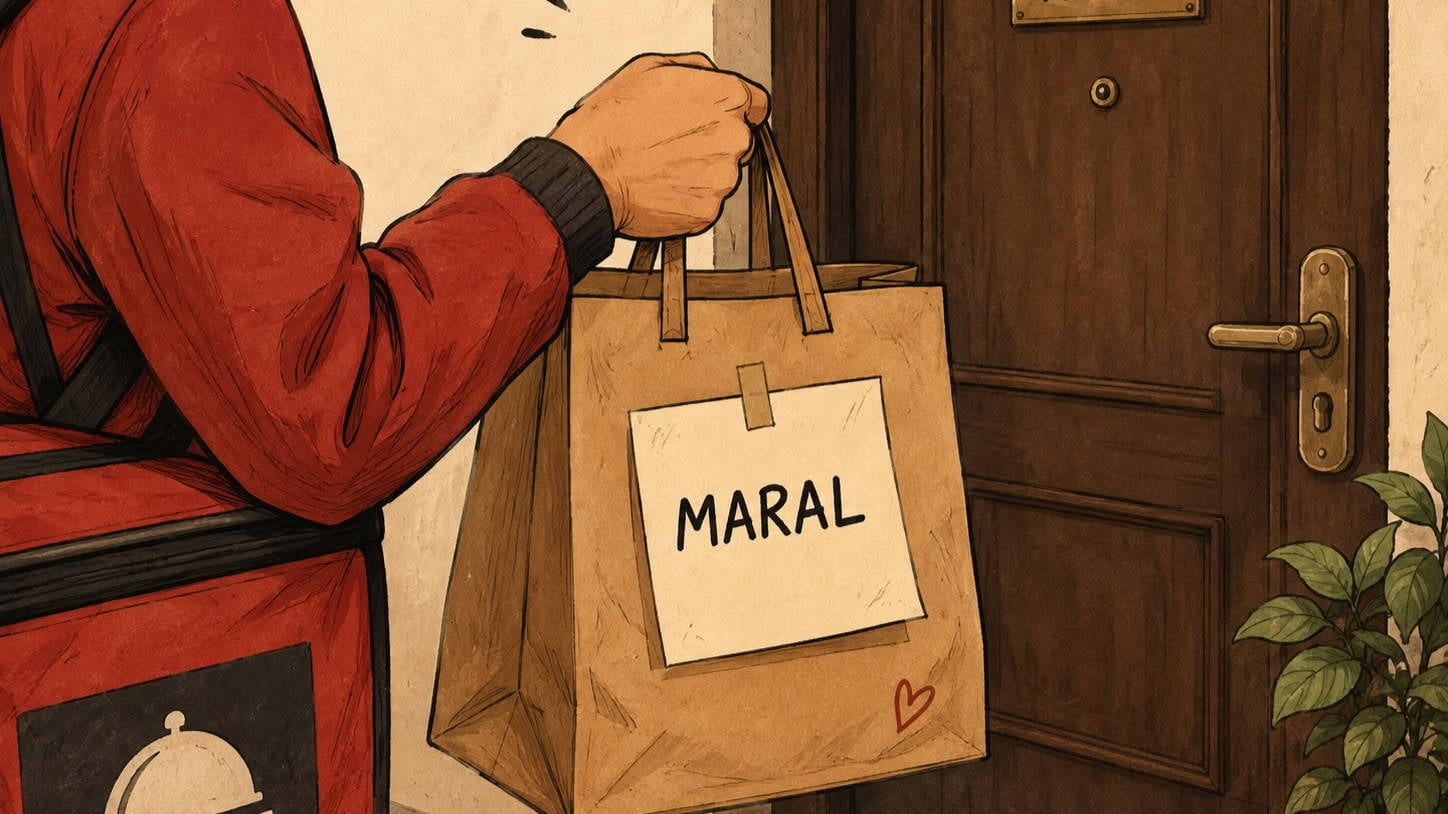
Suddenly, we both relaxed. I can’t describe how the invisible weight on our shoulders seemed to lift. “I can speak it,” I said. “Me too,” he said. As it turned out, amid all that confusion, that linguistic labyrinth that had been going on for minutes, our common language had been Turkish all along. I immediately gave his directions to the door. Two minutes later, we were standing face-to-face on the doorstep, me holding a bag of food. He looked at my name on the order receipt, and a huge smile appeared on her face: “Your name is Maral,” he said, “There are lots of people with that name where we come from, too.”
“Where are you from?” I asked. With that familiar intonation in his voice, he told me he was from Tashkent, Uzbekistan. At that moment, I realized that we, who had met in that apartment stairwell, were actually both complete strangers to each other and, at the same time, deeply familiar.
For years in Yerevan, because I didn’t know Russian, I had always felt somehow incomplete, pushed outside that linguistic geography. That night, for the first time, I laughed out loud at this deficiency of mine. I knew Armenian, he knew Russian; English, declared as the common denominator of the global world, was no use whatsoever in our communication and brought us together on the threshold of a third language we had never expected.
Istanbul in the hairdresser’s mirror
And I soon realized that this kind of linguistic encounter wasn’t limited to couriers or apartment stairwells either. I was accustomed to Armenians from Syria, Lebanon or Iran, who are familiar with Turkish and Turkish television series; this was an entirely normal cultural reflex. But did you know that local Armenians from Armenia watch Turkish TV series, too?
I learned this from the woman who dyed my hair at the hairdresser’s the other day. At one point, our eyes met in the mirror, and while combing my hair she suddenly asked: “Oh Maral, do you watch Uzak Şehir [Distant City]?” As my eyes widened in astonishment, she added with great admiration on her face: “Very beautiful, very beautiful!” And she said it word for word in Turkish! At that moment, a very strange, ironic wave of astonishment rose inside me. You travel all the way from Istanbul to the heart of Yerevan, and just when you are overwhelmed by the language barrier, you suddenly come face-to-face with the boundlessness of popular culture while sitting in a hair salon with hair dye on your head.
Immediately afterward, another woman from the next chair joined the conversation: “Oh, I absolutely love Çukur [Hole] and that boy in it!” Thankfully, I had watched Çukur back in the day, so I was able to pick up the conversation from there and save the situation. Suddenly, I found myself in a Yerevan hair salon, acting like Istanbul’s unofficial popular-culture ambassador, confirming the handsomeness of Turkish actors. As soon as I left the salon, overwhelmed by the absurd comedy of the situation, I felt an urge to rush onto the internet and look up those series I knew nothing about. After all, if someone asks me about another series one of these days, I should at least be a little more familiar with the subject as an unofficial representative.
Under the roof of a common word
I often think of these encounters while walking on the streets of Yerevan. On one side, a deliverer who has left Central Asia behind in search of a livelihood; on the other, a shared cultural curiosity spilling from television screens in a Yerevan hair salon… Those thick lines drawn by politics, borders and history suddenly become thinner through the ordinary flow of life, popular culture, or simply the urgency of food delivery.
Sometimes you understand that a city truly changes not from population statistics, but from the language spoken by the person knocking on your door or the name of a TV series that catches your ear at the hairdresser’s. Yerevan has taught me this again and again. Sometimes people find one another not because they are citizens of the same country or official owners of the same language, but because, at an entirely unexpected moment, they establish a tiny connection in an apartment stairwell or in a hairdresser’s mirror. And sometimes a city’s real story is hidden in that tiny acquaintance you make with someone you never expected to meet.