

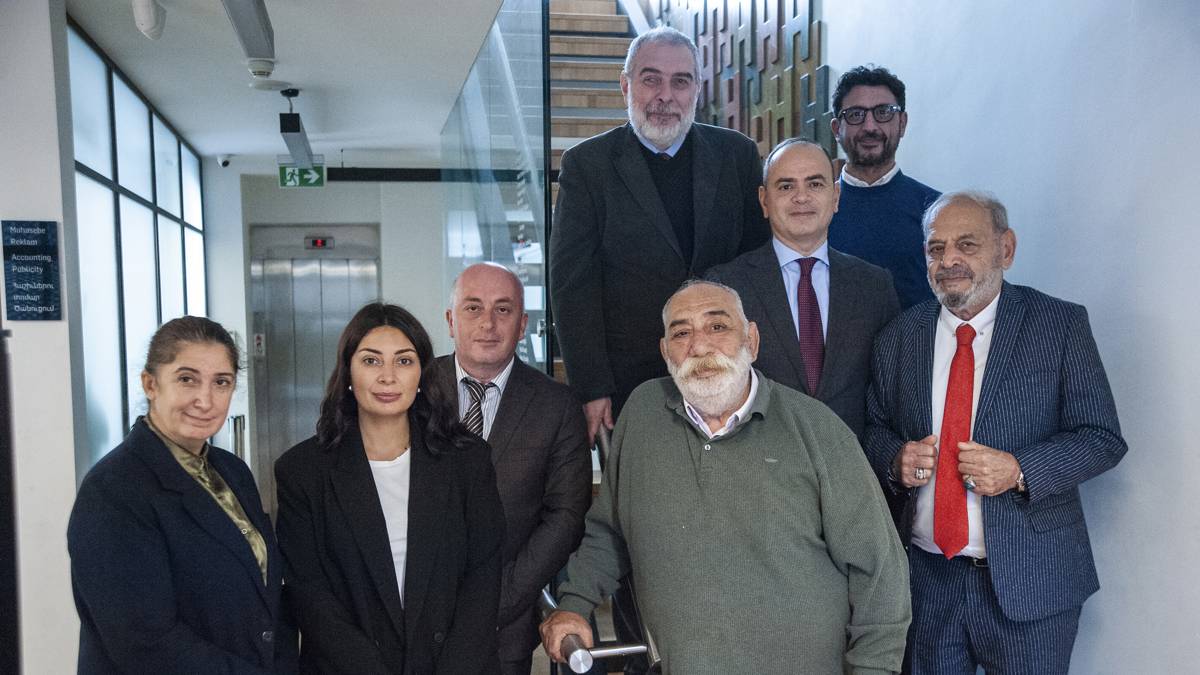
Zareh Sinanyan, the Republic of Armenia’s High Commissioner for Diaspora Affairs, visited Armenian institutions in Istanbul, including the Patriarchate, and held meetings. Sinanyan also visited Agos, where he was briefed on our work and answered our questions. He shared information about his family history, which is rooted in these lands, and offered his assessment of relations between the Diaspora and Armenia.
Your family’s history is rooted in Istanbul. When you come to Istanbul, do you experience different feelings compared to your visits to other countries?
In addition to my father having been born in Istanbul, my paternal family lived in Bahçecik (Izmit) for several centuries. Therefore, I have a very long-standing connection not only with Istanbul but also with Bahçecik. I know that the members of the first major orchestra established in Istanbul in the late 1800s and early 1900s, called the “Sinanyan Orchestra”, belonged to our family.
I do not have any particular feelings towards Istanbul itself. I have particular feelings towards the Armenians of Istanbul. To me, the Armenians of Istanbul are very genuine. Because, in a way, I associate them with my father and with my uncle Garo Hamamcıyan, who was my father’s cousin. In other words, I did not come to visit Istanbul; I came to visit the Armenians of Istanbul. I came to see our brothers and sisters. My feelings are connected to our Armenian community in Istanbul.
In your opinion, what differences are there between Armenians in Turkey and Armenians in diaspora?
Of course, there are differences. But these are not differences in terms of being “a better Armenian, a worse Armenian, a less Armenian, a more Armenian...” There is no difference in that sense. The difference is that they live in the Republic of Turkey, and, as you all know, this plays a major role in their way of life. In other words, living in the United States as an Armenian in the Diaspora is one thing; living on the territory of the Republic of Turkey is something entirely different.
We have a history with Turkey. We have a history of having lived for a long time not only in the territories of the former Ottoman Empire but also in Istanbul itself. And this history contains some very dark and painful chapters. Despite everything, our compatriots continue to live in Istanbul today, to keep their schools open, preserve their churches and raise their children as Armenians. In my opinion, this is quite a heroic undertaking in Istanbul, compared with many other places.
Contacts between the Armenian Diaspora and Armenia have fluctuated throughout history. Following the recent introduction by Prime Minister Pashinyan of the “Real Armenia” concept, which promotes establishing positive relations with neighboring countries, have relations between the Armenian Diaspora -of course, there is not just one Diaspora but various diasporas - and the Republic of Armenia taken on a new form? Has there been any criticism from the Diaspora?
As you said, the Armenian diaspora is very diverse, and there are different organizations and political movements. It is natural that there is a segment that takes a very critical approach towards me, us and our work. I consider this normal. Through our substantive work rather than words, we are trying to demonstrate our values, objectives and cooperation-oriented mindset. We want to be united. Therefore, we are subjected to criticism. Would you like to know what kind of criticism it is?
It is well known that they accuse our government of distancing itself from national values, of not being good Armenians, of being against the nation and of being somehow responsible for the loss of Nagorno-Karabakh...
They also accuse us of wanting to establish good relations with the Republic of Turkey. I certainly do not accept these accusations; they are interpreting all of this incorrectly.
Yes, we want to have neighborly relations with Turkey. If good relations emerge from this in the future, we will only be happy.
We want Armenia to be in a secure neighborhood. If they are going to blame us for that, fine, let them blame us. We accept the accusation. Similarly, they talk about our European values and our efforts to join the European Union. Fine, if that is an accusation, I accept it. Yes, we are turning towards Europe; this means that we want our people to live in prosperity. What is wrong with that? I think even if we do our very best and everything within our power, there will always be people criticizing us. We approach this in a very healthy and calm manner.
As for the Third World Armenian Summit, held in Armenia last week, mutual trust in Turkish-Armenian relations was also emphasized there. How do Armenians in diaspora view this emphasis on “mutual trust”?
Undoubtedly, from the perspective of Armenians in diaspora, the key issue, the very foundation, so to speak, of Armenia-Turkey relations is the Armenian Genocide. In other words, the Armenian Diaspora was shaped as a result of it. Naturally, for them, any relationship established with Turkey must include a resolution concerning the Genocide. I understand this. It is perfectly natural. Diaspora’s reservations about relations between Armenia and them stem precisely from this. In Armenia, we say the following: We will never forget history. We cannot forget it. We have no right to forget it. Nor is it possible for us to forget. However, we must move forward and live in the present.
This is very clear and understandable to us. We have to live. And in order to live, we have to live alongside our neighbors. One of our neighbors, and the largest one, is the Republic of Turkey. This is our approach. In diaspora, in the United States, you can live and say, “No, let us not establish any relations with Turkey until the process of recognition of the Genocide is resolved.” Fine, you can do that in Los Angeles. Stay in Los Angeles and do not establish relations with Turkey. For us, this is not realistic. We are living in the present, looking towards the future within the realities of today. We have to, we are obliged to and we are compelled to find common ground with our neighbors and establish neighborly relations. And perhaps one day these neighborly relations will also bring about good relations between neighbors.
So, your job with the Diaspora is difficult.
Very difficult. Because the Diaspora, understandably, has the luxury of maintaining very high moral standards by saying, “We would never do this.” Fine. We, on the other hand, will do everything that is in the interests of the Republic of Armenia. And what is in the interests of the Republic of Armenia is to have neighborly relations with the Republic of Turkey. Full stop.
What is the current state of relations with Turkey? The borders have not been opened. We know that Turkey is waiting, partly because of its close relations with Azerbaijan. Are they waiting for a constitutional amendment? What is your opinion on this?
Only our Turkish counterparts can answer this question. They themselves know why they are waiting. We have made, and continue to make, every effort to establish diplomatic relations with the Republic of Turkey, open the border and reach this level of neighborly relations. However, as you also pointed out, the entire process is very transparent. Turkey is in a waiting position. As far as I understand, Turkey does not have a problem with us; Turkey has a problem with its own position.
There have been some problems concerning people who wish to become Armenian citizens but do not have baptism certificates. What is the latest situation in that matter?
A major change is being prepared regarding baptism certificates. For example, there are people who say: “I am Armenian, I converted to another religion, my name is Mehmet, I am from Dersim or Hemshin, grant me citizenship.” If a person is of Armenian descent but does not have an Armenian name and does not speak Armenian either, we are obliged, under the procedure, to grant that person citizenship. Now, naturally, such people cannot obtain a document from the Church. The person is not saying, “I am Christian”; they are saying, “I am Armenian.”
A birth certificate should be one of the ways to establish this. If you are Armenian, the matter needs to be examined more thoroughly. You cannot say, “If you are not baptized, sorry, we cannot grant you citizenship.” It cannot be done in this way.
However, the process is much easier with a baptism certificate.


