


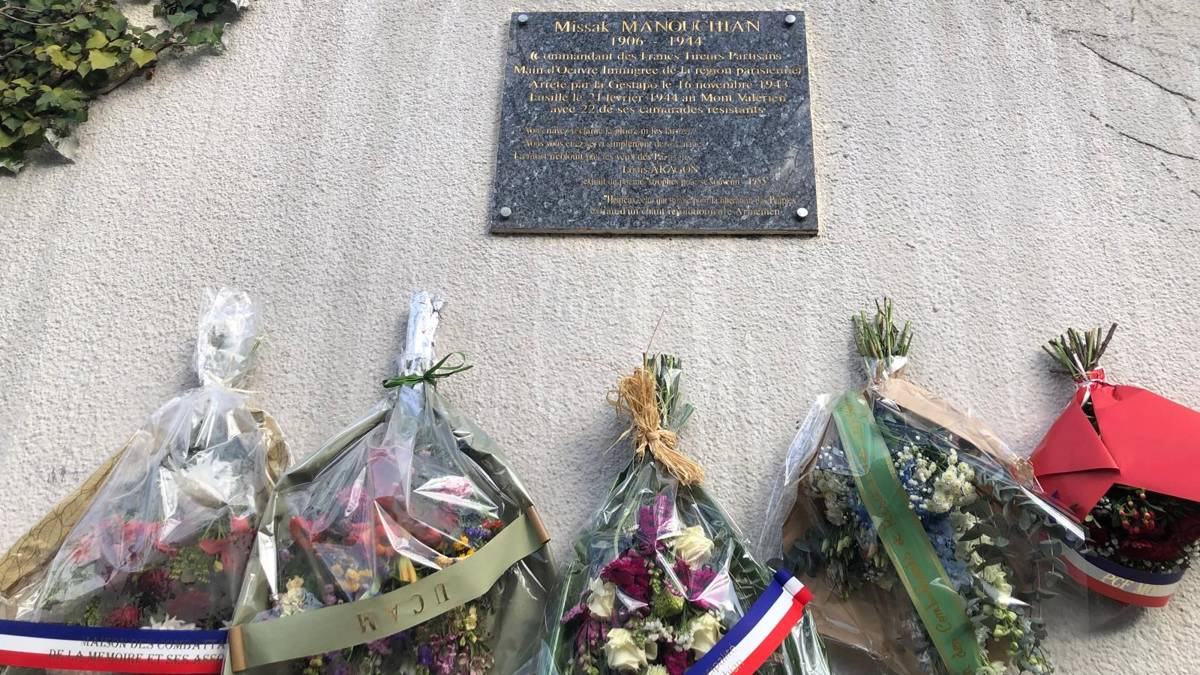
The ceremony was attended by Méline Le Gourriérec, Montreuil Municipal Councilor for Youth, Memory, and Veterans; Edmond Yanekian, President of the Armenian Cultural Union of Montreuil; the Armenian Cultural Union of Montreuil; and various veterans' associations. The event took place at the "Mélinée and Missak Manouchian Square," located at the intersection of Pépin and Marguerite Yourcenar streets, which was renamed in 2025.
In the speeches delivered during the ceremony on Sunday, February 21, striking warnings were issued regarding current global crises and the rising far-right, alongside the heritage of past resistance.
"Establishing Peace is the Greatest of Struggles"
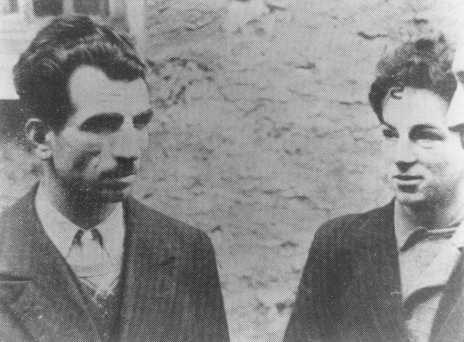
Edmond Yanekian, President of the Armenian Cultural Union of Montreuil, took the floor and emphasized that memory must encompass not only the past but also the present. Yanekian criticized international diplomacy by pointing to conflicts in regions such as Ukraine and Nagorno-Karabakh.
"They were Jews, Spaniards, Italians, Armenians from various Eastern European countries like Poland, Hungary, and Romania, and two of them were French. Most had fled persecution in their own countries, yet the struggle they waged by making the ultimate sacrifice for freedom has forever etched their names into France’s Panthéon.
This was the case for Missak Manouchian, a survivor of the first genocide of the 20th century. It was the same for his Jewish comrades who suffered persecution in various European countries before the Holocaust, for Italians or Spaniards who were victims of dictatorship and fascism, and for Poles, Hungarians, or Romanians. They all had common reasons not to submit to the German occupation. They all shared a vision of a better, fairer, and more fraternal society.
Nothing had predetermined that Missak Manouchian would become the man history remembers today. In 1934, he joined the French Communist Party, where he found the opportunity to express his beliefs freely.
His pride and commitment as a militant inspired Manouchian to pour his feelings and solidarity with the working class into poems titled 'The Unemployed,' 'Staying Awake,' or 'Tailors.' However, he was not a man to settle for a merely intellectual approach. He aided all social struggles against injustice.
He supported the young Soviet Armenian Republic through the Armenian Relief Committee (HOK), where he served as secretary. Alongside Henri Barbusse and Romain Rolland, he took part in the Amsterdam-Pleyel movement against war and fascism. He joined the Popular Front (Front Populaire). He was a member of the Aid Committee for Spanish Republicans. After being imprisoned twice, he joined the FTP-MOI to take part in the resistance. Within a very short time, the record of the Manouchian group was striking: 56 attacks, 150 dead, 600 wounded.
These actions shook the morale of the Nazi troops. High-ranking officials of the Nazi regime, such as Julius von Ritter, who was responsible for the Compulsory Labor Service (STO) in France, were punished. This action was carried out in Trocadéro, Paris, under the responsibility of Marcel Rayman.
This commemoration is not just about a past era. Unfortunately, the same evils continue to gnaw at our societies today. Our vigilance and determination to act against the rise of racist, xenophobic, nationalist, and extremist ideologies must be maintained with the resolve required by respect for the most fundamental rights of a human being, regardless of their origin, skin color, or religion.
Although history is never written exactly the same way, the consequences of wars are always tragic. The war in Ukraine is unfortunately the worst example of this, with the risk of spreading to all of Europe and even beyond. Today, we strongly condemn Russia’s aggression against a state within its internationally recognized borders. Nevertheless, we believe that since the dissolution of the USSR, everything has not been done to prevent these tensions—which affect the world and especially Ukraine today—from escalating and reaching a deadlock. As Jean Jaurès reminded us, our common compass must be the defense of peace.
To quote him: 'Establishing peace is the greatest of struggles.' Even though we are aware of the complexity of the context and the magnitude of today’s task... The resolution of tensions and conflicts in the world unfortunately often gets lost in the geopolitical labyrinths of an unfinished diplomacy that lacks a perspective for a lasting solution, as seen in the Israel-Palestine conflict.
There is another conflict that concerns us closely: Nagorno-Karabakh. To be honest, this issue does not interest many people. The ethnic cleansing applied by Azerbaijan against the Karabakh Armenians, who have lived on their ancestral lands for thousands of years, along with the heavy humanitarian crisis it brings and the destruction of monuments and places of worship that witness an ancient civilization, creates a conflictual environment that could even threaten the very existence of Armenia today.
Today, Armenia and its people are once again under the threat of extinction on their own lands, which were registered with the Alma-Ata Protocols in December 1991. Faced with this threat, the Lemkin Institute for Genocide Prevention had issued a warning in January 2023 regarding Azerbaijan’s actions.
Missak Manouchian and his comrades belong to the history of France. It is a duty for current and future generations to remember the sacrifice of those executed by firing squad along with the Red Poster (L’Affiche Rouge). Our loyalty to the values embodied by the Manouchian group, and more broadly by the resistance in all its diversity, must never waver."
Heroes Whose Names Are Difficult to Pronounce
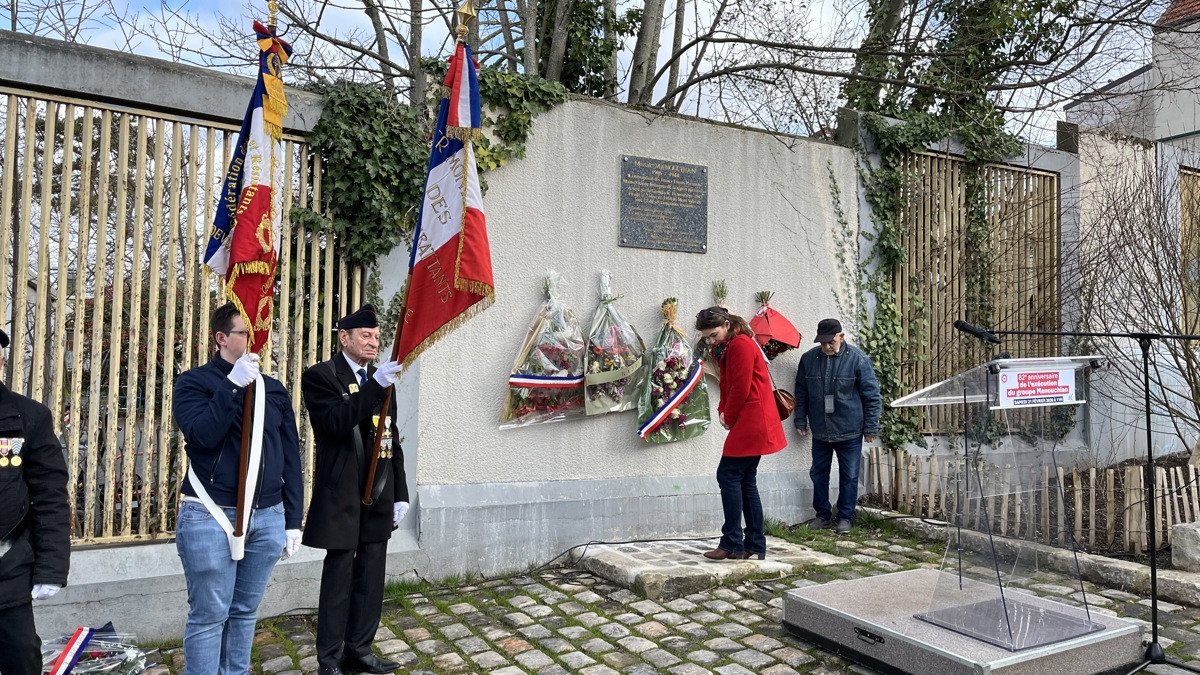 Méline Le Gourriérec, Municipal Councilor for Youth and Memory in Montreuil, touched upon the importance of the "immigrant resistance fighter" identity represented by the Manouchian group in today’s political atmosphere. Issuing warnings as a report against the global rise of far-right ideologies, Le Gourriérec pointed to the risk of history repeating itself.
“Most of these 23 people were immigrants who had been exiled, either themselves or their families, due to fascism or poverty in their countries. They were women and men from elsewhere who chose to defend France, even though it sometimes welcomed them poorly. They fought until death for the liberation of this country, which they believed to be the land of freedom and human rights and saw as their new homeland.
They were communists and were burning with ideals of fraternity. What a great lesson it is that these women and men, whose names are so difficult even to pronounce, have become symbols of the French resistance in our country and far beyond. This country they took refuge in finally offered them the respect they deserved in 2024 by admitting Mélinée and Missak Manouchian to the Panthéon and placing a plaque to honor their comrades.
"Violence Starts Not with Rifles, but with Words"
Today, exactly 82 years after the execution of the Manouchian group, thousands of far-right militants, neo-Nazis coming from all over France and neighboring countries, are demonstrating freely in Lyon with the approval of the Minister of the Interior and under the protection of law enforcement.
In the 1930s, far-right groups were also marching in France. They were screaming their hatred for the Republic, foreigners, Jews, trade unionists, and communists. Many underestimated the danger they represented. We know the price that was paid for that.
In recent years, many have warned about the normalization of far-right ideas, their dominance in the media, and their electoral success in France. In the world, the ‘Brown Plague’ (fascism) has already infected many countries: Hungary with Orbán, Italy with Meloni, Slovakia with Fico, the Czech Republic with Babiš, Chile with Kast, Argentina with Milei, El Salvador with Bukele, the USA with Trump, Israel with Netanyahu... The list is long.
Yet history reminds us that political violence does not start with rifles; it starts with words, with the normalization of what is unacceptable.
The Struggle Against Racism, Antisemitism, and Islamophobia
Today, honoring the members of the Manouchian group is not just about laying a wreath; it is deciding to join together in the struggle against all forms of racism, antisemitism, Islamophobia, xenophobia, and exclusion. It is deciding together to fight for respect for the other, justice, equality between women and men, the rights of everyone, the right of peoples to self-determination, democracy, and peace. It is our responsibility to call fascism by its name. It is our responsibility to call racism by its name.
Over 80 years ago, the 23 members of the Manouchian group made a choice. Today, it is our turn to make a choice.”
The ceremony, the second major anniversary event held following the transfer of Missak and Mélinée Manouchian’s remains to the Panthéon in 2024, concluded with the laying of flowers at the monument. In addition to municipal officials, numerous representatives of non-governmental organizations and local residents attended the ceremony.


