

My cousin Hagop was my cousin because his father Garo was my father’s first cousin and a good buddy through the years in exile from the restless, chaotic 1960s until their deaths occurred in Western Europe. Garo died in Switzerland. My father in France. Far, far from the streets of Istanbul where they knew their ways without paper map guidance nor technological assistance from mobile phones as of today.
They also knew how to exist in languages they had made their own through Armenian family roots and Turkish geopolitical circumstances. Conversational or intuitive Greek could be added to these men’s skills. Although I never ever heard them speak Greek, somehow, I knew they could be communicative in Greek, if needed, like other men and women of Istanbulite upbringing.
From belonging to a minority in their own country they became part of invisible strangers in new countries where they didn’t belong, but where they settled and invented lives for themselves at the workplace, at home, at the coffee-shop, on trams and buses in languages unknown to them, German and French, they tried to master. A well-documented pattern that shall be repeated along the centuries ahead of us, despite all attempts from nationalists throughout the globe to prevent foreigners to reach well-guarded shores or jump off rebuilt walls. The so-called frontiers of human history.
I wish I had been more inquisitive in my youth when both men were around. My father told me a few stories, but not much really. Garo came to visit us in Paris a few times, but not so often. I wish I had interviewed those two cousins, Garo and Hovsep. Today I know almost nothing about them. I remember voices, laughs, sounds, words. My father’s eyes fiery, almost watery, with excitement at the prospect of a simple chat with Cousin Garo. Garo’s jubilant loquacity and effervescent tendency to articulate jokes, to recall anecdotes from their past. Two cousins, not alike except for their dark eyes and dark complexion, grown distant over decades spent in different European territories, and yet still acting like close relatives. The two men are like twins reunited. Merriment fills the day. I remember how reluctant I was to feel the night creep onto that time-space. The silence of the night – not my cup of tea, to use a hackneyed expression.

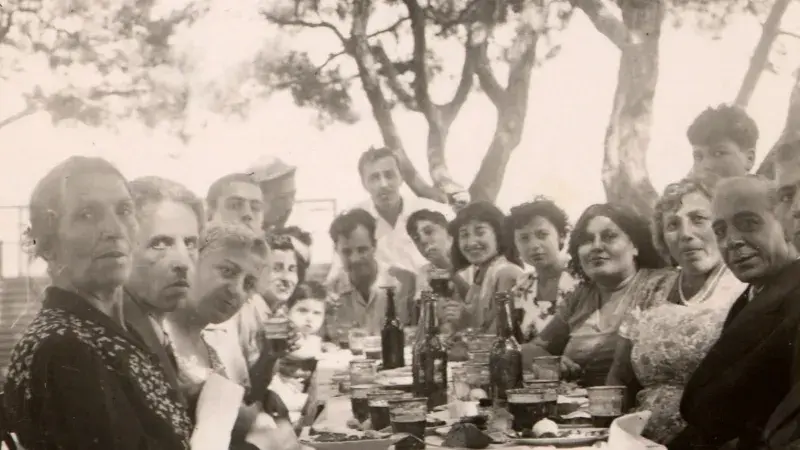
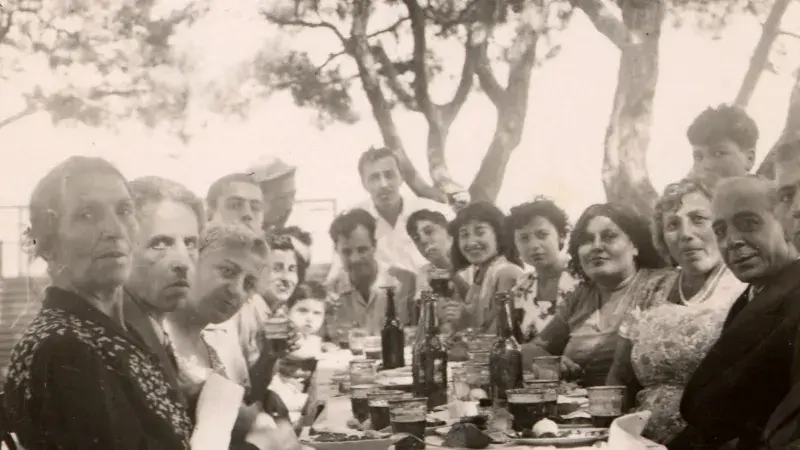
the young boy on the left is her cousin Hagop, the man partially seen behind
Hagop is his father Garo in a family gathering from 1950s.
One day Garo brought his first-born son along, Cousin Hagop who was two or three years older than me. I knew him from Istanbul. We had attended some family events in our childhoods, but we had never or rarely spoken to each other, let alone play games. In those days (in the 1950s) children did what they were told. Boys stayed away from girls. Girls stayed away from boys.
Years later, as Hagop and I had become exiled in the wake of our parents, our encounter in Paris did not amount to much. Hagop was a very young man, handsome, solemn, aloof. I must have felt and looked rather awkward in my teens. I raised no interest in Hagop and vice versa. Our immigrant fathers’ mutual pleasure at bonding in a suburban living-room did not seem to affect us. We were a new generation of displaced Armenians, perhaps ready to shed the traumas of the past, inclined for sure to battle and absorb new rules, values, customs, languages, and most certainly willing to embrace a flawless future. The future would be ours, under alien skies, whether in France or Switzerland. And neither of us cared about the other’s predicament, current or upcoming.
However, many, many years later, I felt the desire to reconnect. Garo and Hovsep, long gone from this earth. I paid a visit to Hagop in Switzerland. He and his wife Catherine welcomed me in their Swiss village near Zurich. Theirs was a harmonious home. Hagop drove me everywhere as though he had sensed my urge to see places. We went to Basel, Luzern, Zurich. We crossed bridges, walked downtowns, sauntered by waterways, lunched at a mall, attended an open-air festival. Hagop introduced me to every member of his family. They all talked Swiss German. We were able to communicate thanks to phrases in English, smiles, and good will.
In that Swiss village near Zurich, a few streets away from Hagop’s house, I even met with his younger brother who was about to move to Yerevan with his newly-wed spouse whose Eastern Armenian I could barely understand. The younger brother had no idea who I was. I told him our paths had crossed long ago back in the city of Istanbul. I knew he had traveled from there to there but said nothing. I knew his life story to a certain degree but said nothing. Nevertheless, I did ask him to show me pictures from our common past. There and then I came across some ensemble images never seen before. It broke my heart to witness those Istanbul family gatherings but strove not to spread my sadness. The moment was unique, not to be spoiled with mawkishness. Both Hagop and his sibling were well-learned, spoke impeccable Armenian. I was aware of the language gap and resorted to English whenever my second-grade Armenian failed me.
We anticipated further get-togethers.
Useless to say, the anticipated get-togethers never materialized.
On a June morning, I heard of the passing of Cousin Hagop. A wise man with a white crown of hair and the bluest of eyes. A relative who understood the meaning of every word I conjured up from our Turkish-Armenian past.
Who is Esther Heboyan
Born in 1955 in Istanbul, Turkey, where she spent her early childhood and attended the Anarad Higutyun Elementary School. In the 1960s the family went into exile first to Germany, then to France.
Heboyan holds an M.A. in Journalism from the University of Iowa and a Ph.D. in American literature from the University of Paris III-Sorbonne Nouvelle (thesis on Grace Paley’s short fiction). Worked as an associate professor of American literature and cinema at the University of Artois in Arras, France (1996-2021).
She has various published books and translations.