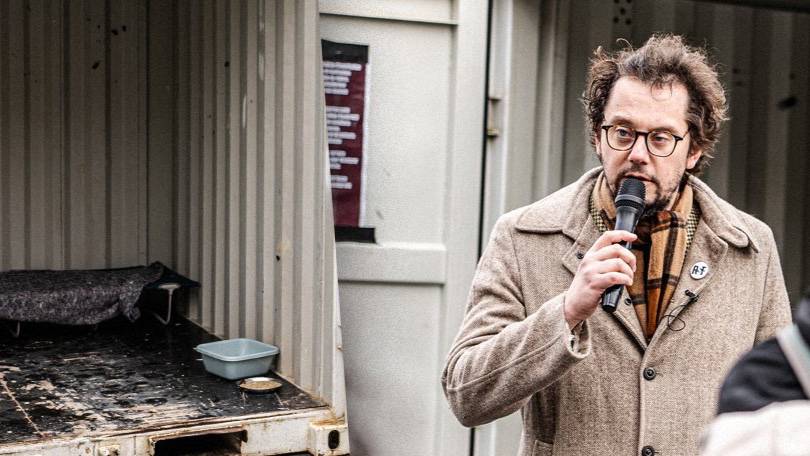

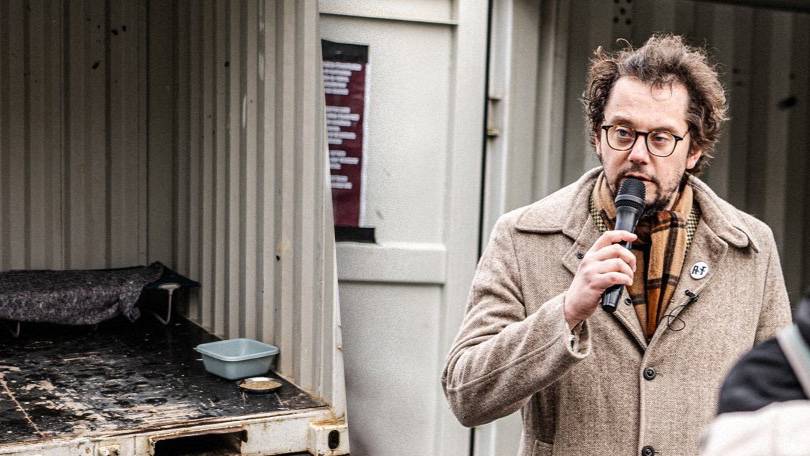
On January 28, RSF organized an international protest in the European cities of Paris, Berlin, and Bern to condemn the crackdown on media, simulating the harsh prison conditions faced by journalists.
Containers and Pressure
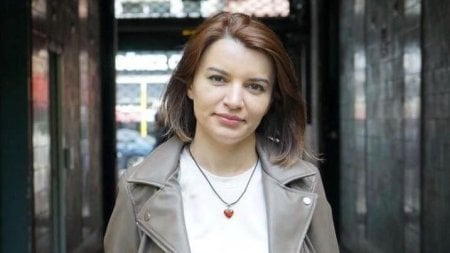 RSF Director General Thibaut Bruttin explained that imprisonment has become a tool of censorship in Azerbaijan. He stated that the protests—held via four-square-meter containers placed in city squares—serve the purpose of defending the right to report:
“In Azerbaijan, prison has become a tool of censorship. The regime attempts to suppress journalists physically and professionally by depriving them of health, water, communication, and information. Through these 'container protests' reflecting the conditions of detention, we want to draw attention to this organized oppression and remind everyone that these journalists continue to defend the right to report even from behind bars.”
A single four-square-meter container was placed in the Place de la République in Paris. This space corresponds to the area of an isolation cell in a temporary detention center where many journalists are held, sometimes for many years. The structure contains a camp bed, ubiquitous filth, and insects that journalist Elnara Gasimova calls “unwanted friends”: imprisoned journalists are not even permitted to clean their own cells. Accompanied by sound effects, visitors explore the interior of the container by flashlight to witness the inner workings of prison life.
25 Journalists Imprisoned in Azerbaijan
During her 800-day imprisonment, Sevinj Vagifgizi, the editor-in-chief of the independent investigative media outlet Abzas Media, has been subjected to particularly harsh mistreatment by prison staff. Personnel have deprived her of adequate food and water and refused to provide her personal belongings.
Last September, she was abruptly transferred to a remote prison to distance her further from her relatives. The corruption she exposed in her investigations is a serious issue in Azerbaijan, and this reality is reflected in prison conditions. Alesker Mammadli, a seriously ill journalist, is being denied medical treatment, while independent journalist Nargiz Absalamova reports that doctors sometimes demand several times the normal price for medicine and treatment.
Behind bars, Sevinj Vagifgizi and other journalists continue their work by writing about the conditions of detention and the status of other prisoners. Nargiz Absalamova wrote in a letter: “Hot water is only provided twice a week for two to three hours. Cold water is provided twice a day, for one hour in the morning and one hour in the evening.”
These reporting efforts lead to "punishments" by prison staff. Communication with the outside world is heavily restricted if it contains testimonies about prison life. This is a particularly difficult situation for those practicing the profession of journalism. Ulviyya Ali, a former employee of Voice of America (VOA), writes: “I am trying not to lose my sense of reality in the face of the information blockade in prison.”
A Media Outlet That Exposed Corruption
Sevinj Vagifgizi is the editor-in-chief of Abzas Media, an independent investigative outlet that primarily covers corruption among the political elite. Its editors brought to light several corruption scandals related to the reconstruction of Nagorno-Karabakh and opaque fund allocations benefiting the president’s family and Turkish business partners.
The investigative journalist’s insistence on the right to information has subjected her to constant pressure for years: including bans on leaving the country, police violence, arrests, threats, and interference with her work. Although she was sent into temporary exile in Berlin in 2021 through an RSF fellowship, she continued to be monitored by Azerbaijani intelligence services via Pegasus spyware. In November 2025, the journalist was honored with the RSF Press Freedom Award in the Courage category.
Nine Years in Prison for Reporting
Arrested on November 21, 2023, Sevinj Vagifgizi was sentenced to nine years in prison on charges of “currency smuggling.” Five other editors of Abzas Media were also sentenced to prison terms ranging from seven to nine years following an unfair trial. Similar cases were opened against journalists from Toplum TV, Meydan TV, and other independent media organizations.
Since Russia’s full-scale invasion of Ukraine, Azerbaijan—an authoritarian petrostate—has become a strategic energy partner for the European Union. Despite the regime's widespread crackdown on press freedom and civil society, fossil fuel supplies are planned to increase significantly by 2027.
A restrictive media law adopted in 2022 is being used to censor all critical voices and significantly complicate the financing of media. The blocking of access to international media outlets like BBC News Azerbaijani makes it nearly impossible to access independent news in and about Azerbaijan.