


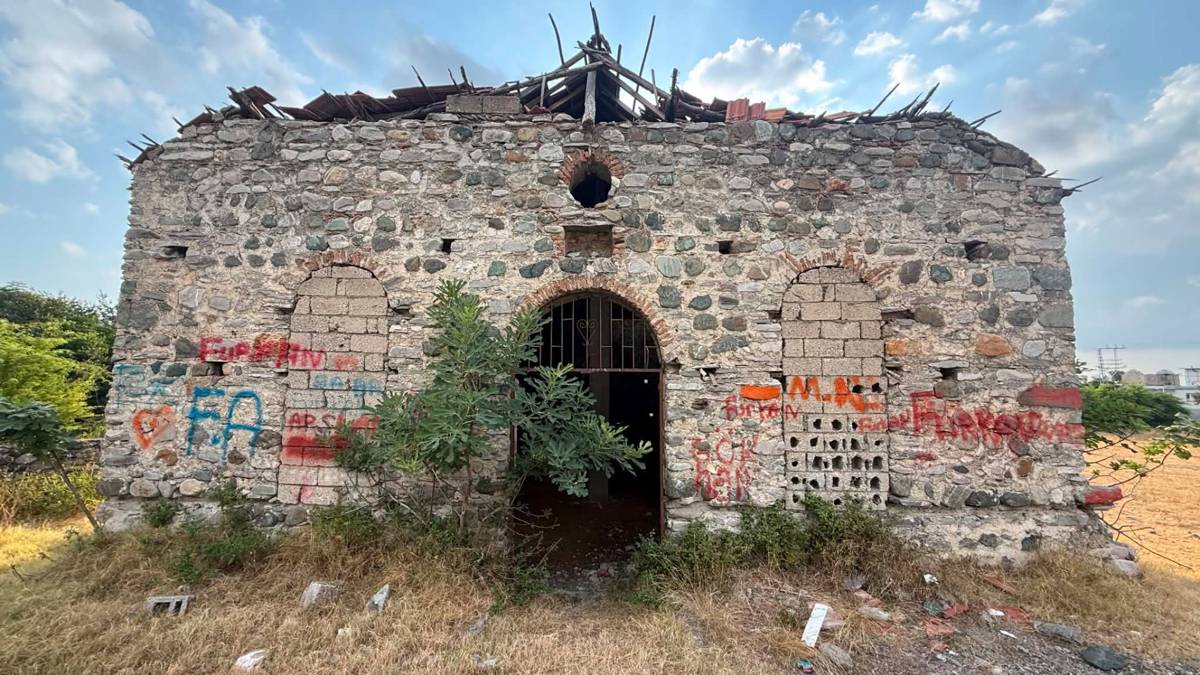
Known for its multicultural history and rich archaeological heritage, Dörtyol district of Hatay contains a historic legacy that has been left to decay within the boundaries of Özerli Neighborhood. Located on Değirmen Street at the geographical coordinates 36°49'25.8"N 36°13'49.7"E, the historic Armenian church ruins, whose ownership status remains unclear, are struggling to withstand the passage of time, natural conditions, and human-caused destruction.
Although the building’s official registered name has not yet been definitively established, historical archival documents reveal its remarkable and vibrant past. While its name has not been formally registered with certainty today, records of the Armenian Patriarchate of Istanbul suggest that the structure may be the Surp Krikor Lusavoriç Church, built in the village of Özerli in 1877. According to S. Eprigyan’s “Historical Texts”, Özerli then was a remarkably lively settlement of 300 households, 250 Armenian and 50 Muslim. It is noted that the Armenians there spoke Turkish in their daily lives. The village contained a beautiful church called “Diramayr” (Holy Mother of God), a school, a marketplace, extensive gardens, and a tobacco-registry building. In fact, during the summer months, the district governor’s office of Payas would even move its administrative center to this cool and prosperous village. A structure that had witnessed such a deeply rooted administrative, economic, and cultural history now stands in a state that is, sadly, its complete opposite.
According to information gathered during visits and examinations of the historic structure and site by Garen Kazanç, the building’s original roof collapsed and was replaced with a makeshift wooden roof covered with tiles, while its windows were bricked up with concrete blocks. The historic inscription above the main entrance has also, unfortunately, been removed. Left unprotected, with its floor completely covered in earth, the historic church ruins have been used over the years as a hayloft or stable. Accounts from local residents and people living in the surrounding area also clearly indicate that the building was used for many years as a shelter for goats, during which time its structural integrity was seriously damaged.
Cultural Heritage or Simply a “Ruined Building”?
The most significant legal and bureaucratic obstacle that is believed to have prevented the building from ever being placed under protection is its ownership status. Official land-registry and cadastral records reportedly classify the property not as a place of worship or historic monument, but simply as a “Ruined Building and Its Plot of Land.” This appears to indicate that the structure is probably privately owned and registered to an individual.
Under Turkey’s legislation concerning the protection of cultural heritage, structures of this kind that are privately owned and either unregistered or stalled in the registration process may be prevented from receiving state protection because of legal barriers such as insufficient funds for expropriation and protections surrounding private property rights. Local authorities likewise cannot restore them under these circumstances.
With its windows sealed with concrete blocks, its walls defaced with spray paint, and its interior turned into a shelter for goats, this structure is a silent witness to Hatay’s multilayered historical memory. With its ceiling deteriorating and its roof left unprotected, it is yet another piece of shared cultural heritage that risks being completely erased from Dörtyol’s historical landscape.


