


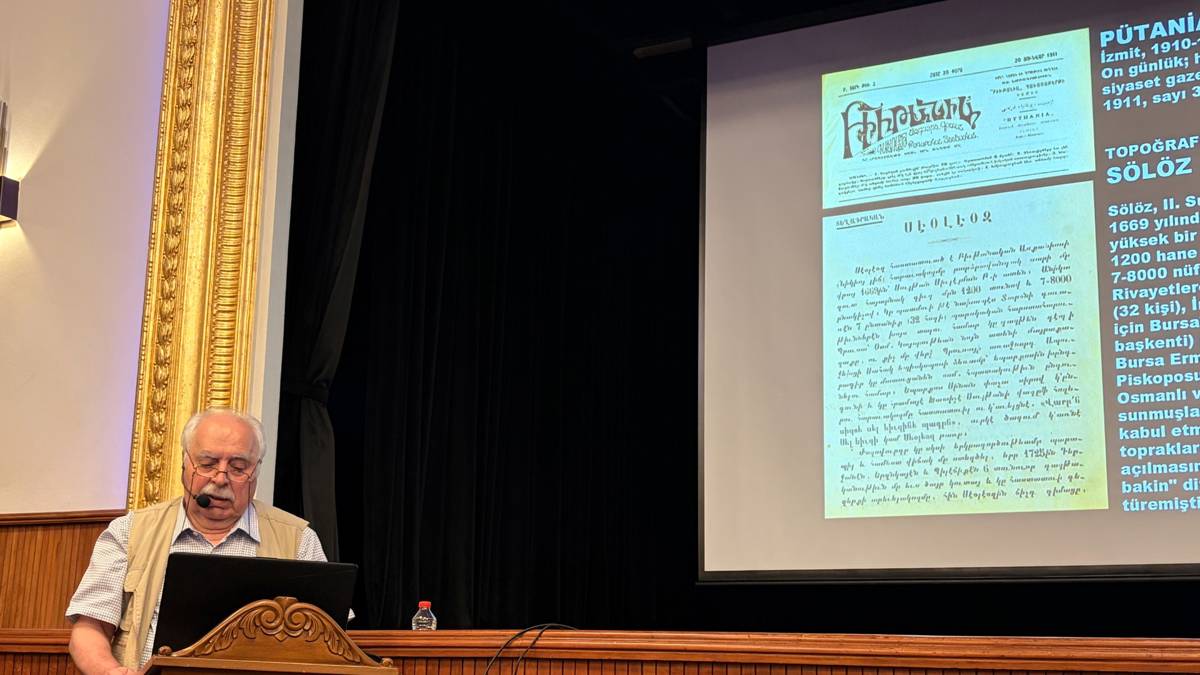
Stating that he began working on Sölöz on the occasion of the ‘Hantibum Festival’ organized by Yeseyan Association every March, Mildanoğlu commemorated Yetvart (Tomo) Tovmasyan, one of the founders of Aras Publishing and the Yesayan Association, and Sarkis Seropyan, the Editor of our newspaper's Armenian Pages whom we lost in 2015 and who first wrote about Sölöz in Agos.
Sölöz, a small village north of Bursa and south of Lake Iznik, was home to a dense Armenian population a century ago. Zakarya Mildanoğlu narrated this history based on a multi-layered spectrum of sources ranging from Turkish newspapers in Armenian script to Ottoman archival documents, and Patriarchate correspondences to missionary reports.
"Today, let alone a school and a teacher, there is not even a single Armenian"
Mildanoğlu mentioned that the Hreşdagabet Church, the largest and most magnificent religious structure in the village, was built of ashlar stone and featured three altars, two entrance gates, and facades adorned with statues. Conveying that the sound of the church's bell—which weighed approximately 235 kilograms and was cast in Zeytinburnu, Istanbul, from equal amounts of copper and silver—reached as far as Lake Iznik, Mildanoğlu said, “I also remember that the bell of the Samatya Surp Kevork Church could be heard from Eminönü."[*]
The church housed rooms for priests, spaces for ritual preparation, and a co-educational school building; expenses were met by the Armenian community, not by the local municipality. In the 1902 academic year, 380 students were educated at the Saint Savorican Boys' School and 270 students at the Saint Hripsimyan Girls' School in the village, with a total of 13 teachers serving in both schools. Drawing attention to these figures, Mildanoğlu said, "Today, let alone a school and a teacher, there is not even a single Armenian."
Church items worth 300 thousand gold coins
Mildanoğlu shared that the Armenian Patriarchate of Istanbul recorded the assets of the spiritual leaderships in Anatolia in 1914, and in an inventory preserved in the archives of Ottoman Armenian historian, researcher, philologist, and educator Arşak Alboyacıyan, the items of the Sölöz Church were recorded one by one; the total value was determined as 300 thousand gold coins at the prices of the period.
Silk and Olive
The economy of Sölöz was built on two main axes: sericulture (silkworm breeding) and olive oil. A large factory affiliated with the Sericulture Institute, which was established following the outbreak of a silkworm epidemic across Bursa, was built in the village. The structure, which is currently in ruins and under private ownership, was Sölöz's most magnificent building.
Conveying concrete evidence showing that the Sölöz Armenians possessed a deep knowledge in this field, Mildanoğlu stated that a sericulture book published in 1907 in Turkish with Armenian script was foremost among these. The silkworm eggs produced in the village were marketed as far as Tbilisi with quadrilingual cards written in Turkish, Russian, Georgian, and Armenian. There were 10 olive oil factories in the village, and olive harvesting was celebrated with festivities during years of abundant harvest.
"We will not endure this torture for 16 hours a day"
In his presentation, Mildanoğlu also touched upon the 1910 women workers' strike. Many cocoon-producing women, young and old, coming from Sölöz, Bilecik, Pazarköy, and surrounding villages, launched a joint strike against the working conditions and wages in the Bursa silk factories. In the factories where male workers earned 6-7 kurush and women earned 5-6 kurush per day at that time, the women workers united and walked off the job. Mildanoğlu read the manifesto published by the women who took part in the strike to the participants.
Stating that the strike ended with a certain compromise and the workers returned to the factory, Mildanoğlu also underlined that while there was comprehensive coverage of the strike in Armenian newspapers of the period such as “İşçi” (The Worker) and “Abaka” (The Future) whereas the strike was never included in Ottoman and Republican labor history.
Stating that a youth, an education, and a women's association were also active in the village, Mildanoğlu mentioned that a large arched ashlar stone bridge was built with the donations collected by the women's association, and a public bath was also built in the village center.
Touching upon the tension between Gregorian and Protestant Armenians in the village, Mildanoğlu conveyed that Apostolic Armenians initially fiercely opposed Protestant missionary activities, physical violence was inflicted on those who sold Bibles, and Protestant shops were boycotted, with these incidents being reflected in the newspapers of the period.
Mildanoğlu noted that he also encountered people from Sölöz in the “I am Looking for My Family” classified ads series published in Agos.
The two prides of Sölöz
Mildanoğlu closed his presentation with two important figures raised in the village. Painter Hovhannes Semerciyan was born in Sölöz in 1920; after migrating to Greece with his family, he went to Paris and studied at the Ecole des Arts Décoratifs. The artist, known by the name Jean Jansem, opened exhibitions in Paris and New York and received a major award in 1958; Japan, meanwhile, built two museums in Tokyo and Nagano in honor of this artist.
The second name was Hagop Oşagan. Born in Sölöz in 1883, Oshagan’s father was a gardener and his mother was a silk factory worker. After being educated at the Armash Seminary, Oshagan worked for Istanbul newspapers and also served as a teacher in Malkara and Istanbul. He was arrested eight times while evading surveillance by the Ottoman police, managing to escape each time; at the end of the war, he crossed into Bulgaria disguised as a German officer. The post-war years turned into a productive literary period for him. His work titled Hankırvanner (Stages), in which he describes the customs and traditions of Sölöz, was published by Aras Publishing.
The event came to an end following the question-and-answer session.
[*] Samatya and Eminönü are two districts of Istanbul and the air distance between them is approximately 3 miles. (e.n.)


