


Some cities make women raise their shoulders. Others let them lower them. First, the way you walk changes. Then your voice. Finally, your relationship with the night. And when you look back, you realize you had already changed long ago.
The years I moved to Yerevan coincided with the pandemic. I had arrived in a new country, yet it felt as though I had arrived nowhere at all. There was no city, no streets, no squares; life had been compressed into four walls. My world consisted of our home, the garden we shared with our neighbors, and the balconies of the apartment buildings across from us. For days, I watched those same balconies. Women hanging laundry, men smoking cigarettes, children riding bicycles. Like everyone else, I filled in the unknown lives in my imagination. When you cannot truly know a city, your imagination fills its empty spaces.
The pandemic locked people inside their homes; the war that followed drove them into the public squares. With death at the doorstep, the city no longer seemed like something to fear, but like a shared home where grief was carried together. I came to know Yerevan not first through its streets, but through the faces of the women carrying the coffins of boys barely old enough to be called men. Trying to breathe in a place where death was so close and sorrow so fresh, I was overcome by a strange feeling: a sense of refuge intertwined with guilt.
As the city mourned its own losses, it somehow watched over all of us as well.
The vigilance that faded from the streets
I do not remember that first peaceful night in perfect detail, but I have never forgotten what stayed with me from it: the fact that I felt nothing at all.
For a woman, sometimes the greatest freedom is precisely this.
I left the restaurant. The night was calm, with a light breeze. I walked home. Without checking over my shoulder. Without quickening my pace. Without wedging my keys between my fingers and turning them into a weapon. Without gripping my phone tightly in my palm so I could reach someone instantly if danger arose... I simply walked.
Yet for women, being able to walk alone at night should not be an extraordinary act of courage but an ordinary human right.
We, I mean women, however, learn not the shortest way to home but the most illuminated one in vast cities like Istanbul, which necessitates to be on the alert constantly. We know exactly on which streets our pace will quicken, at which bus stops we should never wait, and whom we need to text, "I'm home." Only another woman can truly understand why your heart starts beating faster when your phone battery drops below ten percent.
And we grow up believing this constant state of alertness is normal.
Memorizing the possibility of a gaze
The other day, I was on the Istanbul metro. It was a hot summer day, and I was wearing a light summer dress. Without even realizing it, I caught myself lowering my head to check my skirt. Had it ridden up when I bent over? Was I exposing myself while sitting? Then I adjusted the way I was sitting. Pulled my bag a little farther across my lap. No one had told me to do so. Perhaps no one was even looking at me. But sometimes the body learns before the mind does. After years in the same city, a woman learns not only its streets, but also the possibility of a gaze. The harassing gaze. The judgmental one. Even when those eyes are nowhere to be found, the body remains on watch.
Then one day, after leaving behind Istanbul's relentless rhythm, you arrive in a smaller city that feels like a large neighborhood. Without even noticing it, your body begins to let go of that old, deeply rooted fear. You realize you have changed first through your reflexes.
What was left on the table
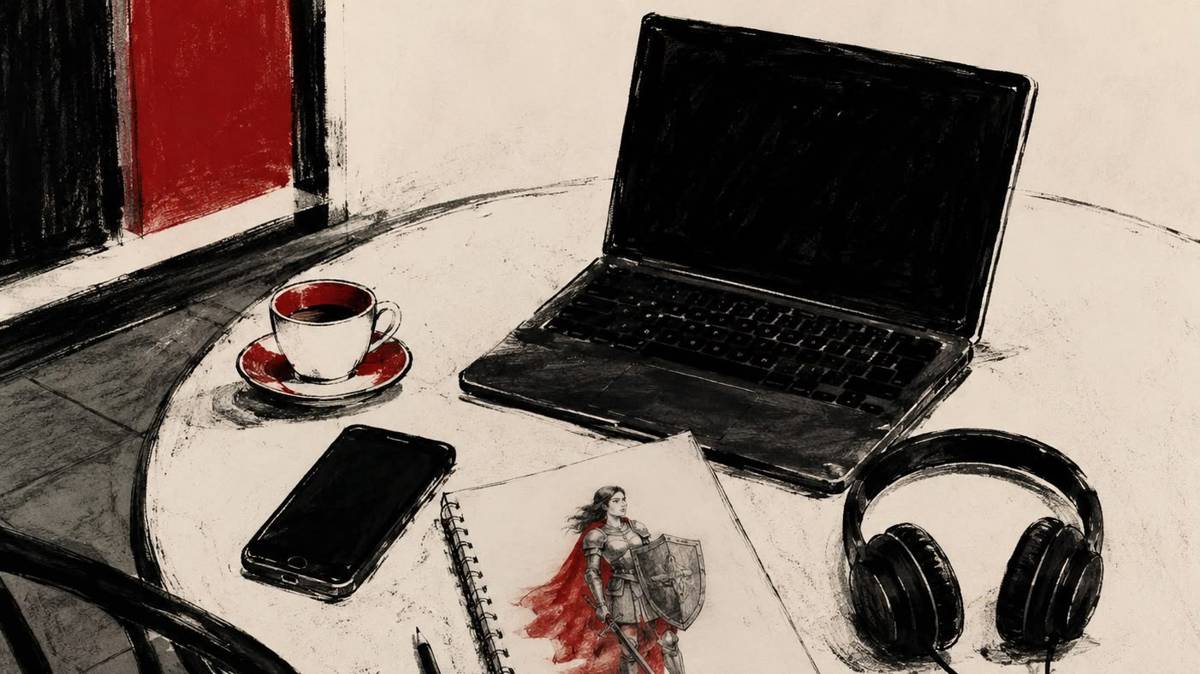
In time, that looseness began to seep into other corners of my life. I started working at cafés. One day, when I got up to use the restroom, I realized something: my laptop, my phone, and my headphones were all sitting on the table. I had not gathered any of them, nor had I even asked the person at the next table to keep an eye on my things.
When I came back, everything was exactly where I had left it. At first, I thought the remarkable part was that my belongings had been safe. Later, I understood. What I had left on the table was not my phone or my computer, it was the vigilance I had carried with me for years.
It turns out that one day, quietly, you can leave behind the constant alertness you have worn like protective armor your entire life.
Perhaps that is why being able to walk at night without fear and being able to leave your laptop unattended on a café table always feel like two expressions of the same emotion to me. In one, you forget your body. In the other, you forget your belongings. At the heart of both lies the invisible comfort of not feeling compelled to remain constantly on guard.
The guardians of public space: people
Urban theorist Jane Jacobs described safe cities with the phrase "eyes on the street." She argued that what makes a city safe is not simply police officers, surveillance cameras, or high walls. Rather, real security emerges when people are naturally present in public life. The people sitting in cafés, the shopkeeper locking up for the evening, the neighbor watching the street from a window, the children playing in the park... None of them are security guards, yet all of them become, without realizing it, witnesses to a shared public life.
Perhaps that is why what impressed me most about Yerevan was not the absence of crime. Such a city without crime does not exist anyway. What moved me was that trust has become an ordinary part of everyday life.
Indeed, data published by Armenia's Prosecutor General's Office in recent years point to declines in many categories of crime, along with improvements in crime clearance rates. Statistics alone, of course, cannot capture the soul of a city. But sometimes they offer small clues about how much a society trusts one another.
Perhaps that is why people can leave their laptops on the table and go to the restroom. Perhaps that is why women can lower their shoulders just a little more as they walk at night.
"Go ahead. I'm right behind you."
That feeling of security did not remain confined to my own body; it seeped into my motherhood as well. In Istanbul, the moment my son's hand slipped from mine, almost the same sentence would leave my lips every time: "Don't let go of my hand." In the park, on the sidewalk, in the middle of a crowd… I did not even realize how I was passing the fear that had settled inside me on to my child.
Then one day, in an open square in Yerevan, a completely different sentence came out of my mouth: "Go ahead. I'm right behind you."
The distance between us was only a few meters. But those few meters taught me that sometimes trust is simply a mother being able to let go of her child's hand a little sooner.
There is safety, but what about equality?
Of course, as I write this, I know that the freedom the streets offered me does not mean we live in a perfect society. Because safety and equality do not always lead to the same direction.
Indeed, one of the most significant issues that women's organizations and United Nations agencies have drawn attention to in Armenia for years is domestic violence. According to the latest figures shared by UNFPA, approximately 17 percent of women report having experienced domestic violence at some point in their lives. Experts, however, say this is only the visible tip of the iceberg. Many women never tell anyone what they have endured, and even when they do, they often do not believe they will receive support. The sense of safety experienced in public spaces does not always extend into private life.
This is precisely why we must not confuse safety with equality. A society may give women back the night while still failing to share life with them as equals. In other words, the street may not hurt you but sometimes the place that hurts you most is your own home.
The memory of muscles
Even so, none of this diminishes the significance of the night that Yerevan gave back to me. Because trust is not merely a characteristic of a city; over time, it becomes something the body learns as well.
I notice this most clearly whenever I return to Istanbul. My phone finds its way back into my tightly clenched hand. My son's hand disappears once again into mine. Without realizing it, my steps begin to quicken as evening falls.
It turns out that memory does not live only in photographs, family stories, or old letters. It also settles into our muscles.
Cities do not merely construct buildings; they shape people. They do not merely build roads; they create new reflexes. Sometimes we remember the cities we used to live not by our minds, but by our muscles. Because some cities are simply places where you live. Others become part of your body's memory.


