

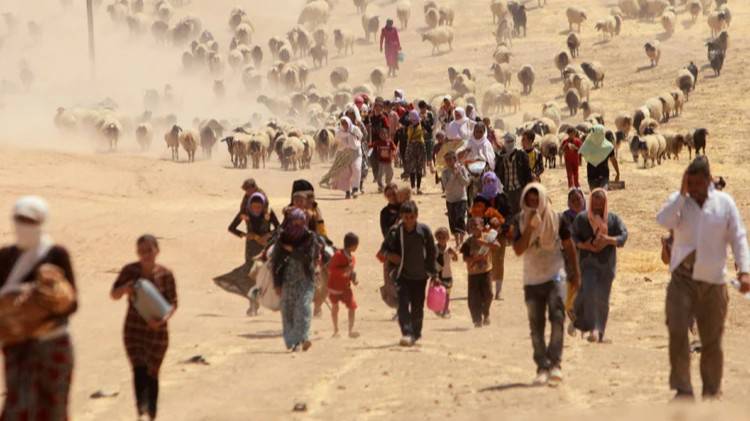
On August 3, 2014, ISIS attacked the Sinjar district of Iraq's Mosul province, killing 2,213 Yezidis, forcing 390,000 people to flee, abducting 7,000 people, and looting 68 religious sites.
According to a report published by the United Nations (UN) Human Rights Council in 2016, ISIS committed the crime of genocide against the Yezidis, enslaving women and children and attempting to destroy the community. Twelve years have passed since the massacre, yet the fate of thousands of abducted people remains unknown, and the perpetrators have still not been brought to justice.
Call for a parliamentary inquiry
Ceylan Akça Cupolo, Diyarbakır MP for the Peoples' Equality and Democracy Party (DEM Party), called for the formation of a parliamentary inquiry commission in the Turkish Grand National Assembly (TBMM) to investigate not only the humanitarian crisis that emerged after the Sinjar massacre but also the violations and allegations of human trafficking affecting Yezidis living in Turkey.
The motion stated that thousands of Yezidis lost their lives during the attacks on Sinjar, while more than 5,000 women and children between the ages of 6 and 70 were abducted. It noted that those abducted were sold in markets established in Mosul, Raqqa, and Tal Afar, and were subjected to forced religious conversion and sexual slavery.
Calls for justice echoed around the world
The European Syriac Union (ESU) and the Bethnahrin National Union Party (HBA) called for the missing to be found, confiscated property to be returned, and for the autonomous governance rights of the Yezidis in Sinjar and the Syriacs in the Nineveh Plain to be placed under international guarantees.
In its statement, the ESU said: "August 2014 marked a profound rupture in the history of Mesopotamia's ancient peoples. On August 3, Yezidi people in Sinjar were subjected to a devastating genocide following ISIS attacks. On August 6, the Syriac (Assyrian-Aramean-Chaldean) people of the Nineveh Plain were targeted, forcing hundreds of thousands to abandon their homes."
In its statement, the HBA said: "On the occasion of the 12th anniversary of the genocide suffered by the Yezidi people and our Syriac people at the hands of the terrorist organization ISIS, the Bethnahrin National Union Party commemorates with profound sorrow and respect the souls of thousands of innocent victims brutally massacred, the women and girls sold as slaves and enslaved, the children robbed of their childhoods, and the families displaced in one of the most horrific crimes witnessed by the modern era."
Meanwhile, a ceremony marking the 12th anniversary of the Yezidi Genocide was held with the participation of Kurdistan Regional Government (KRG) Prime Minister Masrour Barzani. In his speech, Barzani stated that efforts to locate the Yezidis who remain missing are ongoing and reiterated his call for the implementation of the Sinjar Agreement and the establishment of a special court to prosecute ISIS members.
Rights platform established in Diyarbakır
In 2015, the Platform for the Struggle for Women Held Captive was established in Diyarbakır to work for the rescue of abducted and forcibly detained Yezidi women and children and to defend their rights.
Platform member and former Peoples' Democratic Party (HDP) MP Feleknas Uca spoke to MA about the anniversary of the attacks and the platform's work. While drawing attention to the silence of the international community, Uca emphasized the uncertain fate of the 2,700 women still held by ISIS. Stating that the white firman (silent genocide) against the Yezidi community continues in Europe, Feleknas Uca said:
"The white firman continues"
"The grave dangers and fears facing the Yezidi community continue. Before the eyes of the world, the 'white firman' against our Yezidi community continues. They survived one firman, but other firmans still stand before them. They escaped one firman, but through this one, even more has happened—and continues to happen—to them in the diaspora. Today, the fate of 2,700 women remains unknown; they are still in ISIS captivity. Dozens of mass graves have yet to be fully excavated. We are talking about what is officially recorded and known, but there are also countless unknown cases—people whose fate remains uncertain, whose entire families were massacred, leaving no surviving relatives behind.
Mass killings were carried out in every village where Yezidis lived. Women and girls were separated there. The men were gathered together and buried alive in mass graves. Yezidi women were burned alive in cages because they refused to renounce their faith. They were burned alive because they refused religious conversion, their executions were filmed, and those videos were circulated. That is why we say this firman happened before the eyes of the world. The horrific acts committed by ISIS gangs against Yezidi women were broadcast on television channels. What happened to them defies description. It cannot be expressed in words. It is impossible to describe this wound, this pain, because it remains alive before our eyes. Their cries still echo in our ears, and what they endure remains before our eyes."
What had happened?
The European Parliament recognized the massacre carried out by ISIS against the Yezidis on August 3, 2014, as the "Yezidi Genocide."
It was subsequently recognized as "genocide" for the first time by a German court on November 30, 2021. This recognition was later adopted by numerous parliaments and international organizations. The German parliament also recognized the Yezidi Genocide in January 2023.
Although reports prepared by international institutions classify the massacre as a "crime against humanity," it has not yet been officially condemned by Turkey's ruling government.


