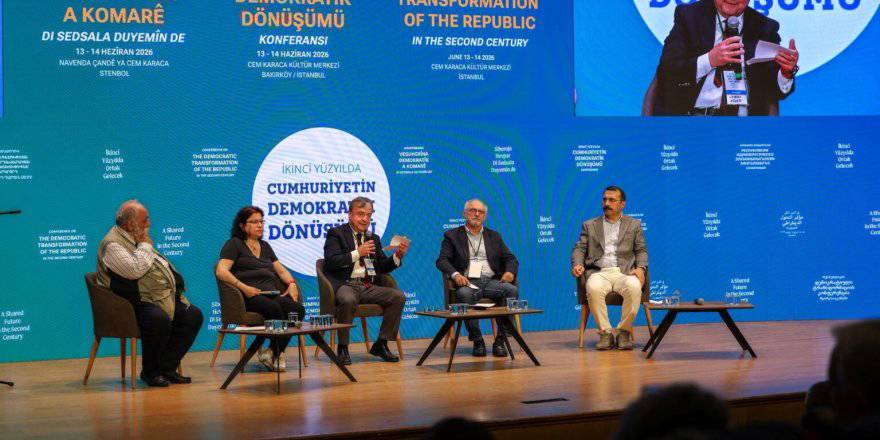


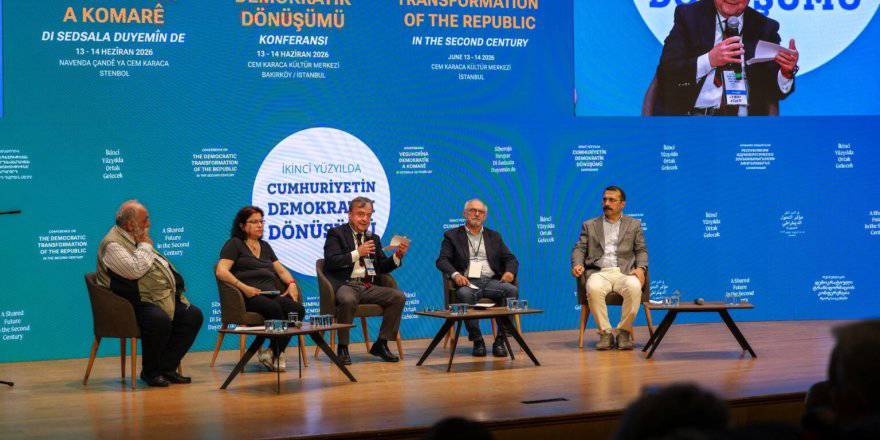
At a time when all kinds of judicial decisions hold a decisive importance over the country's political life, and political party congresses are cancelled by court orders, the series of conferences held last weekend became even more meaningful.
The conference, titled "The Democratic Transformation of the Republic in the Second Century," was held on June 13–14 at the Cem Karaca Cultural Center in Bakırköy, Istanbul.
On May 21, 29 conveners shared the date, venue, and content of the conference with the public through a press statement. As a result, a large crowd began to gather in the hall starting on the morning of June 13.
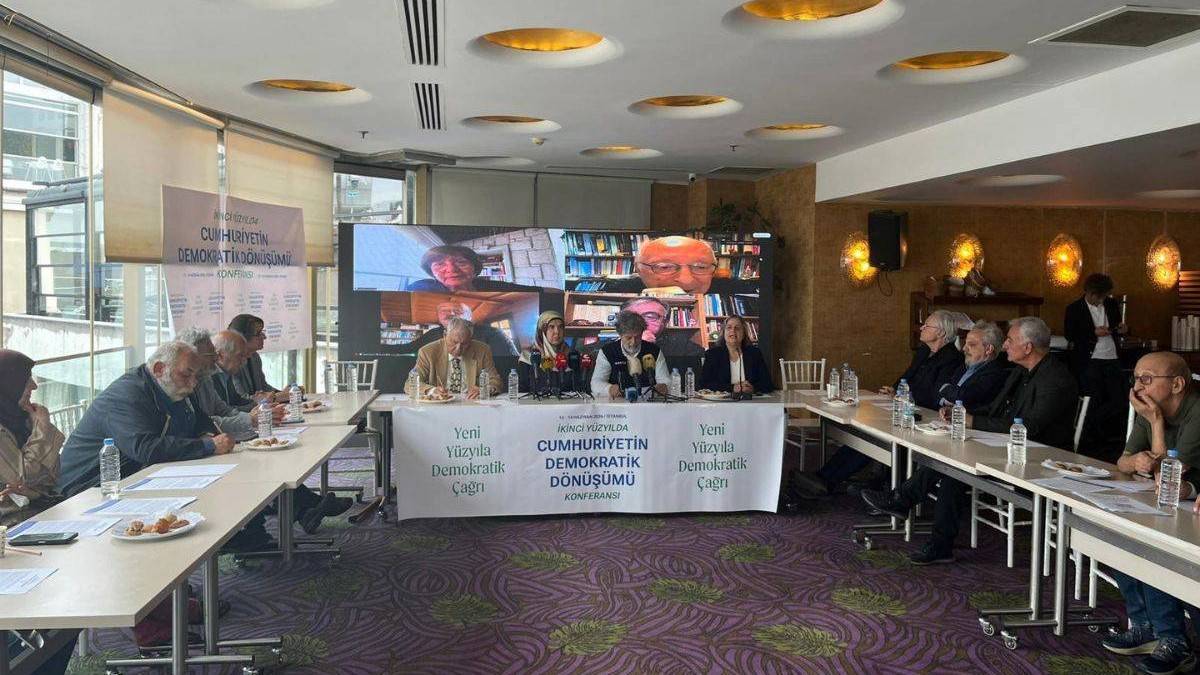
The opening speeches of the conference were delivered on behalf of the organizing committee by former member of parliament Gülten Kışanak and former diplomat Rıza Türmen. Following them, guest speaker Burhan Sönmez took the floor via teleconference. This address was particularly noteworthy as it was enriched with a literary style. Messages were also sent to the conference by CHP Chairman Özgür Özel and DEM Party Co-Chairs Tülay Hatimoğulları and Tuncer Bakırhan. Özel stated, "I find it highly valuable that vital issues such as democracy, peace, equal citizenship, and social consensus are addressed with the participation of different perspectives and experiences," while the message from Bakırhan and Hatimoğulları read: "Our expectation is that in the second century of the Republic, a new understanding of democratic citizenship will strengthen, where no one is excluded due to their identity, language, belief, gender, or lifestyle. Our demand is for the Republic to gain a pluralistic rather than monistic, inclusive rather than exclusive, and libertarian rather than security-oriented character." Additionally, DEVA Party Chairman Ali Babacan and Future Party Chairman Ahmet Davutoğlu sent messages to the conference.
The first session of the first day took place under the moderation of Levent Köker. In the session titled "The Founding History of the Republic, Opportunities, and the Outcasts" presentations were given respectively by Erdoğan Aydın, Hülya Osmanağaoğlu, and Namık Kemal Dinç. As the writer of these lines, I was also among the speakers.
In my speech, while drawing attention to the policies aimed at "reducing" non-Muslim communities throughout the history of the Republic, I pointed out that the Kurdish movement needs to maintain a closer and more embracing relationship with the Syriacs in the region, as the necessity for such a need has been making itself felt for some time.
We witnessed an intensive program with the two-day conference and the closing sessions held in a forum format. We once again witnessed the presentations of individuals, each specialized in their own field. The conference predominantly addressed the opportunities for democratization in the second century of the Republic, the Kurdish issue, the citizenship experiences of women and LGBTI+ individuals, as well as ecology and labor struggles.
The closing declaration of the conference includes the following statements:
“Our conference has pointed to an important historical opportunity. Emerging possibilities for a democratic and peaceful solution to the Kurdish issue represent a historical threshold that will reinforce not just the solution to a single problem, but the democratization of the whole of Turkey. In such a period, introducing regulations that will provide institutional guarantees for peace and freedoms without delay, and taking reassuring steps with a strong political will that confronts past policies of denial and exclusion, restores social trust, and paves the way for democratic transformation, should be viewed not merely as a political preference, but as a responsibility toward our shared future. We believe that such a future can take root where the transformative power of society meets political and institutional transformation. Peace and democracy are two paths reaching to the same horizon, two founding values building the same future.
What is needed in the second century of the Republic, alongside the necessity of democratizing the state, is for society to develop its own democratic organization, expand solidarity networks, strengthen the foundations of shared life, and broaden the social bases of democratic politics. Lasting democratization is a process in which building a democratic society and restructuring the state on the basis of law, freedoms, and equal citizenship nourish one another.”