
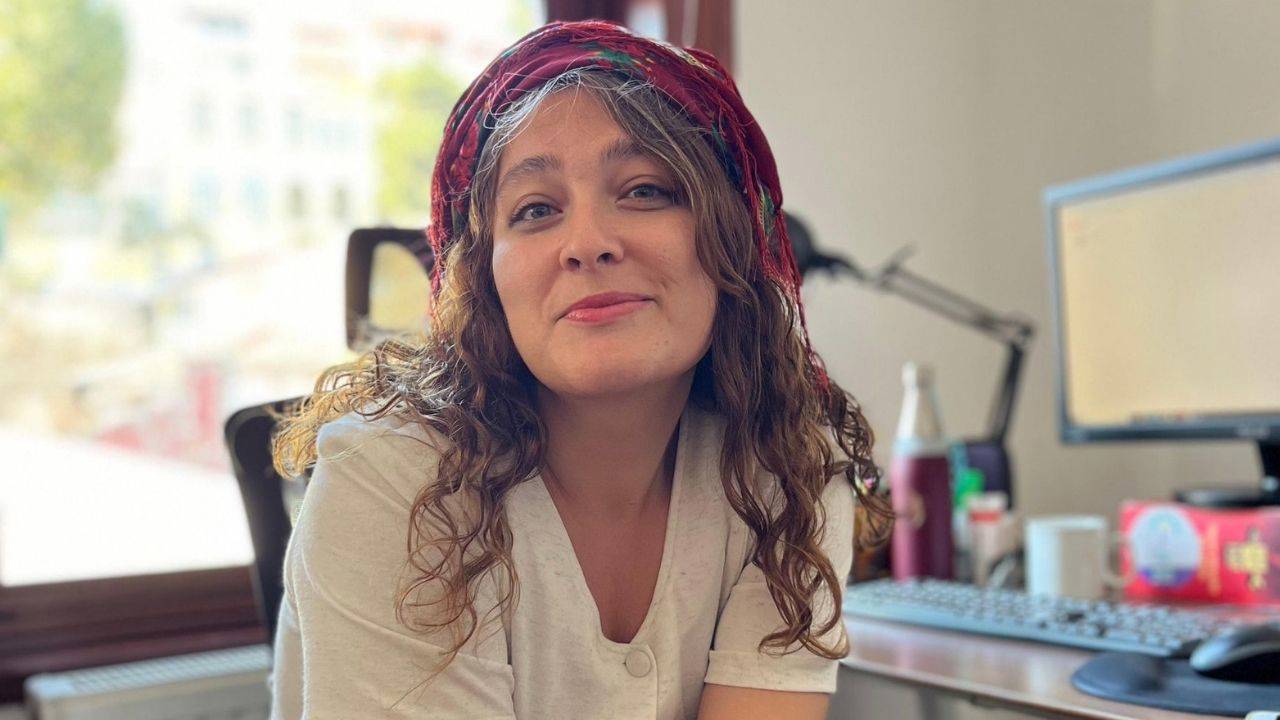
Bianet editor Tuğçe Yılmaz, against whom a lawsuit was filed under Article 301 of the Turkish Penal Code (TCK) regarding a news report featuring interviews with Turkish-Armenian youth, appeared before the judge on Tuesday, December 2.
Yılmaz is being prosecuted on charges of “publicly degrading the Turkish Nation, the State of the Republic of Turkey, the institutions and organs of the State” because of her article titled: "Turkish-Armenian youth speak out: 109 years of lasting mourning."
During the hearing at the Istanbul 2nd Criminal Court of First Instance in Çağlayan, Yılmaz was defended by lawyers Deniz Yazgan, Batıkan Erkoç from the Media and Law Studies Association (MLSA), and Elif Ergin from the Journalists' Union of Turkey (TGS).
A large audience also followed the hearing. Relatives, journalists, and representatives of civil society and freedom of expression organizations were present in the courtroom. Professor of Public Health Onur Hamzaoğlu, Reporters Without Borders (RSF) Turkey Representative Erol Önderoğlu, and Committee to Protect Journalists (CPJ) Turkey Representative Özgür Öğret were among those observing the trial.
Before starting the hearing, the judge ordered the removal of the crowd who could not find a seat in the single row of audience benches and were standing, citing the small size and insufficient ventilation of the courtroom as the reason. The hearing then began with the identification process.
Giving her defense against the indictment, Yılmaz said, "The reason I am here today is that I was reported to CİMER after exercising my freedom of expression, which is protected by law, as a journalist."
Yılmaz stated that she was reported due to a subject that has caused disagreements for years, such as the Armenian Genocide, likely by someone who is bothered by the coexistence of all segments of society and harbors racist tendencies. She then recounted her detention, arguing that the necessary legal period for filing a lawsuit against her had been exceeded:
“On my way home, I was stopped by the police and spent a night in detention under the suspicion of 'fleeing.' Moreover, I later learned that I was being tracked with a facial recognition system like a criminal. This could only happen in a poorly written detective TV series.
Being tried today simply because of a news report I made, at a time when peace discussions are ongoing in the country, constitutes a clear intimidation against our profession. Furthermore, I must remind you that one aspect of this peace process is the relations with Armenia. Years later, Armenian Prime Minister Pashinyan came to Turkey at the invitation of the President, and now the opening of border gates and the start of trade between the two countries are envisioned.
Therefore, I insist on stating that what is sought to be prosecuted here is my profession, which I have pursued with the same excitement and curiosity every day since 2015. As someone who is only trying to perform their job better, I believe there is no legal basis for my prosecution under such a controversial and ambiguous article.
As stated in the charges against me, I did not degrade anyone; on the contrary, I have always listened to those in this society who feel degraded.”
Yılmaz concluded her speech by commemorating Hrant Dink, who was also tried under TCK 301 and subsequently murdered. She requested her acquittal.
Following Yılmaz, Deniz Yazgan took the floor. Yazgan stated:
“I cannot apply to CİMER to prevent an act of violence by a man, but an investigation and lawsuit can be launched—by overriding the deadlines in the Press Law—for the term 'genocide,' which has been unequivocally deemed not to constitute a crime and to violate freedom of expression if subject to trial, by thousands of acquittal decisions, and by violation rulings from the Constitutional Court (AYM) and the European Court of Human Rights (ECtHR). This is in itself a judicial harassment that deters journalists who act as public watchdogs.
Of course, the public prosecutors are aware of these decisions. They certainly know that there is no ban on detention, and that a statement cannot be taken two days after an indictment is drawn up.
Article 2 of the Constitution is clear. The Republic of Turkey is a state of law. We are talking about a constitutional order where this series of illegalities cannot be accepted. Great prices have been paid in this country due to Article 301. Given the Dink v. Turkey decision, the Akçam v. Turkey decision that revealed the historical nature of this concept, and dozens of final decisions, this prosecution must end. We do not want new costs to be added to these already paid.”
Yazgan requested Yılmaz's immediate acquittal.
Lawyer Batıkan Erkoç also argued that the lawsuit was not filed against Yılmaz within the legal time limit. He explained that the prosecutor based the duration for opening the case on the date of the police report (faisleke) from the Directorate of Security. He said, "This has no connection with seriousness."
Secondly, Erkoç stated that the complaint made to CİMER has no legal validity. Arguing that investigations can be initiated through notification, complaint, or ex officio (on their own initiative), Erkoç stated, "What we have here is an investigation opened with a petition. However, according to the Criminal Procedure Law (CMK), this cannot be accepted as a complaint. A petition with hidden identity details cannot exist. The form of a petition is clear. It must include your name, surname, request, and address."
He asked the court to deliver a verdict without obtaining a legal opinion on the merits of the case and without a condition of prosecution being met.
The judge, however, did not comply with this request and asked the prosecution to present its opinion on the merits. The prosecutor then requested time to prepare the opinion. The court accepted the request. The next hearing is scheduled for April 21, 2026, at 2:30 PM.
What Happened?
bianet editor Tuğçe Yılmaz was taken to the Kadıköy Pier Police Station for questioning by police during a General Information Scan (GBT) at Kadıköy Pier in the evening on Tuesday, June 3.
Giving her statement to the investigating prosecutor at noon on June 4, Yılmaz said, “My news report has no connection with Article 301 of the TCK. It is covered by the requirements of my profession, and my professional rights are guaranteed by the Constitution. I prepared the news within this scope. The content only includes the statements of the people I interviewed. I had no intention of degrading the Turkish nation or the State of the Republic of Turkey. I reject the accusations," and was released after her statement at the Istanbul Courthouse in Çağlayan.
Courts Ruled Before: Calling it Genocide is Not a Crime
There are precedents in Turkish courts that previously ruled that defining the Armenian Genocide does not constitute a crime. For example, on July 2, 2024, journalists Haluk Kalafat and Elif Akgül were acquitted in a case where they were tried on charges of "publicly degrading the Turkish nation (TCK 301/1)" due to six news reports published on bianet in 2015, 2018, and 2019.
In 2018, three members of the Human Rights Association were detained for carrying banners mentioning the Armenian Genocide during a press statement that was not permitted on April 24. The prosecutor decided not to prosecute, explaining that the word 'genocide' should be evaluated within the scope of freedom of thought.
Another example: The Diyarbakır Bar Association held press releases titled 'April 24/The Great Calamity: Sharing the Pain of the Armenian People' on April 24, 2017, and 'Sharing the Unending Pain of the Armenian People' on April 24, 2018. A lawsuit was filed against 10 members of the bar's executive board, including the then Bar President Ahmet Özmen and the subsequent Bar President Nahit Eren, for using the term genocide in the statements. Following the defenses, the court acquitted all defendants on the grounds that the legal elements of the crime had not been constituted. The Diyarbakır Bar Association had previously faced lawsuits for its statements on the Armenian Genocide, which also resulted in acquittals.
(bianet, Agos)