

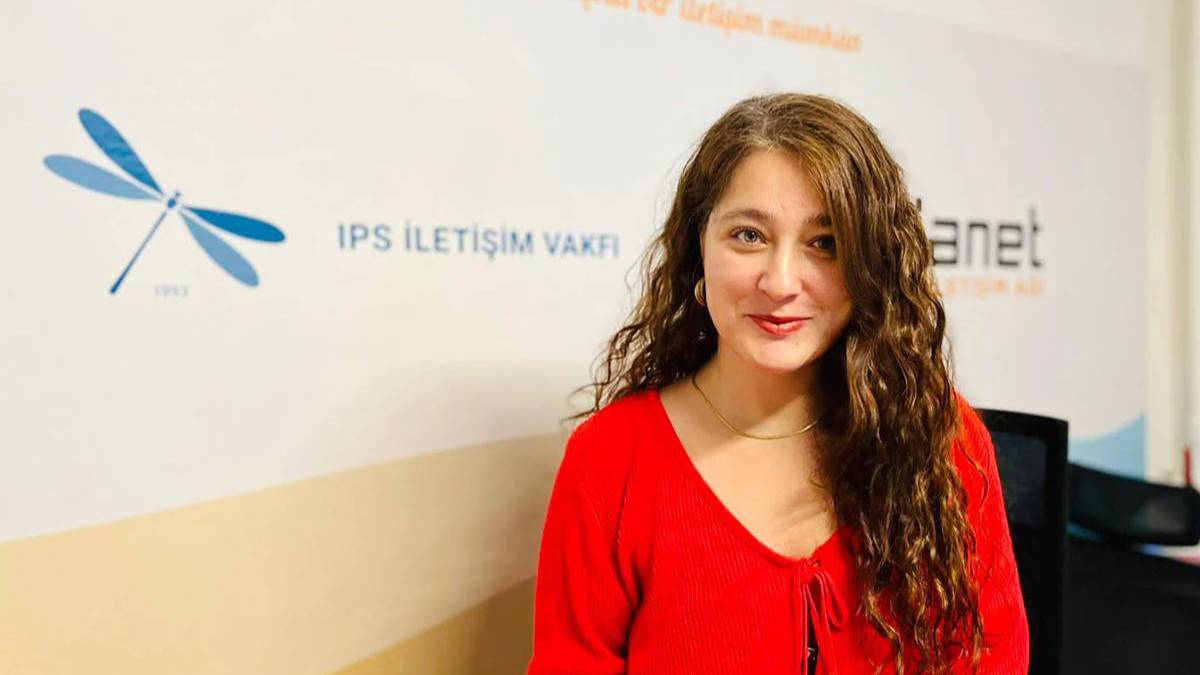
The hearing in the case against journalist Tuğçe Yılmaz, who was charged with “publicly denigrating the institutions of the Republic of Turkey,” took place at the Istanbul 2nd Criminal Court of First Instance. Attending the hearing with her lawyer, Deniz Yazgan, Yılmaz said she would continue her journalistic work.
Reading aloud the condolence message that President Recep Tayyip Erdoğan had sent to the Armenian Patriarchate on the anniversary of the Armenian Genocide, Yılmaz said: “The prosecutor cannot bring a case because of this condolence message. I am a journalist, and this year, too, I will report on the condolence message the president sends.”
Yılmaz also addressed the complaint submitted through CİMER, Türkiye’s Presidential Communication Center, saying: “I am being prosecuted on the basis of a CİMER message that may have been sent by someone who is not mentally sound.”
Stating that she would continue working as a journalist, Yılmaz said: “Like President Erdoğan, I advocate peace between the Armenian and Turkish peoples.” Yılmaz paid tribute to Hrant Dink, the founder of our newspaper, who was also prosecuted under Article 301 of the Turkish Penal Code, and requested her acquittal.
Lawyer Yazgan: The deadline for filing the case has passed
Deniz Yazgan, Yılmaz’s lawyer, stated that the case had been filed two years after the complaint against her was submitted to CİMER and that the identity of the person who made the complaint had still not been established.
Drawing attention to deficiencies in the case file, Yazgan cited European Court of Human Rights (ECtHR) rulings concerning Article 301 of the Turkish Penal Code and said that the deadline for initiating proceedings, as stipulated in Article 26 of the Press Law, had expired, and accordingly the case should be dismissed.
Paying tribute to Hrant Dink, Yazgan stressed the need to confront “the darkness that turns a child into a murderer,” the phrase used by Dink’s wife, Rakel Dink, following his death.
The prosecutor reiterated the final opinion on the merits, requesting that Yılmaz be sentenced. When asked to make her final statement, Yılmaz said: “I want to have faith in the law. I hope that the decision you make in the Turkey–Armenia normalization process will help bring about positive outcomes.”
The court determined that the case had not been filed within the four month statutory period prescribed by the Press Law and ruled that it be dismissed.
What had happened?
On June 3, 2025, journalist Tuğçe Yılmaz was stopped during an identity check conducted by the General Information Collection (GBT) system at Kadıköy Pier, in Istanbul, in connection with an investigation launched over an interview she had conducted on April 24, 2024, with two young Armenians about the Armenian Genocide and what it means to be Armenian in Turkey.
Yılmaz was told that an arrest warrant had been issued against her. She was taken to the Kadıköy Pier Police Station and spent the night in custody. She was released the following day after giving a statement to the prosecutor.
An investigation under Article 301 of the Turkish Penal Code had been launched against Yılmaz following a complaint submitted to Presidential Communication Center, CİMER, after the interview was published on April 24, 2024. The complaint alleged that using the term “genocide” in reference to the events of 1915 incited the public to hatred and hostility.
In her statement, Yılmaz maintained that her report had nothing to do with Article 301, explaining that she had merely reported the statements of the people she interviewed and was carrying out her journalistic duties.
(Source: MLSA — Media and Law Studies Association)


