


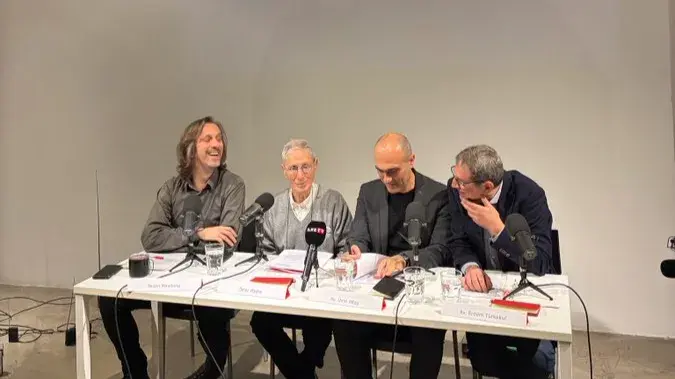
The terrestrial broadcast license of Açık Radyo—which was founded in 1995 by a group of entrepreneurs coming together like a cooperative and putting in money, and is known for being "open to all the sounds of the universe"—was canceled about two years ago.
It all started when the Radio and Television Supreme Council (RTÜK) imposed an administrative fine and a 5-time broadcast suspension on the program Açık Gazete and Açık Radyo due to a guest using the term "Armenian Genocide" in the program on April 24, 2024.
Following the fine and suspension penalties, RTÜK canceled Açık Radyo's broadcast license on the grounds that it did not implement the broadcast suspension decision. Let's make a note here: The Açık Radyo team, who paid the administrative fines, stated that they could not access the attachment containing the broadcast suspension dates in the board decisions notified electronically by RTÜK due to technical reasons. During this process, radio lawyers asked RTÜK officials when the broadcast suspension dates would be notified, and received the answer that "the information was in the attachment of the notification and the dates had already passed." In their application on July 2, 2024, RTÜK was informed that the relevant attachment could not be opened and therefore the dates were unknown, and a new date was requested from the institution in writing. However, RTÜK did not respond to the application and canceled the radio's license on the grounds that the broadcast suspension measures were not complied with. Consequently, Açık Radyo's terrestrial broadcasts were stopped by RTÜK on October 16, 2024. The radio began its internet broadcasts on November 8.
Following these events, the legal struggle continues both for the resumption of Açık Radyo's broadcasts and on the basis of freedom of expression.
Ömer Madra: This process is a blatant injustice
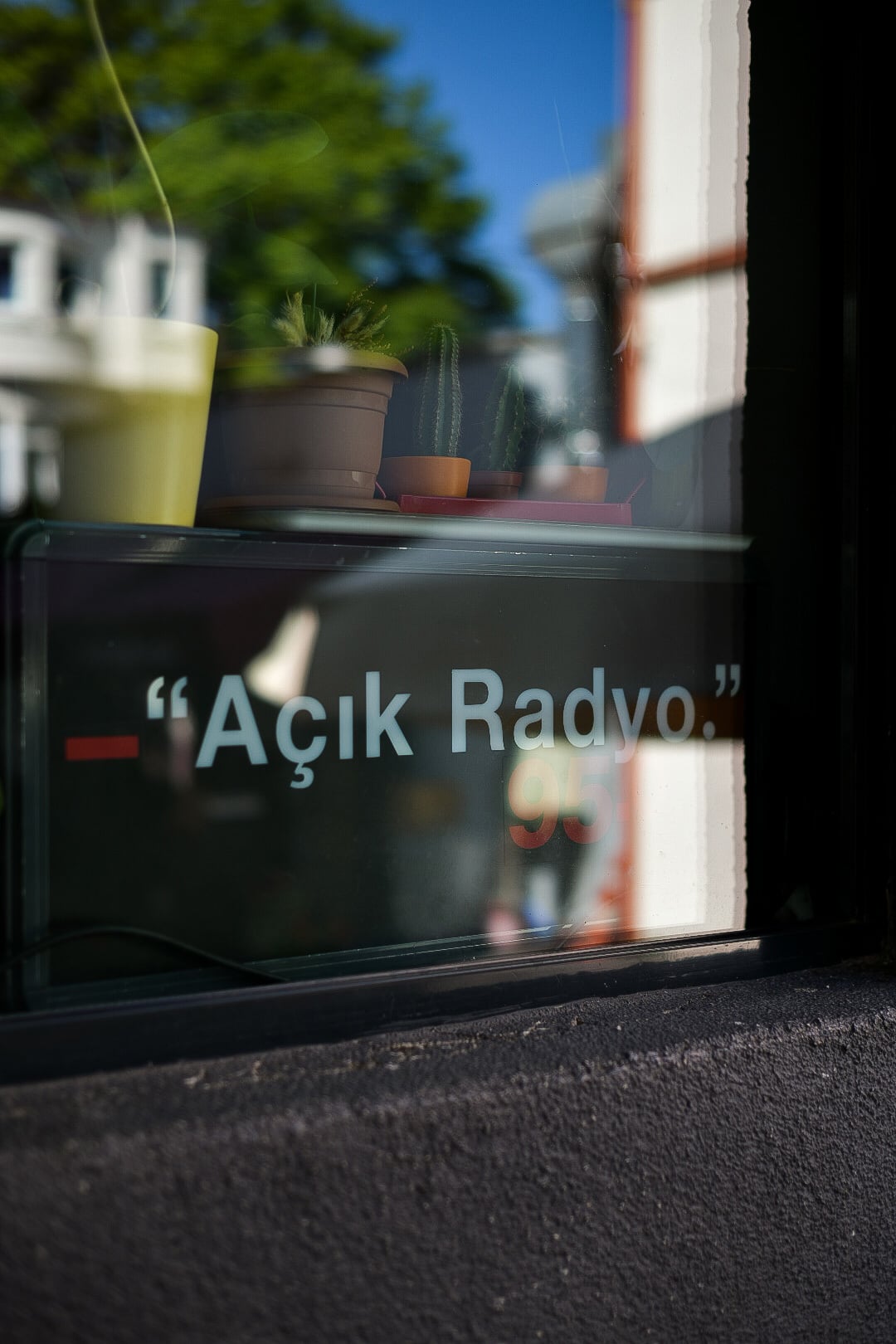 After nearly two years, Açık Radyo and its legal team organized a press and public meeting to share developments regarding the ongoing judicial process with the public. At the meeting held on Tuesday, March 31 (today) at Tütün Deposu (Tobacco Warehouse), the radio's co-founder and editor-in-chief Ömer Madra, broadcast coordinator İlksen Mavituna, and Açık Radyo lawyers Ümit Altaş and Erdem Türkekul made statements regarding the process and answered questions.
Ömer Madra began his speech with the words, "We are in one of the most terrifying periods of modern history on earth. The world is in a great crisis; we are in a mud pit where we are submerged up to our throats." Describing the process as "a blatant injustice and a wall we face" while explaining the legal struggle waged by Açık Radyo, Madra used the following expressions:
"For the last year and a half, we have been quietly trying to express this 'blatant' injustice. However, despite all the in-depth legal opinions, all the technical expert reports, all the legal precedents, and all the evidence we have presented, the only answer we get in the lawsuits is the sentence 'In accordance with the law,' which is built in front of us like a wall. To say it as an allusion to the great poet Tevfik Fikret: 'In the name of the law, the law was trampled upon...'
Throughout the case, we tried to address important points regarding freedom of expression, the right to receive news, the right to access news, and the duty to report news. By the very nature of independent broadcasting, neither Açık Radyo nor any other media organization subjects its guests or programmers to a self-censorship mechanism. Penalizing a broadcasting organization over the pronunciation of certain concepts is a common problem not only for Açık Radyo but for all serious media organs and organizations in Turkey, and poses an extremely serious problem for the freedom of broadcasting in the country."
"You cannot say 'Armenian Genocide' on the radio"
Following Madra, lawyer Ümit Altaş took the floor. Altaş began by saying, "Mr. Ömer gave the simplest summary of this struggle we have been waging for two years with the concepts of 'blatant' and 'wall.' We are faced with a blatant injustice; despite all our statements, there is constantly a wall in front of us," and then explained the legal process.
Altaş stated that the lawsuits filed by Açık Radyo were rejected. He conveyed that in the court's reasoning, the individual use of the term "Armenian Genocide" was considered within the scope of freedom of expression, but the same expression was not seen within this scope in a radio broadcast:
"On June 14, 2024, we filed a cancellation lawsuit in the Ankara 21st Administrative Court. In our petition, we demonstrated that the expressions in question were within the scope of freedom of expression; and that imposing a penalty due to the words of a guest participating in a live broadcast, without evaluating the purpose of providing news, was unlawful.
We relied on the precedents of the Constitutional Court, the Council of State, and the ECHR, as well as academic opinions. However, we were faced with a wall again. The court rejected the lawsuit. In the reasoning, it was stated that the expression 'genocide' could disturb a section of society. What is even more striking is this: It was said that if this expression is spoken individually, it can be considered freedom of expression, but when a radio broadcast is in question, it cannot be evaluated within this scope. In other words, the court adopted an approach that restricts freedom of expression based on the medium.
The court played the role of the academy without making any statement regarding the determination of 'historical reality,' and did not provide any explanation as to how the expressions 'referred to as genocide' and 'Armenian genocide commemoration' used by our guest could 'provoke the public to hatred and hostility and create feelings of hatred,' nor how it posed a clear and present danger.
Our detailed appeal against the rejection decision was rejected by the Ankara Regional Administrative Court's 10th Administrative Law Chamber with only a single-sentence justification: 'The decision is in accordance with procedure and law, and there is no reason requiring its reversal.' Finally, on February 20, 2026, a cassation appeal was filed with a request for a stay of execution and a hearing. The file is under review at the Council of State."
"This is a struggle for freedom of expression"
"In this process that has been going on for nearly two years, the heaviest administrative sanctions were applied to our radio by picking out words out of context, without evaluating the whole and the purpose of the program, due to an expression used by a guest participating in a live news broadcast, which is clearly within the scope of freedom of expression according to both established national and supranational jurisprudence. The activities of a broadcasting organization were completely stopped in an unfair manner with a disproportionate and unmeasured intervention, without evaluating the petitions, evidence, and statements we submitted.
This picture is not just an action against our institution; it is a serious violation of freedom of expression, press freedom, and the principle of the rule of law. Our legal struggle continues before the Council of State. Our goal in this process is to defend not only the rights of our institution but also freedom of expression, the freedom and right to receive and provide news, which should apply to everyone."
Will we not be able to say "Armenian Genocide" on Radio Agos?
Following the statements, questions were taken from members of the press. After stating that this penalty given due to the expression "Armenian Genocide" also closely concerns Radyo Agos, which is broadcast on Açık Radyo, Agos asked the question: "Will we not be able to say Armenian Genocide in the programs from now on, what will we say as an alternative? Have you made any decision on this matter?"
Ömer Madra answered the question by saying, "I don't think there is anyone among us who knows the answer to your question," and then continued:
"There is a 'Kafkaesque' situation; we are actually inside the novel The Trial. We are actually inside a book that we cannot stop ourselves from reading, even if it thoroughly squeezes one's soul. Or, quoting Ahmet Hamdi Tanpınar: 'Neither am I within time, nor fully outside it.' We feel the exact same thing. Our being kept in this uncertain environment might be exactly what those who closed Açık Radyo wanted. I cannot say anything definite regarding 'incitement to crime' (laughter), but we will continue freely."


