

One of Armenia’s most established cinema events, the Yerevan Golden Apricot International Film Festival, is meeting audiences for the 23rd time between July 12–19.
This year, the documentary project “Seeds of the Same Pomegranate” from Turkey has also been invited to the festival’s Work in Progress section, which brings together projects in post-production with international film professionals. Previously honored at the Istanbul Film Festival’s Meetings on the Bridge platform, the project is now preparing to be presented to an international community of cinema professionals.
We spoke with director Şeyla Korkut, whose work focuses on identity, memory, belonging, and intergenerational transmission, about both her film and this personal journey. Korkut’s story is about being able to look at each other’s stories not with hatred, but with love. Many Agos readers grew up with similar stories. As Ms. Şeyla tells her own story, we find ourselves buried in our own memories. This is not only her story; it is the story of everyone who has been othered, everywhere and anywhere.
How did you learn that you had Armenian roots, and could you tell us about your family’s story?
My mother is from Kulp, Diyarbakır, and my father is from Hakkâri. I was born in Hakkâri, and we moved to Van when I was ten. As a child, I thought we were simply a Kurdish family. But over time I learned that my mother’s family was Armenian. It wasn’t a secret, but it was only during my adolescence that I understood Armenian identity as something distinct from Kurdish identity. My maternal grandfather, Dikran, was an Armenian from Kulp who lost his entire family as a child in 1915 and survived only by chance. The Kurdish village headman of Serde (Lice) took him in to work in his orchard, saving his life, and gave him the name Hasan. My grandmother’s family was also an Armenian family from Kulp that had suffered enormous losses. Both families were Islamized. Even so, my grandfather and grandmother somehow grew up knowing they were Armenian, and they were married with that awareness in mind.
In fact, we did not discover our Armenian identity later in life. What we did not know was what being Armenian actually meant; we only knew fragments of what had happened. Nothing remained of this identity except traces as its language and religious practices had disappeared, while certain cultural remnants continued to live on. In a sense, all we had left were traces and stories. As a child, I listened to them as though they were fairy tales told by my elders. As I grew older, I began to realize that they were not just family memories, but also a part of my own identity.
Severe trauma can transmit fear and anxiety across generations. Were there similar traces in your family? For example, how were words like “infidel,” “orphan,” or “lost” received in your household?
I feel this very strongly. For example, as my grandfather had been orphaned the word “orphan” was never an ordinary word in our home. He had a deep sense of compassion and protectiveness toward children. Especially when I hear anti-Armenian hate speech, phrases like “they deserved it” or “they were infidels” , I cannot experience it as an ordinary debate. It creates a tension inside me that is difficult to describe. Sometimes I argue passionately; other times I choose to walk away. But perhaps what affected me most was the silence of my mother and my aunts in such moments. I could always sense the tension they experienced when hearing such remarks, yet they usually said nothing. Years later, that silence came to mean so much to me. I think it was not simply a matter of remaining silent; it was the result of spending years unable to find a place for oneself, of being invisible.
Why did you decide to take a DNA test, and what happened afterward?
I carried a small hope that someone from a family torn apart a hundred years ago might still be alive. Throughout my life I often wondered: could we have relatives somewhere in the world? My grandfather had survived as a child all alone. No one knew what had happened to the rest of his family. My grandmother’s family had also lost many relatives. Perhaps it was the realization that my own sense of limbo and emptiness had filtered down from their stories that led me to this search.
In 2023, I took a DNA test. To be honest, I did not have great expectations. But when the results arrived, I had one of the most life-changing experiences of my life. I discovered that I had many second-, third-, and fourth-generation relatives living around the world. The first people to contact me were my cousin Zohrab and his mother, Anahit, who live in the United States. They told me they had found a relative in their ancestral homeland for the first time and wanted to come to Diyarbakır to meet us. I will never forget the excitement I felt at that moment. Two families separated a century ago were about to reunite for the first time in a hundred years. We gathered our entire family, my aunts and cousins, and the great reunion took place in Diyarbakır. In this way, 85-year-old Aunt Anahit’s final wish came true. For hours we shared our stories and emotions in the courtyard of Surp Giragos Church. No one in our family spoke Armenian. Our greatest blessing was that Aunt Anahit still knew Kurdish.
To see that a family story left unfinished a hundred years ago could still continue today was both deeply moving and hopeful. For the first time, the pieces were beginning to come together. The film tells precisely the story of that journey.
How did “Seeds of the Same Pomegranate” come about?
The seed of this journey was my lifelong feeling that I never fully belonged anywhere. We spoke Turkish at home. I never learned Kurdish or Armenian. So, there were times in Hakkâri and during our summer visits to Kulp when I was excluded for not speaking Kurdish. Later, I faced prejudice because I was Kurdish among Turks, because I spoke Turkish in Armenia, and because I spoke openly about my Armenian identity in Turkey. All of this left me with a constant feeling of not belonging anywhere and never feeling completely safe.
For years, I had wanted to document my family’s story. As our elders passed away, memory disappeared with them. When I was studying filmmaking, and I felt that documentary cinema was the most appropriate form to tell this story. I also believed the process would help heal my own feeling of being suspended between worlds. What began as a desire not to fight my past but to understand it, and to love myself in my wholeness, gradually became the question: “How do we learn to love each other?” I hope this film can become a way of looking at one another’s stories not with hatred, but with love.
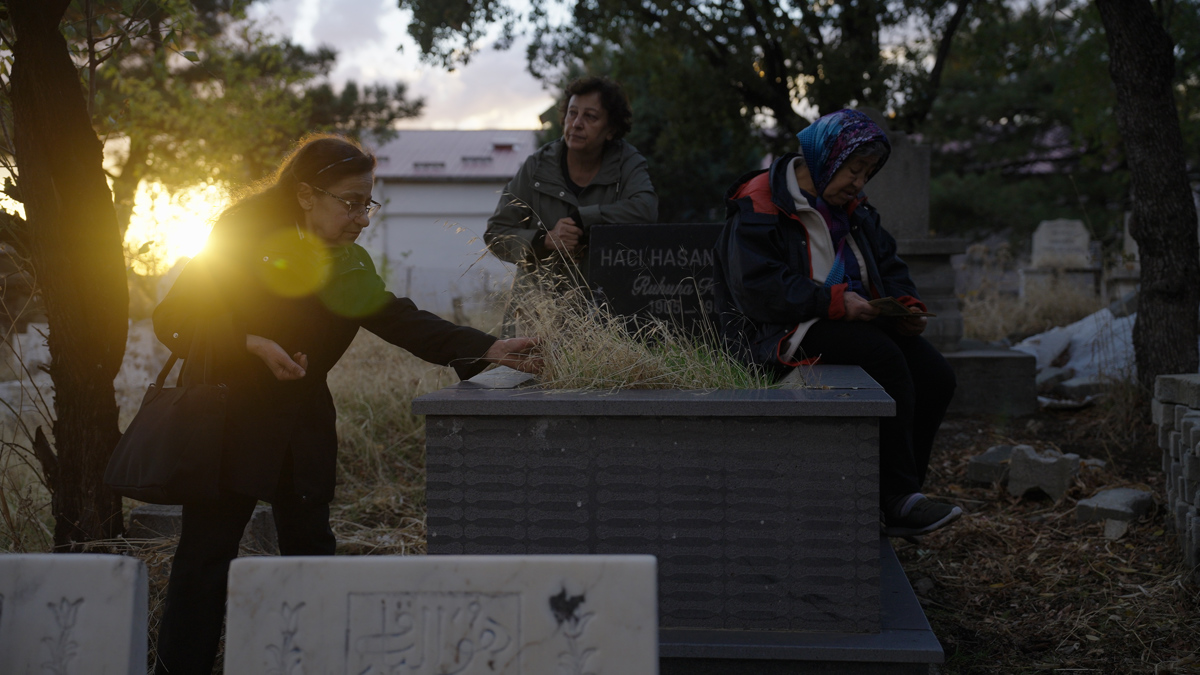
The film includes scenes from your family’s story. You, your mother, and your aunt remember the past together. What was it like to revisit these memories in front of the camera?
What struck me most while making this film was realizing that the stories I had listened to throughout my childhood were not fairy tales. The stories my grandmother and my aunts told always felt like they belonged to a distant past. But when we began talking about them again in front of the camera, I felt for the first time, with their full weight, that these had been real lives.
The emotions my mother and aunt experienced while telling these stories affected me deeply as well. Sometimes memories that had gone unspoken for years surfaced. Sometimes there were long silences. Sometimes we cried together. In truth, we were not only remembering the past; we were passing through a grief that had never been named. Perhaps, thanks to this film, that grief found its name for the first time. For me, the process also allowed me to reconsider my family with a fresh look. I began to better understand their silences, their fears, and their behavior. That is why the film does not simply tell the story of the past; it also creates a transformation within our family.
You visited the Tsitsernakaberd Genocide Memorial in Armenia with your mother and your aunt. What kind of impression did that journey leave on you?
That journey was a profoundly moving experience for all of us. It was the first time my mother and my aunt had ever been to Armenia, and the first time they had entered active Armenian churches. To stand in a land they had heard about in stories since their childhood but had never seen was an indescribable feeling for them. On one hand, there was a powerful sense of belonging; on the other, there was a deep feeling of alienation. We were in a place whose language we did not know, yet where our roots lay. We felt both very close and very distant.
It was a difficult but very real confrontation. The moment we visited the Tsitsernakaberd Genocide Memorial was especially overwhelming for all of us. Together we laid flowers, and in that moment I felt that we were mourning not only for our own family but for everyone who had endured the same suffering. Even though we could not speak the same language, we shared the grief of the same loss. Perhaps that is what this film has taught me most of all: sometimes a shared memory is far more powerful than a shared language.


