


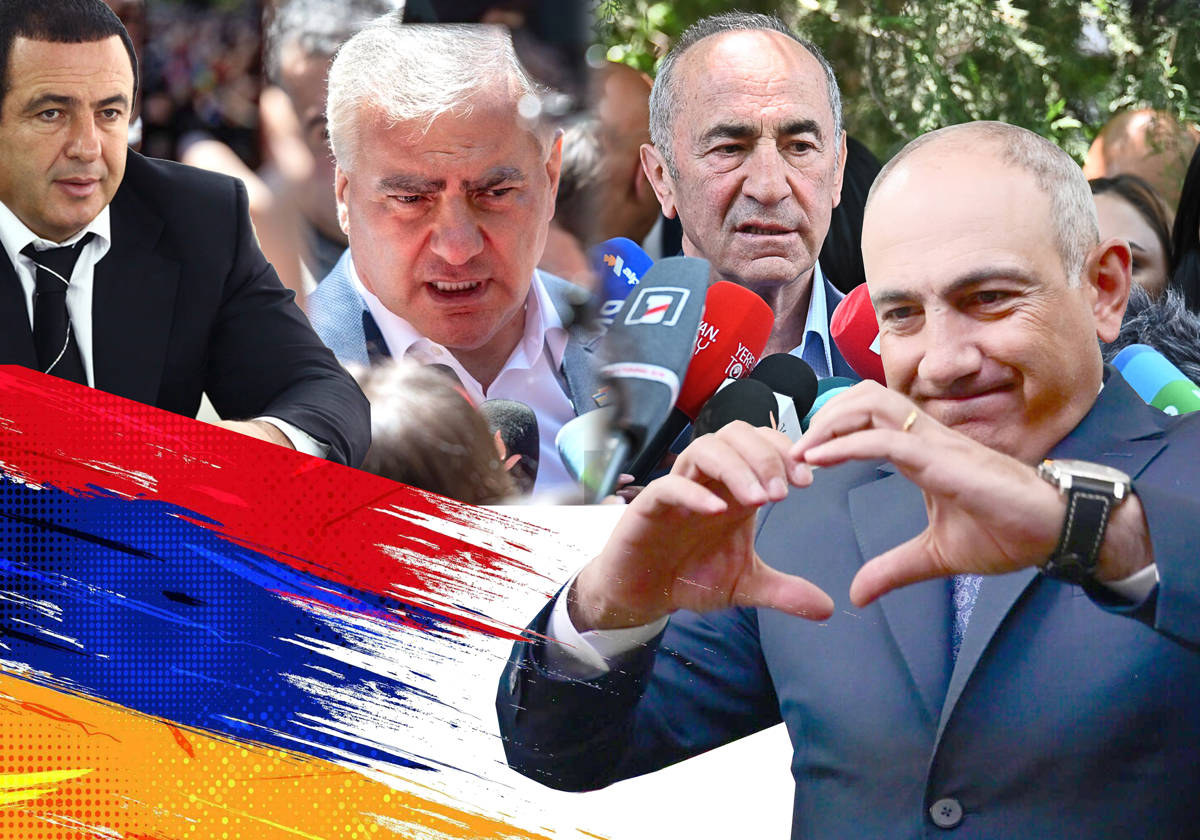
In previous weeks, we tried to understand through various articles what the real question of Armenia’s 2026 election might be. Ultimately, we wondered whether voters would answer the question "Who governs better?" or "Which risk is more bearable?" When the ballot boxes closed on the evening of June 7, the picture became clear, even if it was not yet finalized. The turnout rate rose from approximately 49 percent in 2021 to 59 percent, recorded as the highest-turnout election in Armenia since 2017. This was driven by calls to the polls from both the government and the opposition, albeit for different reasons, and the impact of a month-long propaganda period.
While the Civil Contract party received approximately 50 percent of the vote, the Strong Armenia Alliance garnered 23 percent, and the Armenia Alliance took 10 percent. Prosperous Armenia, on the other hand, remained just a hair below the 4 percent threshold at 3.99 percent, and whether it will enter parliament is still uncertain as this article is being written. This uncertainty will directly affect the number of seats in parliament. If the Prosperous Armenia Party (PAP) stays below the threshold, Civil Contract’s number of seats will be 64, have the 3/5 majority of seats which is critical for certain appointments. However, if the PAP enters parliament, the ruling party's number of seats will drop to 61. In this case, it will also lose the 3/5 majority required for certain appointments. Ultimately, although the opposition increased its vote count, Civil Contract emerged as the clear winner by a wide margin.
Why was Pashinyan elected?
The reason for this is not that the electorate loves Pashinyan intensely. At the end of May, Moscow's export bans, the recall of its ambassador, and hints of a "Ukraine scenario" may have triggered a national reflex rather than generating fear. In all likelihood, the war in Iran, the fragile peace with Azerbaijan, and regional uncertainty completely wiped out the voters' appetite for risk. In such a climate, "predictability" won out over "better governance." However, considering this purely as a fear reflex would be incomplete. Deeper down, it may also be an indirect endorsement of the ideology of a "Real Armenia" (considering recognized borders as the homeland, rather than imaginary geographies). The electorate may have turned away from politics that sanctify trauma and the nostalgia of a lost homeland, choosing instead a pragmatic nation-state with defined borders. Therefore, the votes received are not merely a declaration of love but also show that the electorate has made a cold-blooded calculation of risk. This describes Pashinyan’s fragility just as much as it does his strength.
Civil Contract’s vote share
On the winning side of the ledger for Civil Contract is that it won the first regular election held since 2017 by a wide margin, despite a likely loss of seats in parliament. By winning this election, Pashinyan has set himself on track to become the longest-serving prime minister in the history of independent Armenia. Unlike the low-turnout, bloated proportional victory of 2021, this time he won with a high turnout, increasing his absolute votes. In other words, the potential "illusion of legitimacy" we described earlier has given way to genuine popular approval and authorization. Moreover, this authorization can also be read as an "endorsement of a Western orientation" obtained despite open pressure from Russia.
No majority for the constitution
Nevertheless, a 3/5 majority in parliament is required for many regulations pertaining to changes in the election law, appointments for the Constitutional Court, the high judiciary, the Ombudsman, and the Central Election Commission. This means that if the Prosperous Armenia Party enters parliament, the ruling party will not be able to choose or dismiss members of these institutions by acting alone. More importantly, even if a 3/5 majority is secured, the ruling party remains far from the 2/3 majority required to initiate constitutional changes or take fundamental articles to a referendum. Consequently, the election result grants Pashinyan the authority to govern the country, but it does not grant him the authority to rebuild Armenia single-handedly.
Topics such as the Constitution, the Fourth Republic, the final peace agreement with Azerbaijan, and sovereignty debates are issues too deep to be resolved by parliamentary arithmetic alone. If Pashinyan reads this result as "the people gave me the authority to do anything," today's victory could turn into tomorrow's crisis. But if he reads it as "the people gave me the authority to continue, but I need to generate broader social consensus," this election could turn into a new threshold for the maturation of Armenian democracy. Constitutional change is not merely a technical adjustment; it signifies a founding choice regarding how Armenia will define itself.
The opposition front
The balance sheet is also mixed on the opposition front. Strong Armenia consolidated the vast majority of the scattered pro-Russian opposition under a single address. Since this movement apparently did not carry the leading figures of the old regime, it offered voters a "low-cost protest alternative" and attracted votes well above what polls predicted. Furthermore, the fact that the total vote share of the three pro-Russian/conservative forces is around 37 percent shows that this segment is not a marginal opposition, but a real, mobilizable base.
The historical loss for the opposition, however, is that the electorate clearly detected the old system's elites and bureaucratic networks surrounding the movement. In the eyes of society, these cadres are coded as "local representatives of old ideological obsessions and foreign tutelage." These names marching to power could mean a return to Russia's orbit, closed borders with the West, and an oligarchic restoration. Furthermore, as the opposition remained hostage to the language of revenge and nostalgia of its base, it failed to offer voters a bloodless, warless, and positive narrative for the future.
The ballot box is still decisive
This election also carries dual meanings for Armenian democracy. The positive side is that the ballot box is still decisive, and the electorate has not detached from politics. The government drew its legitimacy from the election, but the opposition was carried into parliament with greater strength. This is a democratic resilience that should not be underestimated for a society that has experienced war and trauma.
The fragility in terms of election results is that the Western-oriented, liberal-democratic axis in parliament is represented solely by the ruling party, and this will create a vacuum. The failure of reformist-liberal "third way" parties to enter parliament leaves voters who are uncomfortable with Pashinyan—but do not want to return to the old regime—trapped between two major fears once again. On one hand, the fear of war, instability, and drifting back toward Russia; on the other hand, the fear of power concentrating in a single hand, rapid constitutional transformation, and a peace process advancing without social consensus.
A new beginning and a new question
This vacuum may provide an advantage to Pashinyan in the short term, because the government faces an opposition that is strong but has still not cut its ties with the past. However, in the medium term, this situation poses a risk for Armenian democracy. If Civil Contract wears out by the time of elections in the coming years, a strong, civilian, reformist, democratic, and Western-oriented alternative to replace it is not visible on the horizon today. Such a vacuum does not strengthen democracy; on the contrary, it could trap politics once again in the dilemma of "survival" versus "revenge."
As of June 8, there is now a new beginning and a new question. Will Armenia be able to establish peace and a new constitutional order through a social consensus generated by trust rather than fear? The answer to this question lies not in the finalized percentage of votes, but in the debates on the constitution, peace, and democracy that will unfold from this point forward.
The election may be over, but Armenia's struggle on the path to an advanced democracy is truly just beginning.


