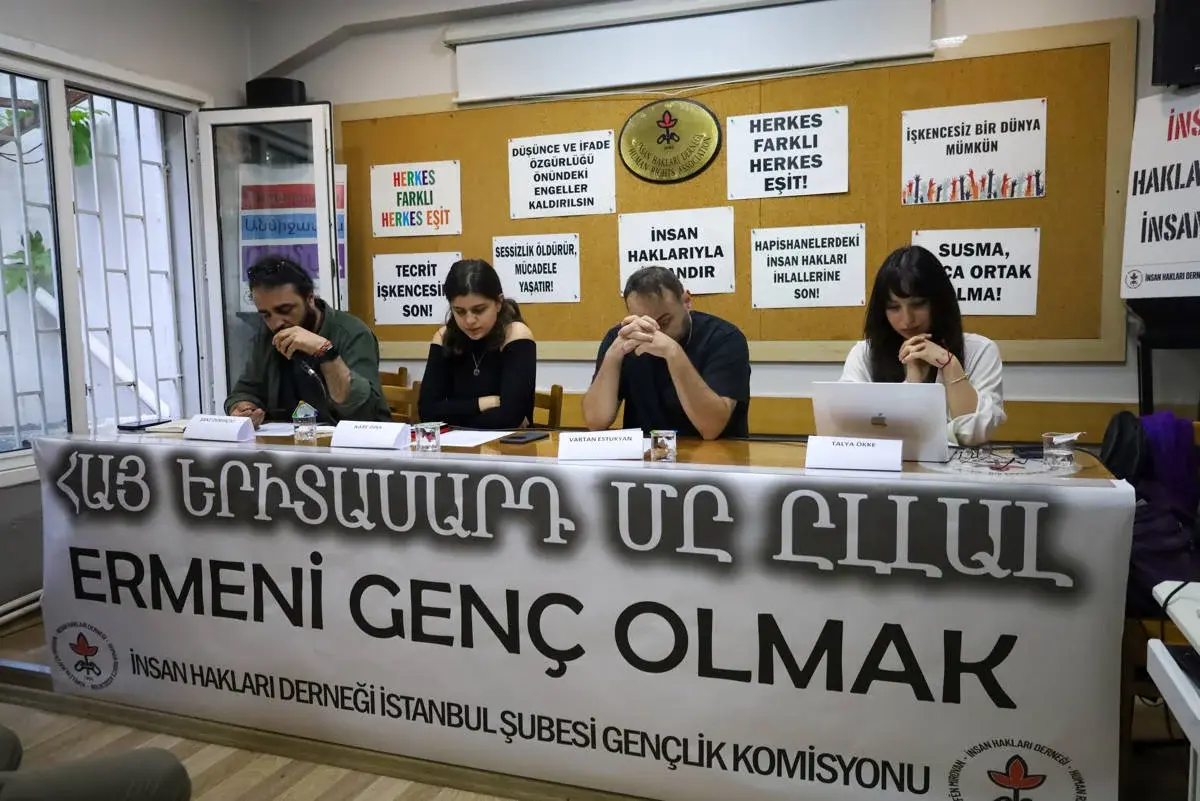

Speaking at the opening of the panel, human rights activist Eren Keskin drew attention to the “world of lies” constructed by the official ideology from childhood onward, emphasizing that breaking down these taboos is only possible through dialogue. In her speech, Keskin recalled the following words by writer Rıfat Bali:
“Rıfat Bali writes: ‘We, the Jews, chose invisibility in order to survive.’
And added the following words:
"In this region, thousands, even millions of people are living by choosing invisibility.”
Everyday Discrimination
The stories of daily life shared by the panelists clearly demonstrated what this “forced invisibility” actually entails. The questions like “Are you Turkish?” encountered everywhere from university hallways to public transportation, and the new attitudes adopted when one’s Armenian identity is revealed, laid bare the silent exhaustion accumulating within individuals. Nare Dink noted that the sudden shift in people’s tone of voice and gaze when she shared her identity, particularly in academic settings, is the most palpable form of everyday discrimination.
Panelist Vartan Estukyan, meanwhile, explained this situation in terms of a choice to “hold back” and “avoid exerting effort.” Sharing that he uses the name “Can” to avoid having his name mispronounced at any coffee chain or to prevent potential questions about his identity, Estukyan touched on the historical significance of this name within the Armenian community in Turkey. Recalling that boys were often given second names like “Şahin” or “Can”—names that didn’t sound foreign—to help them avoid difficulties during military service, Estukyan paid tribute to Sevag (Şahin) Balıkçı, who lost his life on April 24, saying, “Unfortunately, this name could not protect him.”
Hopeful aspects
The panel discussed not only the hardships but also the hopeful aspects of identity. These were stories of identity transforming from merely a “battlefield” into a source of joy. Nare Dink, who initially viewed this identity solely as the harsh battlefield into which she was born, described her encounter with the dance and music of her peers at a summer camp as a turning point. The panelist shared how she discovered that the vibrant side of Armenian identity could actually be easily integrated into life and that this constitutes a cultural richness.
Social pressure faced by young people from families that had converted to Islam—or were forced to convert—as they sought their roots was also among the panel’s key topics. Şant Demirçivi explained that his connection to his Armenian identity had grown increasingly stronger as he became more familiar with the culture and experienced that sense of pride. Noting that the time he spent in Armenia played the biggest role in this transformation, Demirçivi said that he experienced his own culture more fully there and began to hear his language more often. He emphasized that, in contrast to the silence and hesitation in Turkey, witnessing the fearless actions and creative processes in Armenia made him realize that this was exactly what his culture was all about.
The panel concluded with a resolute determination reflecting the young people’s will to break this historical silence by claiming ownership of their own stories.