

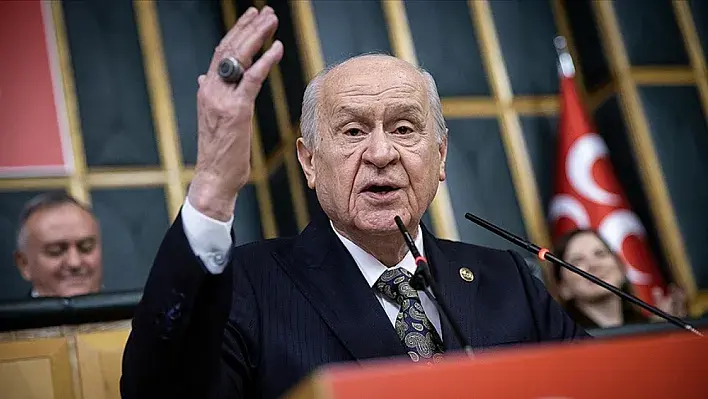
Devlet Bahçeli, the Chairman of Nationalist Movement Party (MHP), which is the main ally of President Erdoğan and his ruling Justice and Development Party (AKP), made evaluations on current issues during his party’s parliamentary group meeting in the Turkish Grand National Assembly. Addressing a wide range of topics from developments in the Middle East to the Caucasus, from the U.S.-Iran agreement to early election debates, Bahçeli also criticized Israeli Prime Minister Benjamin Netanyahu.
Beginning his speech by referring to conflicts in the region, Bahçeli said the world is going through “increasingly intense hard-power wars.” He argued that tensions around the Strait of Hormuz and developments in the Eastern Mediterranean are products of the same strategic calculations and stated that the occupation in Palestine has continued for years.
“Israel, which stands before us today as a blood machine that has sucked the region’s veins of peace, has also attacked Lebanon,” Bahçeli said, describing Netanyahu as a “mechanism for crisis production.”
Saying that President Recep Tayyip Erdoğan had been targeted by Netanyahu, Bahçeli commented, “This is a declaration of Netanyahu’s helplessness, panic, and exhaustion.”
Bahçeli stated that they found the compromise memorandum signed between the United States and Iran “encouraging,” but they are following the process carefully. Emphasizing that “the opening of the door to diplomacy does not mean the closing of the door to precaution,” Bahçeli stressed that rhetoric and initiatives that could increase tensions should be avoided until the agreement becomes official.
A New Name for the Trump Route
During his speech, Bahçeli also changed the name of the Trump International Route for Peace and Prosperity (TRIPP), which was signed last year in Washington by Trump, Pashinyan, and Aliyev. Bahçeli said, “We called it Zangezur, but now let’s call it by its proper name. This route is the Turan* Corridor.”
The Zangezur Corridor designation officially used by Bahçeli and Turkey actually refers to a specific regional and micro-scale transportation route aimed at connecting mainland Azerbaijan to the Nakhichevan Autonomous Republic through Armenia’s Syunik Province, and from there to Turkey. Since the corridor passes through Armenian territory, Armenia refers to it as the Syunik Route. The Syunik Route also forms part of the Trump Route.
Highlights from Bahçeli’s speech are as follows:
“We cannot read developments in the South Caucasus separately from this broader picture. Political activity in Armenia directly concerns the new reality that emerged after the Karabakh wars, the Russia-West competition, the Turkey-Azerbaijan axis, the Middle Corridor, the Zangezur connection, and the possibility of regional peace. Let us remember that after the collapse of the Soviet Union, the occupation process that began in Karabakh locked the South Caucasus for nearly thirty years. Azerbaijani territories remained under occupation, hundreds of thousands of people were displaced from their homes, the region’s transportation and trade arteries were blocked, and the khari bulbul flowers [of Karabakh] waited longingly for the Turkish victory dawn. Karabakh, the bleeding wound of the Turkic world, became a prayer for independence patiently nurtured by our kin. The unending pain of Khojaly and the burned and destroyed lands of Shusha, Aghdara, and Lachin became wounds of sorrow engraved in the heart of the Turkish nation.
Zangezur Will Reunite Nakhchivan with Azerbaijan
But thankfully, in the autumn of 2020, truth prevailed, and the Turkish steel wrist wrote history in Karabakh. The law trampled in Karabakh was restored by the iron fist of the Turkish soldier. Thanks to God that we have lived to see the days when the chains of Karabakh’s captivity were broken. Thanks to God that we witnessed mornings when the crescent-and-star flag once again rose over the mountains of Shusha. Thanks to God that the khari bulbul flowers now bloom in the lands of Karabakh watered by the blood of our martyrs, no longer as a symbol of sorrowful waiting but as a sign of victory. At this point, special and careful attention must also be paid to the Zangezur route, which is the strategic connection of the Turkic world between east and west. Zangezur is a historic passage that will strengthen Nakhichevan’s bond with motherland Azerbaijan and connect Turkey, through brotherly Azerbaijan, to the Caspian and beyond the Caspian to Turkestan. Zangezur will be Nakhichevan’s reunion with Azerbaijan. This means that the consciousness of “two states, one nation” turns to a strategic climate spreading across the entire Turkic world.
This Route Is the Turan Corridor
We called it Zangezur but now let us call it by its proper name: this route is the Turan Corridor. The Turan Corridor is the historic and cultural gateway to the future extending from Kars to the steppes of Turkestan. When this gate opens, the ideal of reunion preserved in hearts for centuries will take tangible form. The barriers sought to be erected between Anatolia and Turkestan will disappear, and the Turan horizon will become clearer, closer, and more powerful. At a time when global trade routes are being reshaped, when the northern route has become sensitive due to war and sanctions, and when southern sea routes from Hormuz to the Red Sea have become hostage to crises, the opening of the Turan Corridor is a strategic opportunity for our region and for Turkey. Considering current challenges, this route will diversify Turkey’s and our region’s export corridors and increase our country’s logistical capabilities. In such a difficult period, when regional states are trapped in economic constraints, the opening of the Turan Corridor will be an economic and geopolitical leap extending from Ankara to Turkestan.
The Turan Corridor Will Be Opened
It will bring economic vitality to Turkic lands from Kars to Iğdır, from Nakhchivan to Baku, and will constitute one of the main transportation and trade routes of the new century. The Turan Corridor is the strategic key to the Century of Turks and Turkey. Turkey will be connected to the Turkic world not only through bridges of the heart but also through railways, highways, and energy lines. The Turan Corridor will be opened. The Turkic world will unite, and the Organization of Turkic States will become stronger. Hearts that swore by proclaiming, “Our struggle continues until a Nationalist Turkey and Turan!” will breathe a sigh of relief. Now there is a new phase before us. Armenia will either continue to pursue its old mentality of occupation, diaspora ambitions, and desires for revenge, or it will accept the new reality of the region and open the door to lasting peace. The foundation of this new reality is clear: Karabakh is Azerbaijan. This reality has been confirmed both on the battlefield with blood and at the negotiating table on legal grounds. The paths that seek to preserve the old mentality of occupation under new disguises are closed. Normalization is possible only through abandoning the language of historic hostility toward Turkey and Azerbaijan, accepting the new reality of the region, and respecting a framework of fair cooperation.
If Yerevan comes to its senses and honestly joins the framework of regional cooperation, the Turan Corridor could become not only a gateway for Azerbaijan and Turkey but also a way out of economic isolation for Armenia. Otherwise, Armenia will cling to dreams lost in the past and waste the opportunities of the future. No formula that erodes the achievements of dear Azerbaijan, obstructs the Turkic world, and draws inspiration from Soviet remnants can be lasting. The Nationalist Movement Party’s ideal of Turan and the People’s Alliance’s** 2053 and 2071 vision point in the same direction. That direction is the Century of Turks and Turkey. For this goal, we will not get tired, we will not be discouraged, and we will not be defeated. We will overcome the obstacles placed before us with awareness, pass through them with patience, and leave darkness behind with perseverance. We will not take a single step back, nor will we hesitate for a moment.”
* “Turan” is the historic term used to refer to the “cultural and political unification” of Turks from Turkey to Middle Asia. (e. n.)
** This is the name given to the alliance of ruling Justice and Development Party (AKP) and Bahçeli’s Nationalist Movement Party (MHP). (e. n.)


