


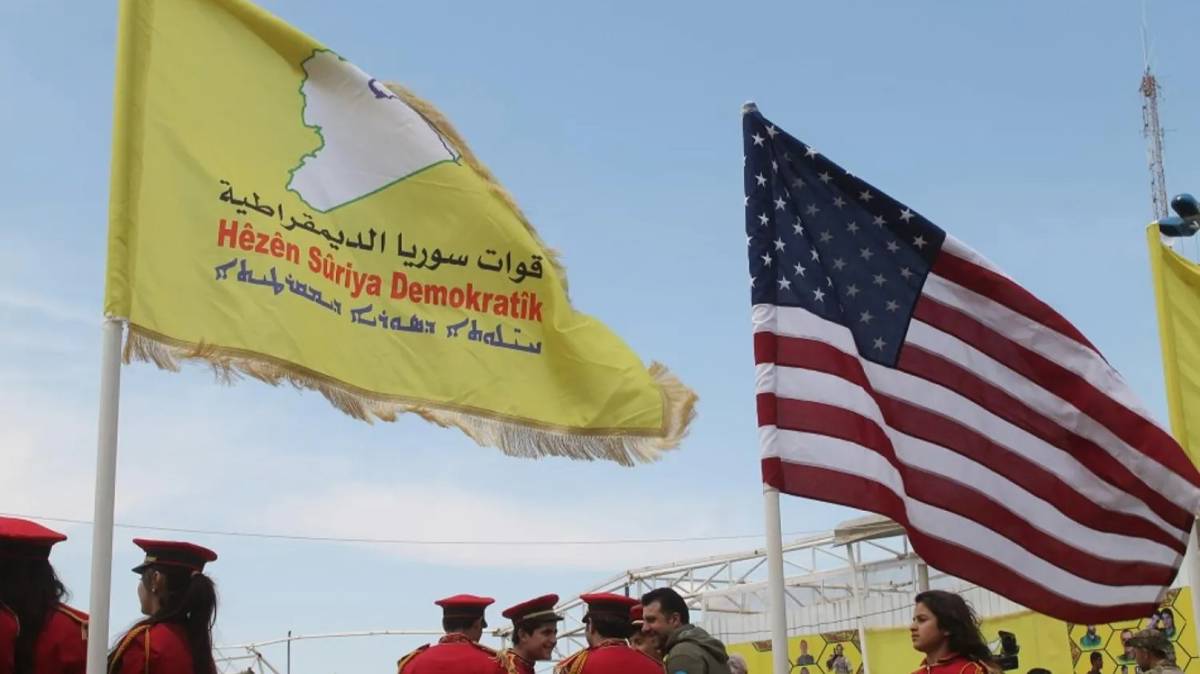
The fuse of the clash that erupted on January 6 between the Syrian army and the Syrian Democratic Forces (SDF), the backbone of which is formed by the Kurdish People's Protection Units (YPG), was lit so quickly that the forces of Syrian Interim Government President Ahmed al-Shara captured most of the territories under SDF control in less than 48 hours. By the time a ceasefire was reached on January 18, the SDF had withdrawn to the east of the Euphrates River with significant losses. The Kurds, who had established themselves with all national and international parties through the fight against ISIS in Syria, are now left only in Kobani and Hasakah. As al-Shara—or Jolani, by his Al-Qaeda name—took the seat in Damascus as the leader of the Islamist organization Hayat Tahrir al-Sham (HTS) and moved closer to America, the situation evolved against the Kurds. While protests in favor of the Kurds continue in many parts of the world, the fate of the process Turkey is conducting with Öcalan is a matter of curiosity. Journalist Fehim Taştekin, who has written books on Syria and knows the Syrian field intimately, explained the current point the Kurds have reached and the reasons behind it.
 The Kurds were almost at the point of gaining autonomy; what happened in three days that caused them to lose most of their gains?
There was a bit of a disconnect from reality among the Kurds and an unrealistic belief that the "borrowed support" coming from the outside would offer them a permanent guarantee. That guarantee, even if they didn’t want to believe it, was America. They wanted to believe in it because their alternative was a group coming from ISIS and Al-Qaeda. They waited with the assessment that the SDF would gain international value against such a group and would not be abandoned by its partners. The American administration, however, never supported autonomy from the very beginning and offered no political guarantee. The Americans were actually honest; they said, "One day will come, and we will leave." Therefore, trusting America was a mistake. Later, the stance displayed by Israel during the massacre of Druze in Suwayda led to an expectation among the Kurds that the same scenario would be staged for them. This was also unfounded. As long as America is east of the Euphrates, Israel will not raise the stakes for the Kurds.
Then, of course, there is Turkey. Israel was very inclined to see the north as Turkey's sphere of influence in order to get what it wanted in the south. Israel would not choose to corner Turkey. When these factors were forgotten, a calculation error was made. Furthermore, it was thought that Jolani would not be recognized internationally, but he was. There was an expectation that America would not lift sanctions on Syria, but it did. Lobbying was done for clear conditions for the SDF if sanctions were to be lifted, but that didn't work either. Only the advancement of integration within the framework of the March 10 agreement was requested from the SDF.
The ISIS members held in the Al-Hol camp and the war against ISIS were also important criteria, weren't they?
Yes, the Kurds thought, "We are the West's partner in the fight against ISIS, they cannot ignore us; we are guarding thousands of ISIS members in prisons." America simply handed them over to Damascus and completely neutralized the "fight against ISIS" card held by the SDF. Now, with this self-confidence, from what I understand, during the talks in Damascus when the Americans said, "Hurry up, complete the integration because we are leaving; how will you be protected once we are gone?" the SDF essentially put the Americans in their place by saying, "That’s our business, not yours," which caused the rift. Beyond that, there were high expectations from Europe. That also failed. This time, they thought, "Maybe if we wait a bit, al-Shara will stumble and the international community will pull the plug at some point." That didn't happen either. They always said: "The SDF is trained, has combat experience, has American weapons." In fact, until now, whenever Arab tribes rebelled, the SDF always suppressed them. They thought that as long as the American red line remained east of the Euphrates, no operation would be launched here. Turkey had started a move while Assad was falling, but the US stopped it. Based on the same scenario, they thought that if the Syrian army launched an operation, it would be stopped by America, but America did not stop it.
Another miscalculation was thinking, while withdrawing from Aleppo, "Okay, we withdrew from Aleppo, but Israel and America will still support us in the remaining parts." They didn't. Because America now prefers to work directly with the Jolani administration.
“The SDF was talking about 100,000 people, but the majority of them were Arabs. Also, these numbers might not even be real. Because in conflict zones, this is a tactic. High numbers are cited for deterrence and to receive military support. Now, the SDF has effectively reverted to being the YPG. It has returned to its essence. I asked recently; they said there are 7,000–8,000 people in a position to fight.”
So, has Syria now entered the American axis, and is the SDF no longer needed?
Yes, that was the goal; they wanted Syria to move away from Iran. They wanted a Syria that provides guarantees to Israel. These things happened. This is another miscalculation by the Kurds. Those who convinced Trump to keep troops in Syria had set roughly certain goals: Don't let the oil regions fall into Assad's hands. Assad is gone, and there is an administration in Damascus recognized by America.
That happened too. Additionally, preventing Russia from winning a victory here was one of the most important issues. Russia is also in the "losers' club." The most important thing, of course, was the securing of Israel. In other words, America obtained the Syria it wanted with an Islamist organization. Now, Kurdish autonomy, democratic values, gender equality, etc., are of no concern to America. There is no such thing as "values diplomacy" in the handbook of American imperialism. There never has been. When we look at it on a global scale, a man who has bruised the world so much will not look at the Kurds' social contract and say it is very valuable. This is not in the book of imperialism.
In your broadcast a few days ago, you said that relations between the SDF and Arab tribes were not very good either.
I have always said that the SDF's partnership with the tribes was fragile. The Kurds did perform while putting themselves forward and gaining acceptance through the canton system. Of course, the inference that they partnered with all Arabs, Syriacs, Circassians, and Armenians is wrong. But certainly, partnerships occurred. Actually, Kurds are a minority in these regions. The history of some places that Kurds now define as Rojava is barely a century old. Kobani has no such history, for example. The Kurdish population of Derik or Qamishli a century ago was around 15 percent. If you suddenly call these places Rojava or Western Kurdistan, local people start asking what is going on. Syrians were saying, "These places were ours." This drew a reaction. A sensitivity toward "Kurdish supremacy" developed in Arab regions, and more importantly, they started saying, "The Kurds have seized the oil, the Kurds are stealing the oil."
We have to be honest. The primary motivations for the Arab tribes' partnership with the SDF are losing their validity: these were the fight against ISIS and the security provided by the SDF. Initially, while the rest of Syria was struggling with war, this region was stable. They were saying, "Let the SDF exist, let it be managed by Kurds, but it provides us security." But the SDF couldn't deliver what it promised. The economic order continued as before. There were complaints: Kurds decide everything regarding military, political, and economic matters. More importantly, there were complaints that the PKK and Qandil within the Kurds were making the decisions. This led to a backlash. When I spoke with Dehham, the leader of the most important Arab tribe, the Shammar, who was the co-chair of the Jazira Canton, he first said he valued the SDF's model. A few years later, he said they were no different from the Ba'ath. Why? The man is a co-chair, but the decisions are always made by the "cadres," and he is, in a sense, a figurehead (trustee).
According to the Arabs, where were the revenues going?
According to the Arabs, these were never, ever used for the benefit of that region. Furthermore, Syria is the cradle of Arab nationalism. And an Arab, a Sunni—namely Shara—sat in the leadership seat in Syria. This is very important. They look at Shara, they watch him, and they see their own colors. Shara is a man with the ability to act strategically, in American terms. We condemn this man by looking at his massacres, but the sovereign powers do not look at it the way we do. They look to see: "Can he control, can he rule, can he implement the decision he made, can he produce strategy?" America says, "Yes, I dismantled this place, but someone needs to gather it locally." Someone democratic and pluralistic cannot gather it; only a "tough guy" can. And that is Jolani, or Shara.
“There are 35 Syriac villages around the Khabur River. Calls are coming from these villages. They accuse the YPG of being occupiers and say, 'let the government forces save us.' Some Christian villages in those regions were villages where the YPG had been stationed in the past. Civilians had left the villages. Now they say, 'ISIS is gone, but these people have settled and stayed in our villages.' There is discomfort. Of course, property issues are involved. In some places, Armenian and Syriac properties were confiscated or seized. But minorities have a dilemma: whichever side they say 'yes' to, they become the enemy of the other side. It has always been this way for minorities.”
Despite everything, the SDF wasn't expecting such a rapid disintegration, was it? We're talking about a force of 100,000.
The SDF had to withdraw quickly from the region when the tribes switched sides. The majority of those 100,000 were Arabs. Also, these numbers might not actually be real. Because in conflict zones, this is a tactic. High numbers are cited for deterrence and military support. Now, the SDF has effectively turned into the YPG. It returned to its essence. I asked recently; they said, "We have 7,000–8,000 warriors in a position to fight."
There is an ongoing dialogue process with Turkey. While all this was happening, we heard no statement from Öcalan.
From what I understand, Ankara wants the process to continue and not be disrupted because of Syria. But the truth is, the main factor that started this process was the situation in Syria. Turkey knew that the Kurds had been developing relations with Israel for three years. Turkey wanted to sideline Syria with the positive reactions Öcalan would also give. Öcalan did not exactly give Ankara what it wanted. Because Öcalan sees Syria as his own project. It is a structure he organized personally while living in Syria. "Apocu-ism" (Apoism) is stronger in Syria. I don't expect Öcalan to say "here, take it, it’s yours" for Turkey's benefit. I think Öcalan, with a realistic approach, does not foresee that the SDF can remain as a whole east of the Euphrates. Öcalan displays an approach where local police forces consist of Kurds, administrative autonomy rights are recognized, and the Kurdish issue is resolved with the democratization of Syria. Turkey concludes from this that Öcalan wants liquidation, while the SDF says the opposite—that Öcalan wants integration. Öcalan played on such an ambiguity, and of course, we cannot say it found a response on the ground. That is, Öcalan's messages did not satisfy the SDF. He did not provide a roadmap that told the SDF exactly "do this" or "do that." In the messages he sends out, Öcalan does not say very clear things. He uses a language that can rather open up space for initiative. Additionally, from the beginning, America said that for the sake of not having problems with Turkey, the Qandil cadres should stay away from Syria. But they didn't. This was one of the rifts.
Turkey wants to continue. Statements coming from Qandil contain the message that a peace process cannot be conducted over the "funeral of Syria." This is critical. Of course, Öcalan is decisive. Ultimately, Qandil conducts its business through the "Öcalan myth." They do this to send a message to Öcalan in that sense, but the boss of the process is Öcalan. Therefore, Öcalan needs to declare his new position. Turkey is not in a direct military operation in Syria; it is helping. Therefore, I foresee that Öcalan will not go toward a break with Turkey.
So, will this situation in Syria reverse? What might we see in the coming days?
Now, probably both Turkey and Damascus will conduct risk assessments. For example, they promised not to enter Kurdish regions. Is this promise fixed? It might not be. They said Hasakah would not be entered, but Hasakah has an Arab population of over 60 percent. They probably won't want to allow Kurdish control here. But they will want to increase the pressure—in a sense, to take the SDF captive—and they will try this. This might not be directly entering Kobani or sending in troops. Still, one should speak cautiously.
In some places, Christian properties were confiscated
What will happen to the Christian minorities?
HTS’s fierce hostility is mostly directed toward Muslims it sees as "heretics" (zindiq) or "apostates" (murtad). That is, Alevis, Ismailis, and Druze. That is the mindset. To Christians, it offers protection. ISIS was doing this too. ISIS would personally call Christians who had fled and say, "Come back to your business, you will only pay jizya and we will provide your security." The logic is the same logic. On the other hand, the SDF says, "I protected you from ISIS until now, I fought for you, I died." It expects gratitude. However, this caused divisions. Some of the Armenians gave support. The Democratic Union Party (PYD) acted together with the SDF. But the others were on the side of Damascus then. People don't want to be in a contradiction.
A campaign was started in recent days. There are 35 Syriac villages around the Khabur River. Calls are coming from these villages. They accuse the YPG of being occupiers and say, "let the government forces save us." Some Christian villages in those regions were villages where the YPG had been stationed in the past. Civilians had left the villages. Now they say, "ISIS is gone, but these people have settled and stayed in our villages." There is discomfort. Of course, property issues are involved. In some places, Christian properties were confiscated or seized—namely, Armenian and Syriac properties. On the other hand, one way or another, the Syrian state will come to these villages. That's why some churches, in particular, say they have no problems with Damascus; they are sending messages. Also, there is a Christian representative in the government. Someone who appears before the international community and gives statements. He softens the psychological environment for Christians. But of course, minorities have a dilemma: whichever side they say "yes" to, they become the enemy of the other side. It has always been this way for minorities.


