


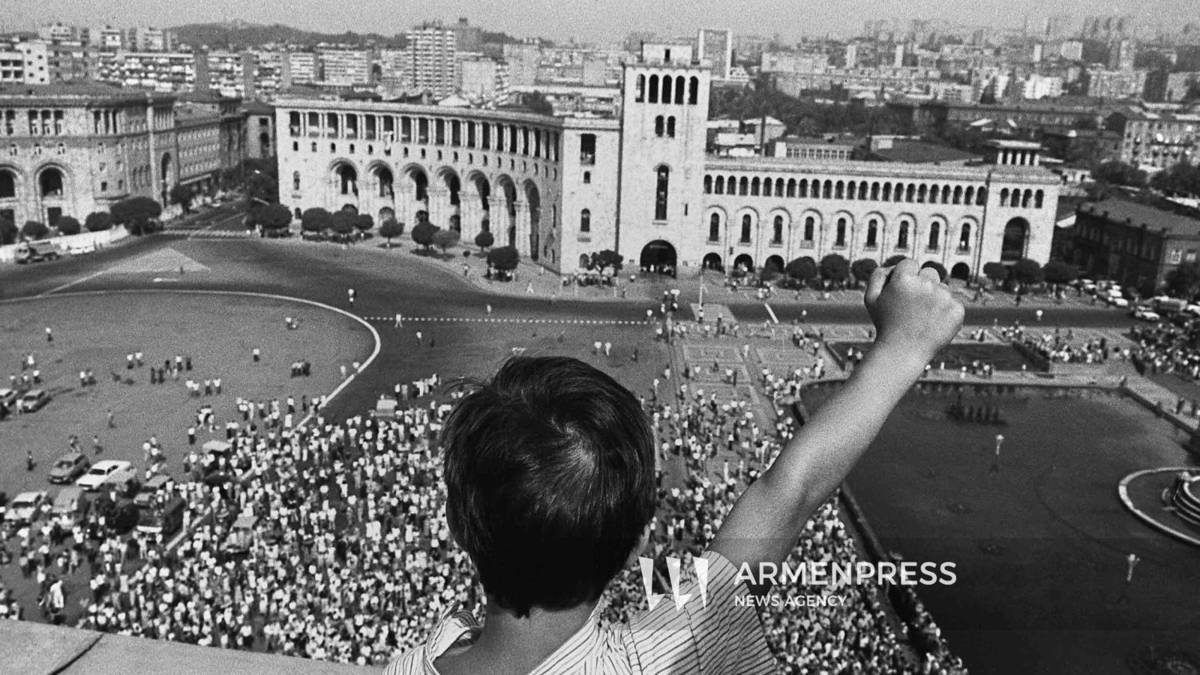
Thirty-five years ago, on September 21, 1991, 95.4 percent of Armenia’s adult population went to the polls, and 94.3 percent voted “yes” to a democratic, independent state outside the USSR. Two days later, the Supreme Council declared independence.
Speaking in Republic Square on September 21 under the theme “Permanent State,” which was the focus of this year’s celebrations, Pashinyan said that Armenians had dreamed of an independent state for five hundred years. He added that there was no longer any need to dream of a homeland because the Republic of Armenia was “the homeland of our dreams.” He emphasized that the permanence of the state was the central issue that had to be secured anew every day, and in the final sentence of his speech he addressed citizens directly: “You are the state; you are the Republic of Armenia.”
What did Pashinyan say five years ago?
It is important to place this closing alongside his speech marking the 30th anniversary five years ago. In 2021, immediately after the 44-day war, Pashinyan ended his speech with the words “Long live and prosper, Armenia; long live and prosper, Artsakh,” in honor of the fallen. Artsakh (Nagorno-Karabakh) was absent from this year’s closing. The omission of a single word is the clearest indication of how the state’s legitimate geography has been redrawn since 2023.
Last year, I wrote that the sentence “You are the state; you are the Republic of Armenia” was the slogan of the “Real Armenia” program announced at the Civil Contract party congress. The theme “Permanent State” was not chosen at random either. In the preamble to the 2026–2031 government program adopted in August, the government stated that it was aligning its current decisions with a vision of the permanence of the Republic of Armenia, and that this new understanding found expression in the ideology of “Real Armenia.”
In other words, the 35th anniversary is the year in which an ideology has been transformed into the language of celebration. But the weeks leading up to the anniversary also showed which sentences in this language have yet to be completed.
Which sentences have yet to be completed?
The first is security. On September 2, Putin said that if Armenia did not need it, Russia was ready to withdraw its base in Gyumri “even tomorrow.” In his response on September 17, Pashinyan noted that the 102nd Military Base was not vital to Armenia’s security. He said that Armenia would not object if Russia wanted to withdraw, but that it was ready to discuss the matter if Russia did not. He responded in a similar tone to the possibility of Armenia leaving the Collective Security Treaty Organization (CSTO). This is actually consistent with the logic of the government program. The 87-page document mentions neither the CSTO nor the military base by name. The only paragraph devoted to Russia speaks of “transforming” relations. Meanwhile, after a protocol was signed on September 18 at the conclusion of bilateral defense consultations with the United States, the Russian press portrayed it as Armenia’s turn toward the United States while freezing its participation in the CSTO.
What is missing is precisely this state of being caught in between. “Real Armenia” describes a state that makes its own decisions, yet Armenia’s status within the CSTO and the future of the military base currently appear to depend on steps Moscow may take. “If they want to withdraw, let them withdraw” may be a position, but it is not a strategy. A claim to being a permanent state, meanwhile, requires writing its own security map in its own words.
Will Armenia pursue both paths at once?
The second issue is the Eurasia–Europe dilemma. On September 17, Russian Security Council Secretary and former Defense Minister Sergei Shoigu accused Yerevan of trying to expand its interaction with NATO and of openly treating the Eurasian Economic Union (EAEU) and CSTO as “exhausting.” He said Russia would not finance Armenia’s European integration, that every step would have consequences, and also recalled Putin’s earlier call for a referendum on choosing between the EU and the EAEU.
The government program, however, aims to pursue both paths simultaneously. It seeks active cooperation within the EAEU while also pursuing alignment based on a 2025 law that initiated the process of seeking EU membership. There is no roadmap explaining when and how the two paths might diverge, and Moscow is therefore also trying to fill that gap according to its own timetable.
The third issue is infrastructure and energy. The program establishes as a principle the avoidance of dependence on a single infrastructure system, route, or product price. In terms of railways, this means revising the Russian-concessionary management system in a way that does not obstruct the historic opportunity to integrate Armenia into international transport networks. Pashinyan also emphasizes that Armenia does not want to sever its ties with Russia, but transferring the concession depends on Moscow agreeing to sell it.
The gap in energy
The gap is more apparent in energy. The program contains concrete targets for solar power, storage, and nuclear energy, but none for natural gas. Yet gas is precisely what is being tested in these weeks. Gazprom Armenia announced that deliveries would be suspended from September 15 to 25 because of scheduled maintenance on the main pipeline in Russia, with the shortfall to be covered by domestic reserves and additional gas from Iran. Similar maintenance was carried out last year as well; so there is no crisis, but there is a lesson to be learned. In practice, diversification in natural gas currently amounts to just one alternative.
The fourth issue, and perhaps the most important, is domestic partnership. The June 7 election had already demonstrated its limits. Voters gave broad approval to the continuation of the “Real Armenia” line, while withholding the two-thirds majority required for a new constitution. I ended my article on the government program with the warning: “If Real Armenia remains only the Armenia of the ruling government, the Fourth Republic will become merely the name of an era.” Permanence, by contrast, is possible only through a conception of the state that can also be embraced by those who did not vote for it. In his speech, Pashinyan offered indications of this, while acknowledging that many problems remained unresolved. He said, however, that no state in the world was without problems and that this could not be a reason to love the state any less.
In its 35th year, the vocabulary of “Real Armenia” appears complete. The concepts of state, citizen, peace, and permanence are all in their proper places. What is missing are the unfinished sentences concerning security, economic direction, and energy. If the goal is a “Permanent State,” those sentences need to be completed not by others, but by the state itself.


