
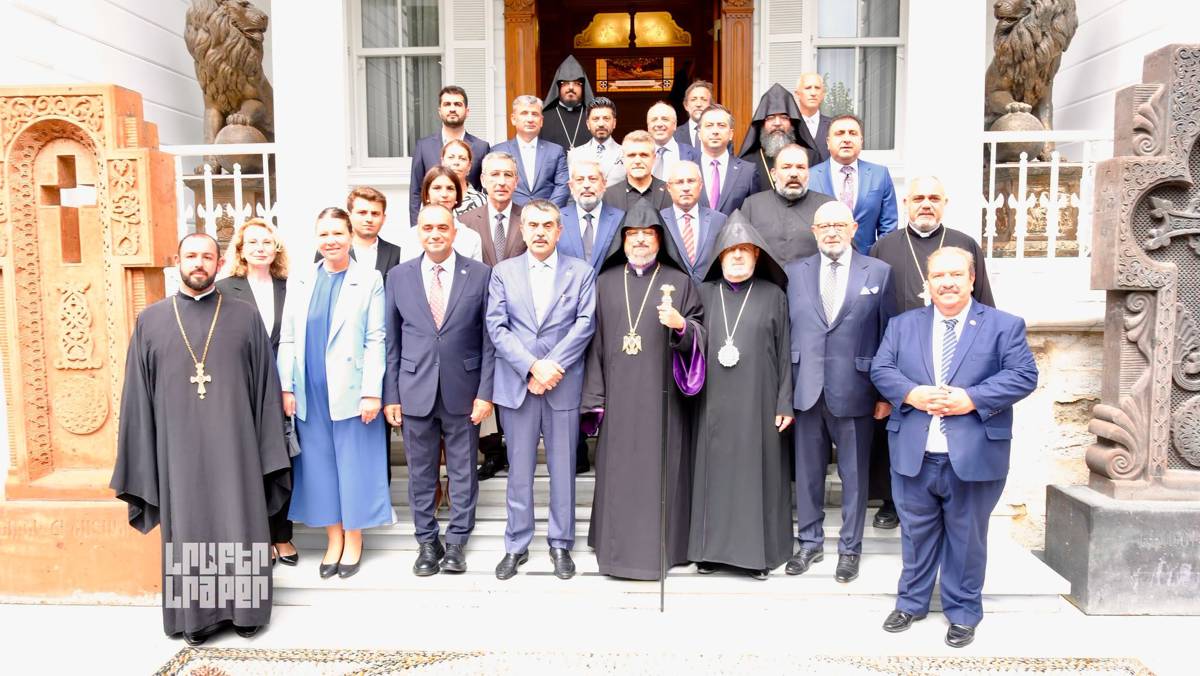
Minister of National Education Yusuf Tekin was welcomed by Patriarch Maşalyan at the entrance of the Patriarchate building in Kumkapı.
The welcoming delegation included Archbishop Aram Ateşyan, Archpriest Hovagim Seropyan, Rev. Kasbar Garabedyan, Fr. Şirvan Mürzyan, Fr. Teotik Çetinkaya, and Fr. Natan Arabyan, along with administrators of Armenian community foundations and educators, AKP Istanbul MP Assoc. Prof. Dr. Sevan Sıvacıoğlu, Presidential Council for Culture and Arts Policies member Aram Kuran, Bedros Şirinoğlu, Chairman of the Board of the Armenian Foundations Union (ERVAB) and the Surp Pırgiç Armenian Hospital Foundation, and Hrant Moskofyan, Chairman of the Board of the Kumkapı Surp Asdvadzadzin Patriarchal Church Foundation.
Following the welcome, members of the ERVAB Education Commission led by Mari Yancı, foundation presidents, community representatives, and educators serving in Armenian schools attended the meeting held in the Patriarchate Hall.
During the meeting, the current state of Armenian schools, issues encountered in the field of education, and evaluations regarding the new curriculum were discussed, and views were exchanged.
After the meeting at the Patriarchate, Yusuf Tekin visited Kumkapı Bezciyan Primary School and met with representatives of the Armenian community and educators.
"The curriculum is being renewed"
At this gathering, ERVAB Education Commission Chair Mari Yancı delivered a speech. Yancı said:
"Your visit is not merely a courtesy meeting for us; it is also an extremely valuable opportunity that allows us to introduce our schools, our educational staff, and the work we are carrying out more closely to you.
The ERVAB Education Commission, operating under the Armenian Foundations Union, is a collaborative platform that aims to produce solutions to the common educational needs of our community schools and to raise the quality of education to even higher levels.
On this occasion, I would especially like to emphasize that ensuring the continued strong existence of our community schools, which are an important part of our deep-rooted educational tradition extending from the Ottoman period to the present day, and passing this heritage on to future generations is a great responsibility for all of us.
As the Education Commission, this year we are carrying out comprehensive work on the curricula of our Armenian language and religion courses within the framework of the Türkiye Century Education Model, which is of great importance for our community schools.
Our primary goal is to complete this work as soon as possible with the valuable contributions and guidance of our Ministry.
In line with the objectives of our Ministry of National Education, we wish to ensure that our children receive a high-quality education in accordance with the requirements of the modern age while also learning their own language, culture, and faith in a strong way. We sincerely believe that these two goals complement one another and contribute to the cultural richness of our country.
Mr. Minister, we would like to express our heartfelt gratitude for the close attention, constructive approach, and support you have shown our community schools to date. We have full confidence that we will continue to feel the support of our Ministry of National Education throughout our educational journey.
Once again, I thank you for your participation and for the value you have shown us, and I greet you all with respect and affection."
"We are awaiting approval"
Dr. Sevan Karabetoğlu, a member of the Platform of Armenian Academics of Turkey, also addressed Minister Tekin, saying:
"As a member of the Board of Directors of the Beyoğlu Üç Horan Armenian Church Foundation and a faculty member at the ITU Energy Institute, I will present, on behalf of the ERVAB Education Commission, the process and current status of preparing the curricula for Armenian language, Armenian Language and Literature, and Armenian Religion courses taught in our schools in accordance with the Ministry of National Education's 2026 Türkiye Century Education Model.
Work began in August 2025 with a team appointed by the ERVAB Education Commission to prepare the curricula and teaching programs for Armenian language courses at the primary level and Armenian Language and Literature courses at the secondary level in accordance with the Education Model. The team consisted of 17 Armenian language and classroom teachers, 3 coordinating principals, and 1 project coordinator. At the beginning of the project, before the curriculum writing process, workshops were organized to bring our teachers and principals together with academic experts from Faculties of Education, enabling them to gain a thorough understanding of the structure of the Education Model.
On January 23, 2026, the coordinating principals and the related academics met in Ankara with Prof. Dr. Cihad Demirli, who at that time was serving as the Chair of the Ministry of National Education's Board of Education and Discipline and now serves as Deputy Minister of National Education. He received information from the delegation, showed great interest in the subject, and conveyed his valuable support.
The curriculum for primary and secondary religion courses to be taught in Armenian schools in accordance with the 2026 Education Model was prepared under the auspices of the Armenian Patriarchate of Turkey.
In June 2026, the final version of the revised secondary religion curriculum and the Armenian Language and Literature curriculum, which had entered the revision process, were simultaneously submitted to the Ministry of National Education through our district and provincial directorates of national education.
As of July 2026, the curricula for primary and secondary Armenian language courses were likewise submitted for evaluation.
At present, the first feedback regarding the secondary Armenian Language and Literature curriculum has been delivered to our schools. The primary Armenian language curricula are also under evaluation, and feedback is awaited. Approval is also being waited for the high school religion curriculum, whose revision process has been completed."
"We emphasize speaking and listening rather than grammar"
Minister of National Education Tekin stated that no distinction is made among students and that, regarding language instruction, a system emphasizing speaking rather than grammar has been adopted.
Explaining that they have adopted a new approach to language teaching in line with international standards, Tekin said:
"Until now, we taught our children language solely through grammar rules. In our current assessment and evaluation system, we have revised our programs to focus on reading, writing, speaking, and listening. Work is also being carried out to renew the Armenian language programs here in accordance with the framework of the Türkiye Century Education Model."
Tekin noted that since his time as undersecretary, he had never treated the problems of students in minority schools differently from those of other schools, and that these institutions had also been included in initiatives such as incentive programs and interactive smart boards. He also stated that students were given the option of answering questions on their own religion in centralized examinations and that every effort had been made to resolve all solvable issues.
Minister Tekin concluded:
"In our schools, whatever I desire as a Sunni Muslim, I desire the same for our other citizens. Together, we will build a Türkiye that embodies this vision."


