

A peace era?
The peace process between Armenia and Azerbaijan has arrived at a paradoxical moment characterised by parallel yet contradictory dynamics.
In one dynamic, it seems as if every week brings new strides forward in diverse kinds of interaction and cooperation that were unimaginable until very recently. The final months of 2025 witnessed the arrival of the first goods in Armenia transiting via Azerbaijan, and the first trade between the two nations in three decades when Armenia bought Azerbaijani energy products. Two cross-border expert visits took place, on a scale that has not happened for some 20 years.
There is an inconsistent, intermittent and indirect, yet still noteworthy dynamic of discursive alignment between the two countries’ leaders that was until recently impossible to imagine.
These new relations are founded first on a stark recession in violence: there have been no frontline incidents or casualties between the two states for nearly 2 years, and this when just one year ago scenarios of an Azerbaijani invasion of Armenia were still seriously being discussed.
New relations are also founded in the text of a normalization treaty, initialled and published in August 2025, negotiated by and for the parties themselves, on their own, without mediation. Other processes, such as border delimitation, where outside actors once played a role, are now run without them.
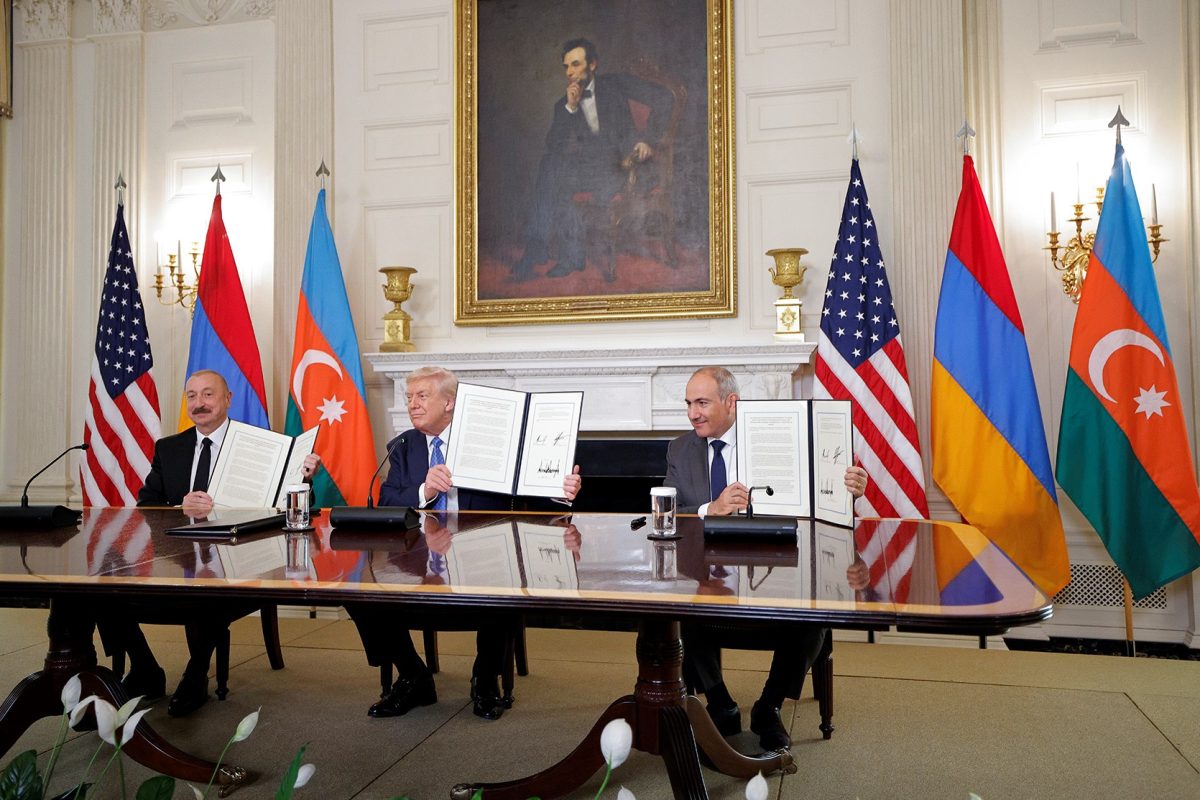
The process apparently still needs external involvement, as President Donald Trump’s convening of President Ilham Aliyev and Prime Minister Nikol Pashinyan in the White House in August 2025 showed. Both states have placed their faith in American capacities to facilitate the critical southern transit route known as the Trump Route for International Peace & Prosperity (TRIPP) or, in Azerbaijan and Türkiye as the ‘Zangezur Corridor.’
Yet it is also noteworthy that for some time neither Baku nor Yerevan has leveraged problems in the other’s relations with Russia in a competitive dynamic that for years helped to keep the Kremlin at the helm.
All in all, these are unprecedented, and seemingly decisive, steps towards new, peaceful relations between the two states.
From horizontal to vertical tensions
At the same time it would be premature to proclaim the advent of new orders or regional architectures. The current moment is profoundly liminal, inchoate and unpredictable.
Most obviously, it is still necessary to highlight that the interstate agreement is merely initialled and not signed, and much can still happen before signatures appear on paper. Signing the initialled treaty remains embroiled in Azerbaijan’s requirement that Armenia revise its Constitution, and consequently, in the unpredictable process of a constitutional referendum in that country.
What is most striking in this new situation, however, is the dissonance between elite accord across the divide and elite-society relations in each context. The new era of peace has coincided with, and been inseparable from, intensifying tensions in domestic politics across the divide. These tensions look different in each country due to the nature of the regimes in question.
In Azerbaijan, adoption of peace narratives has been accompanied by an intensifying wave of repression, arrests and criminalization – of journalists, academics and activists, of opposition leaders, of non-conformist identities and civil society figures now living in exile. As has been the case for many years, contacts with Armenians are still used to silence dissent, such in the case of young scholar Bahruz Samadov, imprisoned for 15 years on false charges of high treason related to his interactions with Armenians.
In Armenia, a different dynamic is evident given first that country’s fractious and imperfect democracy and second its devastating defeat in the Second Karabakh War. Defeat has opened space for the country’s leadership to push through an ambitious reframing of national identity, ‘Real Armenia,’ while silencing those who fall outside of, or who question, this new concept. Some local activists are also raising concerns over blurring boundaries between state and ruling party and what they see as a creeping risk of personalized power.
The decisive territorial settlement of the 2020-23 period, then, has seemingly resulted in a new unsettling of domestic politics. This territorial settlement is in quest of not only a regional international order within which to become normalized and institutionalized, but also a new social contract within each society.
The dilemma of change
It is not surprising that the easing of conflict would throw the spotlight back onto domestic politics, given both the expectations of change associated with peace, and the use of the conflict for decades to discipline Armenian and Azerbaijani citizens. The prospect of change resonates very differently across the Armenian-Azerbaijani divide.
Prime Minister Pashinyan’s brand since he came to power through 2018’s ‘Velvet Revolution’ has been largely based on change. Despite – indeed because of – Armenia’s catastrophic defeat, he has been able to push through a reconceptualization of Armenian identity that for his opponents represents an abject acceptance of defeat and territorial truncation. His political legitimacy is closely tied to the advent of peace and its perceptibility in everyday life.
Armenia, blockaded by Azerbaijan and Türkiye since the early 1990s, only stands to benefit further from the reintroduction of trade and Armenian officials make no secret of their desire to press ahead with the signing of the treaty. It is rather social groups, such as Karabakh Armenian refugees and civil society advocates, that are ambivalent about the terms of that treaty, such as its proscription of legal cases seeking to prosecute war crimes.
The context in Azerbaijan is in many ways the reverse. While opinion polls are not available, there is a general sense of social fatigue with war after a decade of sustained frontline violence between 2014 and 2023. Rather, it is from elite milieus and those they support, that continued exhortations to vigilance and militarism emanate.
This is also true for the lingering vision of ‘Western Azerbaijan’, a retro-irredentist discourse pitching a right of return for Azerbaijani refugees from Soviet Armenia to international audiences and the idea of a still incomplete territorial settlement to domestic audiences, redefining Armenia itself as another lost Azerbaijani homeland – ‘Western Azerbaijan.’
The continued articulation and projection of ‘lost lands’ in a context where Azerbaijan has finally and resoundingly recovered its territorial integrity appears to be a default reflex, signifying mental and political habits that sustain familiar – and controllable – kinds of politics deriving from the conflict. Discussion of what is intended or planned under the ‘Western Azerbaijan’ slogan is, fundamentally, a distraction from a deeper dilemma that the Azerbaijani leadership faces.
For peace to become more rooted, its ‘popularization’ is needed in the sense of both making peace something that is welcomed, approved of and no longer seen as threatening, and in the sense that it needs to become something that is experienced by the populace. In Azerbaijan’s authoritarian setting, this poses the question of how can you popularize peace without popularizing politics.
Answers to this question focus on connectivity, which has dominated discussions about peace between Armenia and Azerbaijan. Indeed, connectivity is the only vision for a positive peace, and it is no coincidence that it highlights horizontal, macro-infrastructural and commodified connections. Connectivity is not being promoted as the diffuse, networked interactions among social spaces and actors.
The strategic ambiguity of peace
The result is what might be understood as the strategic ambiguity of Armenian-Azerbaijani peace. There is a carefully choreographed, highly publicized and elite-managed process fostering incremental, functional interactions monopolized by the state. Strategic narratives stress connectivity, hubness and commerce for a capitalist peace involving local, regional and global state and multilateral actors.
In parallel, however, the conflict continues to play a central role in buttressing elite power by providing a mechanism to discredit opponents in Armenia and discipline dissent in Azerbaijan.
In Armenia, for as long as the principal opposition is associated with the former ruling party and presidents of Armenia Robert Kocharian and Serzh Sargsyan and their failed strategy for managing the conflict with Azerbaijan, PM Pashinyan can claim there are no alternatives to his rule. Given military outcomes and ongoing power asymmetries with Azerbaijan and Türkiye, he can plausibly argue that there is no alternative to ‘Real Armenia.’ Those actors questioning this idea are for now largely powerless and even if many are dismayed by how it is articulated, see no realistic alternative to it.
The real question is whether there is an alternative to ‘Western Azerbaijan’, in terms of a new legitimation strategy in Azerbaijan, and what that alternative is. There is a dissonance between a mythos of victory centred on the person of the president and expectations of peace as a collective good. It does not seem credible that the Azerbaijani leadership wants to reopen the territorial settlement resolved so resoundingly in its favour or to genuinely reactivate the conflict. The lingering cloud of ‘Western Azerbaijan’ speaks instead to an elite bereft of its traditional vehicle for disciplining society – an active and ongoing conflict.
Over the long-term compartmentalized gradualism may lead to a ‘thin’ peace manifested in state-mediated exchanges, trade and functional interactions, yet which is not supported and backed up by a ‘thicker’ peace of networked ties across different sectors, domains and social actors.
One test of a ‘thin peace’ would be domestic crisis on either side: the domestic crisis in Armenia on 1 March 2008, when post-electoral protests were violently dispersed with 10 deaths, coincided with a serious violation of the ceasefire along what was then the ‘Line of Contact’ with Azerbaijani forces. In this sense the Armenian-Azerbaijani conflict will only truly be over when it is no longer used to discipline societies on either side.
Another risk for a ‘thin peace’ is its trajectory should anything happen to the elites who negotiated it. If for whatever reason these elites are no longer in power, the peace they have negotiated is not networked into their societies. If they do not carry it, it is uncertain who will. This underscores the fragility of this moment, and the need for a broadening of the process to start to bring societies in.