


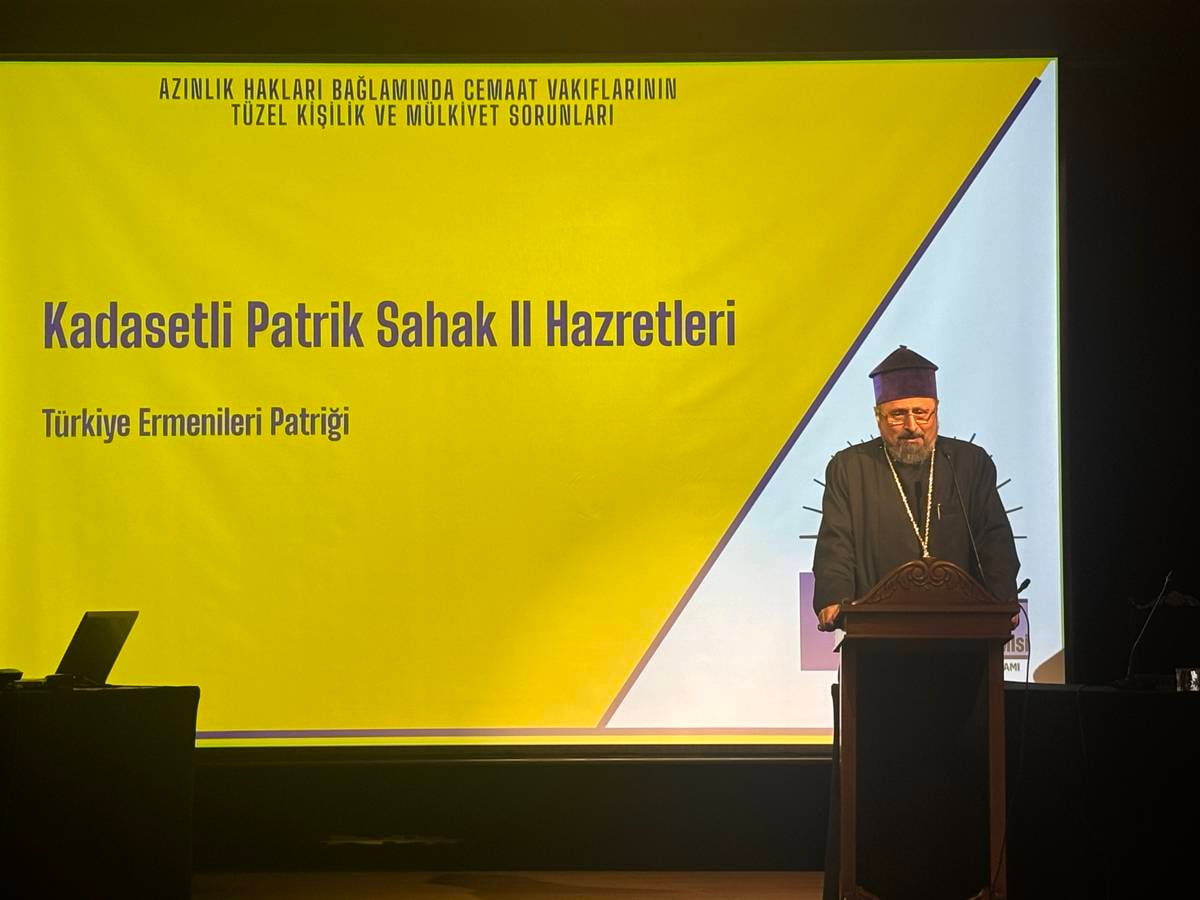
The "Legal Personality and Property Issues of Community Foundations in the Context of Minority Rights" conference, organized by the Beyoğlu Üç Horan Church Foundation, has commenced in Istanbul. The two-day event features prominent legal experts and academics specializing in minority issues. The opening remarks were delivered by Can Ustabaşı, Representative of Minority Community Foundations, and Sahak Maşalyan, the Armenian Patriarch of Turkey. While Ustabaşı noted that foundation elections are set to be renewed in 2027 and called for a revision of election regulations, Patriarch Maşalyan reiterated the Patriarchate's long-standing demand for legal personality.
Supported by the European Union and the Hrant Dink Foundation’s Minority Rights Academy Grant Program, the conference’s first day was attended by religious leaders, representatives of the Directorate General of Foundations, and various church foundation board members. During his opening speech, Assoc. Prof. Rafi Süzme of the Beyoğlu Üç Horan Church Foundation stated that the conference aims to address minority rights through academic and legal lenses to foster a common ground for solutions.
The Struggle for Property Rights and Legal Recognition
Can Ustabaşı highlighted the significance of Law No. 5737 regarding property acquisition by foundations. However, he emphasized that minority foundations in Hatay have been unable to benefit from certain legal protections because they were not included in the "1936 Declaration," a historical document used to track minority properties. Ustabaşı noted that even Constitutional Court (AYM) rulings have remained insufficient in resolving these issues and called for a thorough review of the current election regulations ahead of the 2027 polls.
Patriarch Sahak Maşalyan focused on the "legal void" surrounding the Patriarchate itself. He pointed out that while the Treaty of Lausanne (1923) recognizes minorities, it failed to resolve issues of official representation and legal status.
“Our communities lack a formal legal framework,” Maşalyan stated. “While individual foundations have legal personality, they do not represent the community as a whole. The Patriarch has no official authority over these foundations. We have civil structures like ERVAB (Association of Armenian Foundations), but they lack official status. We are in a state of limbo—legally non-existent despite being physically present. Who will represent the community? Currently, we resolve issues through personal relationships within the bureaucracy, but this is not a sustainable or institutionalized system. We seek recognition and representation—not as a privilege, but as a requirement of equal citizenship.”
Maşalyan further argued that for legal personality to be granted, there needs to be an "ideological transformation" within the state apparatus. He stressed that minority communities should be viewed as equal citizens rather than "fifth columns" or internal threats. He expressed hope that a new era of democratization in Turkey might finally resolve these structural problems.
Academic Perspectives: Reciprocity and Human Rights
The conference also featured academic panels discussing the history and international context of minority law. Prof. Dr. Olgun Akbulut, joining via Zoom from Germany, shared insights into the historical development of minority law in Europe and the precedents set by the European Court of Human Rights (ECHR).
Prof. Dr. Akif Emre Öktem addressed the controversial principle of "reciprocity." Historically, Turkey has often linked the treatment of its Greek-Orthodox citizens to Greece’s treatment of the Turkish minority in Western Thrace. Öktem argued that human rights are universal and should not be subject to diplomatic tit-for-tat strategies. He noted that applying reciprocity to one's own citizens violates Article 10 of the Turkish Constitution, which guarantees equality before the law. “Recognizing and granting minority rights is an advantage for Turkey, not a loss,” Öktem added.
Prof. Dr. Sanem Aksoy Dursun provided a historical overview of legal personality, noting that a 1974 Supreme Court ruling led to the mass confiscation of minority properties, a process that was only partially addressed in the 2000s.
The first day concluded with a panel on foundation board elections. Attorney Setrak Davuthan provided a historical account of Armenian foundation elections from the Ottoman era to the present, emphasizing the urgent need for internal auditing and a central umbrella organization. Attorney Cem Sofuoğlu also presented a case study on the Balıklı Greek Hospital Foundation, which has been unable to hold elections since 1991 despite favorable rulings from the Constitutional Court.


