


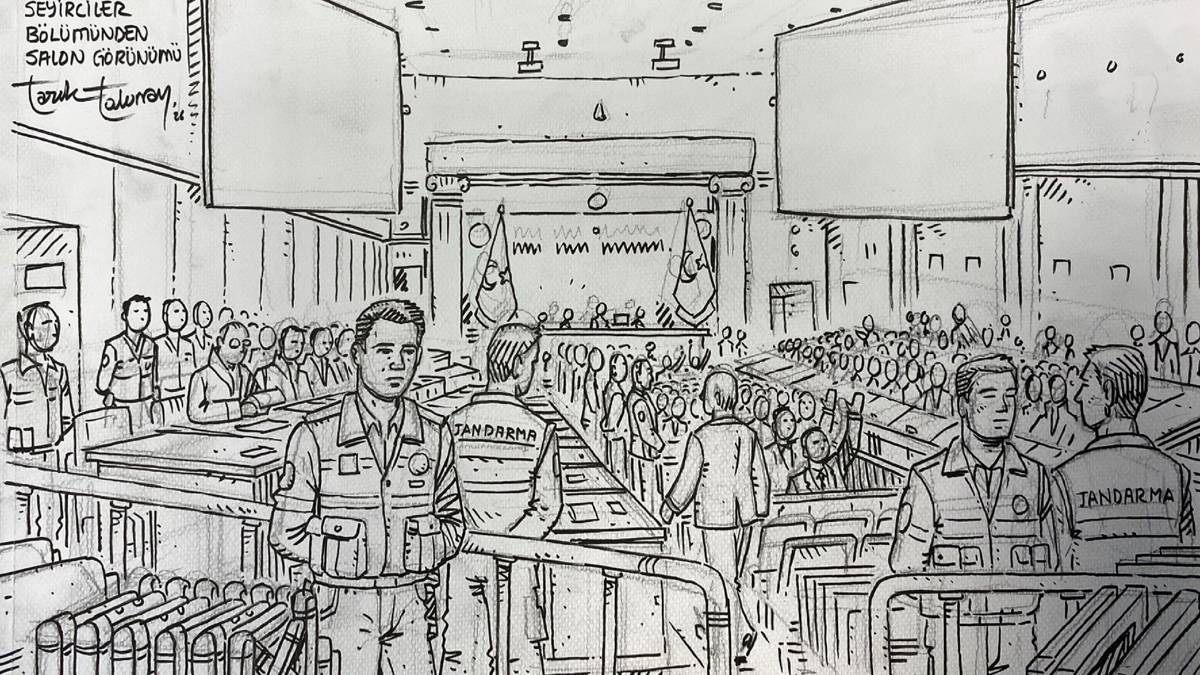
I have found myself on the roads for the past two weeks during those hours when the dark nights fail to reach the light. Most recently, on the day my friend and colleague Furkan was released from prison, I had gone to pick him up and promised myself that I wouldn’t want to stop by here for a while. Unfortunately, I am not destined to keep that promise. In recent years, Silivri has become a mandatory destination for journalism. There are few days when one’s path does not cross here. We are in such days once again... This time, we took to the road to follow a trial that the entirety of Turkey, and indeed the whole world, is talking about and watching. We are all curious about the course of a case involving 407 defendants—105 of whom are detained—and an indictment consisting of nearly 4,000 pages. How could we not be? For the government claims they "will not be able to show their faces in public due to corruption." Yet, we see those who have been detained for a year standing tall before us.
As journalists waiting in lines during the Silivri frost at the crack of dawn, we turn to one another and discuss "what might happen." We recount the potential arguments and the difficulties the press is likely to face. It’s almost like a duty rehearsal... Our previous experiences serve as our guide. However, the call from the gendarmerie saying "press first" surprises us. Journalists passing through the checks easily receive their badges and begin waiting at the courtroom door. Although the fact that the press was inside before everyone else for the first time astonished us, this feeling did not linger for long. We understood as soon as we entered the courtroom and were shown the area reserved for the press. Taking the press in early was not a gesture, nor did it have anything to do with transparency. Located at the furthest right corner of the courtroom, it was impossible to see the detained defendants or the bench, or to clearly hear what was being said. Furthermore, in the seating arrangement, there was no area for the press to take notes, nor was there electricity to charge laptops. There were flexibilities in the 25-journalist limit; we were more crowded than the first day. They had placed the press at the very front. However, all of these were merely performative acts of goodwill.
The space reserved for the press offered a clue
From the very beginning, throwing the press into the back row of an open court gave us an idea of how the trial would proceed. The court bench did not prove us wrong with their attitude the moment they entered the hall. Although Ekrem İmamoğlu—who has been detained for a year, whose name is mentioned in every act in the indictment, and who is accused of establishing and leading a criminal organization—wanted to speak, the court did not allow it. İmamoğlu was insistent on speaking; he had waited a year for this moment. İmamoğlu fueled his search for rights with his "Black Sea persistence" and would not give up. The bench could not cope and found the solution in calling for a recess.
Families greeting their loved ones are silenced
While the hearings continued with difficulty under the court's constantly changing instructions, the hands of defendants—who had been away from their families for a very long time—raised in greeting were forced down; families calling out to their loved ones were silenced; and journalists were distanced or restricted so they could not write or report. Neither citizens nor politicians could be included in the proceedings of a public trial.
The court had engaged in arguments with everyone, from the defendants and lawyers to the journalists and spectators. These arguments were always one-sided; the struggle for rights entered by the defendant, lawyer, or journalist against the bench ended with the court's most solid power: the "decision to adjourn."
The defendants, who had been detained for a year and found their first opportunity to defend themselves, were eager to take the rostrum, but the list, which the court said was "ordered according to the incidents," was not progressing. Even though İmamoğlu insistently said, "Release these people, let them be with their families for the holiday, fight me alone," the detention status of even those who were ill or had no remaining sentence to serve was not being evaluated. Detention had ceased to be a measure and had turned into a tool used for punishment, trampling human dignity underfoot.
"Maya said 'Father'"
For two weeks, families calling out to their loved ones every day consoled one another while trying to hide their tears. News coming from the 7.5-month-old daughter of the İBB Head of Urban Planning, Ramazan Gülten—who was born while he was inside—filled everyone’s eyes with tears. As soon as Ramazan entered the hall, the lawyers and spectators all joined in to help his wife's voice reach him from the spectator rows: "Maya said 'Father'." We listened to the defense of a defendant benefiting from "effective repentance" (informant status) under the weight of those three words. During statements that were contradictory, lacked concrete evidence, and were based on hearsay, only baby Maya came to mind.
The next day, words got stuck in the throat of a young lawyer defending his detained uncle. While defending his beloved uncle against the "effective repentance" statements shown as evidence for mediating bribes, he debunked the allegations one by one. It was one of the moments I was most curious about. I wanted to see his uncle at that moment. His young nephew was beginning his professional life with the most difficult case in the country. Moreover, his uncle was one of the defendants. I wonder how he felt? But I couldn’t see; the lodge that the court bench deemed worthy of the press prevented us from seeing these things. In a case formed by the statements of anonymous witnesses "to the extent they had heard," it was deemed sufficient for the press to write "to the extent they had heard" as well.
The first words of all at the rostrum: "There is someone listening to us"
In seven days spanning two weeks in Silivri, ten defendants finally had the opportunity to explain themselves before a judge for the first time. The first words of every single one of them at the rostrum were, "There is someone listening to us." They all wished to be reunited with their families before the holiday. Despite the pleas from Ekrem İmamoğlu and the lawyers for the bench to make a decision in this direction, there was no response. As they left the hall, the defendants first embraced one another to exchange holiday greetings, then turned to their families and departed, saying, "Happy holidays." At that moment, the atmosphere in the hall grew even heavier; the hands raised for farewell never wanted to come down, and families did not leave the hall until the last detainee was taken away.
After the families left, I looked at the hall for a long time. I remembered my first times coming here, my days as an intern journalist. Ergenekon, Balyoz, KCK, the Cumhuriyet trial... What cases we had watched here. How many separations we had witnessed. Today, that sadness was repeating once again in the same hall. We were once again witnesses to similar pains in different lives. Directly across from us, it is written: "Justice is the foundation of the State." As I grow older in this hall, I find it harder and harder to read. Undoubtedly, it is my vision that is fading. Even if it is far away, the faith within me strengthens its existence. Justice is there, far away. One day, it will go beyond hanging as a mere phrase on a wall. It will come again. It will come back.


