

How would you introduce yourself?
My name is Hasmik Varderesyan, and I am 18 years old. I was born in Yerevan. In 2010, I moved to Istanbul with my mother. My mother began working as an Armenian language teacher at Hrant Dink Armenian School, and I attended the same school until the ninth grade. In 2023, I returned to Armenia. I first continued my education at Hrant Dink School No. 44 in Yerevan and later transferred to the Mkhitar Sebastatsi Educational Complex, where I completed high school. I have not yet decided where I will continue my education or where I want to live. Having spent my life in two different countries, communicating with people from different national backgrounds, and witnessing the Karabakh War and developments in the region up close led me to become interested in Armenia-Turkey-Azerbaijan relations and begin researching these issues. Today, through the content I produce on social media, I try to contribute to constructive and multifaceted discussions on issues affecting the region.
It has been one month since the elections in Armenia. What is the atmosphere like in the country?
To be honest, I expected both the election period and its aftermath to be much tense, but it did not turn out as I had anticipated. So far, because opposition parties have not organized large-scale protests or demonstrations, there has been no noticeable tension in the streets. At least for now, I can say that the overall atmosphere in the country is calm.
You actively use social media, especially Instagram. The videos you produce are generally about Armenian history. Recently, you have also been sharing your personal views on hate speech. What influenced your decision to use social media as a platform for informing people?
The Karabakh War was the main reason I became interested in these issues. I had visited Karabakh before because my grandfather and grandmother lived there. When the war began, I was exposed to intense hate speech on social media from both Armenia and Turkey. After seeing all of that, I asked my mother one day, "Should I start making videos in response to these?" She opposed the idea, saying that during wartime I should not make myself a target and that I did not yet have enough knowledge about these issues. So, I postponed the idea at the time. However, after we lost the war, seeing the atmosphere of hatred in both countries made me feel that I had to do something. I began researching various sources. That is how it all started. My goal was to show what was happening on the other side of the border and to examine the reasons behind these conflicts from different perspectives. I knew that many people would oppose me and that some would even call me a "traitor." But I knew exactly what I was doing and why I was doing it.
When I look at the comments on your videos, I see not only expressions supporting peace between the two countries but also hate speech and racist comments. You do not hesitate to respond to those comments. When you first encountered hate speech, did you ever consider stopping your content?
If the comments under my videos had consisted only of positive feedback, that would actually mean there was no problem at all. But negative comments are connected to the wars that have taken place, the painful past, and the social and psychological effects they have created. I do not take negative comments personally. Everyone is simply reflecting what they know and what they feel. I read every comment on my videos to better understand people's perspectives. If there are negative comments somewhere, then there is a problem. And every problem has a cause. In fact, that is one of the main reasons I create content. I never considered giving up.
You lived in Istanbul for a long time. Could you tell us a little about your experience?

As I came to Istanbul from Armenia, I always looked at the city, and especially the Armenian community there, through the eyes of someone who had come from Armenia. Over time, that perspective changed because I spent a large part of my life there. Living in Istanbul gave me the opportunity to better understand both Turkey and the Armenian community there. At the same time, it encouraged me to explore Turkey-Armenia relations and to better understand how Armenian identity is experienced in different places. Every time I return to Armenia, I tell people about the Armenian community in Istanbul, Armenians in Turkey, and life there. But over time I realized that no matter how much I explain, people can only truly understand it by seeing that environment and experiencing that life themselves. Many people in Armenia are not even aware that there are Armenian schools in Turkey. Sometimes I feel as though I have lived two separate and distant lives.
Recently, we have seen increasing interest from people in Turkey traveling to Armenia. Through various social media platforms, they share their impressions of their trips. Has there been a noticeable increase in the number of tourists from Turkey? Do people share their observations with you personally?
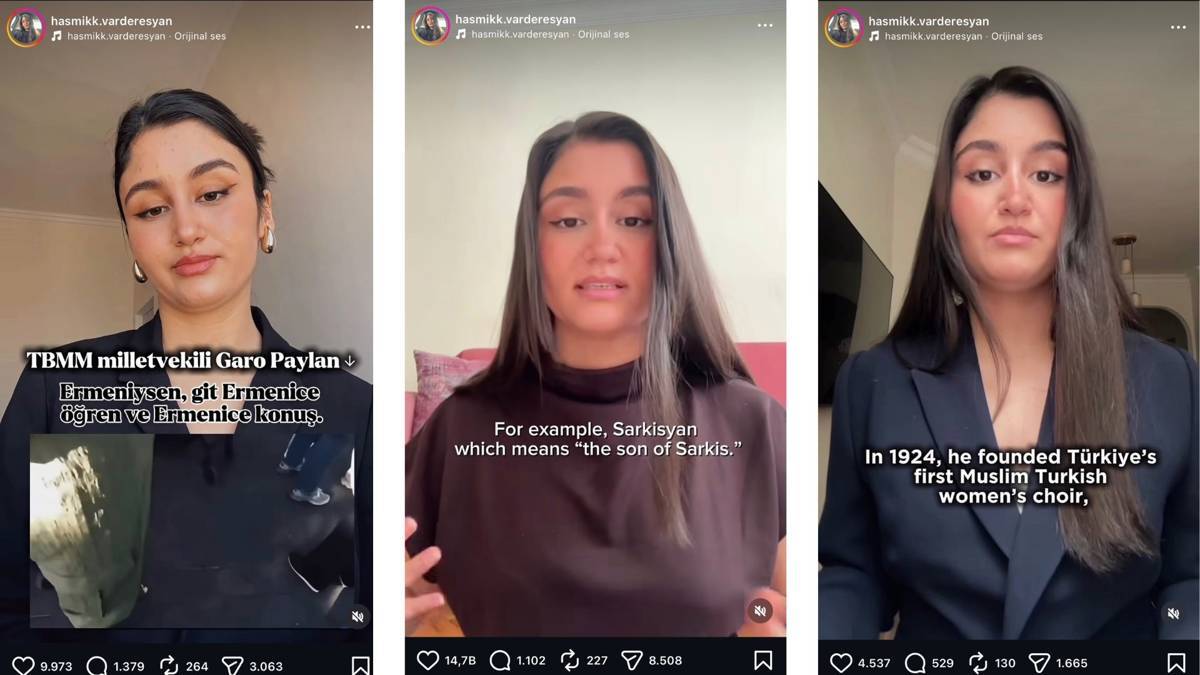
I do see people from Turkey visiting Armenia, but I have not personally encountered Turkish tourists very often. Still, recently I have seen posts from some content creators from Turkey saying they experienced racism while visiting Armenia. In some cases, I think they are right, while in others I believe certain content creators are provocative. As a country, we are going through a post-war period, and there are still sensitivities and tensions within society. For that reason, I think it is important for tourists visiting Armenia to approach the country with understanding. Of course, racism against any nation is wrong. At the same time, however, it is important to remember that the country has lived through years of war and, as a small country, has been deeply affected by that experience. Beyond content creators from Turkey, I also see Armenians from Turkey who visit Armenia facing discrimination simply because they speak Turkish. I have witnessed this myself, and the incident involving Garo Paylan recently was another example. I always say this: just as it is considered natural for people in Armenia to speak both Armenian and Russian, it is equally natural for Armenians from Turkey to speak both Armenian and Turkish. Whenever I encounter such incidents, regardless of which side they occur on, I try to explain that discrimination is wrong and contribute to helping people better understand one another.
You emphasize peace and brotherhood on social media and do not approve of hateful content. Do people your age share similar views?
To be honest, so far I have met very few people who completely share my views. When you speak with both Armenians and Turks, after a certain point most people begin defending their own country's perspective and adopt a more nationalist position. My perspective is shaped primarily by human rights. Whenever I see an injustice, regardless of which side it comes from, I try to speak out. For me, no nation is superior to another. I am also opposed to nationalism. If factors such as state borders, political interests, and nationalism were not so dominant, I believe peoples living in our region would not experience such deep conflicts.


