


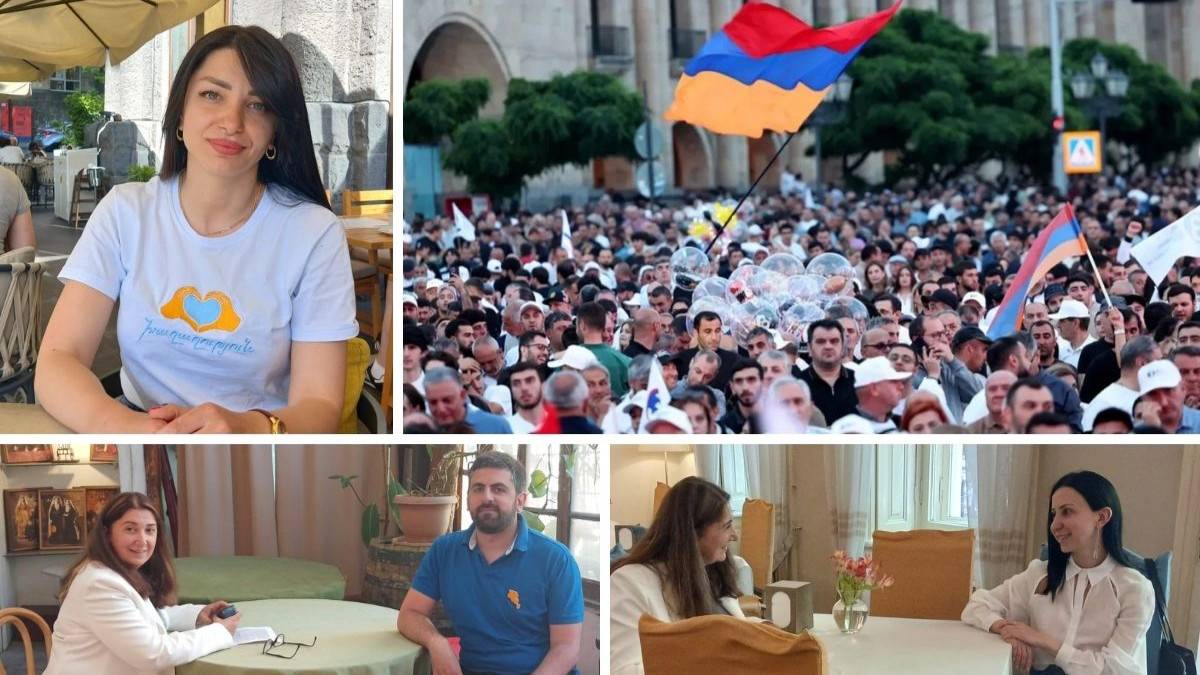
We had the opportunity to meet with three MPs from the ruling Civil Contract Party just before the propaganda bans began in Armenia, namely on Friday, June 5. Sarkis Khandanyan, Maria Karapetyan, and Hasmik Hagopyan shared their views on the pre-election situation and Turkey-Armenia relations. On the other hand, our applications to opposition factions like Strong Armenia, Wings of Unity, and the Armenian National Congress either went unanswered at times or we couldn't conduct interviews due to overlapping with the election ban hours; however, I will continue to make different voices heard. As for Khandanyan, Karapetyan, and Hagopyan, all three appear optimistic about the elections.
Sarkis Khandanyan:
"Citizens have seen that the policy we pursue leads to peace"

Lusyen Kopar with Sarkis Khandanyan
Mr. Sarkis Khandanyan, do you ever find yourself thinking about what will happen if you don't win?
We have also spoken about this publicly with our citizens. We said that if the political forces currently representing the main opposition were to win, the conflict could reignite, and the probability of war would be very high. This is because these political forces have no idea how they will regulate relations with our neighbors.
For this reason, we have worked very hard to secure not just a victory for our party, but a victory for peace and for the independence of the Republic of Armenia.
When Russia restricted product purchases from Armenia, the European Union announced it would provide 50 million euros in support to Armenia. How do you evaluate this support?
This 50 million euros was provided under conditions where the EU acted very flexibly at a time when Russia shut off access for Armenian agricultural products, granting our producers and farmers the opportunity to export their products to European countries.
I believe this is a result of the foreign policy we pursue. This is because we said we would balance our relations and deepen our ties with different partners, and I think this will be appreciated by our citizens.
Many steps have been taken in the normalization process of Azerbaijan-Turkey-Armenia relations. If you lose, will this normalization process be disrupted?
The opposition forces give citizens no idea of how they will continue peace negotiations. They have no answers as to whether the normalization process between Armenia and Turkey will be maintained. In the event of their victory, there is a great uncertainty at best, and a continuation of the conflict at worst. We are not saying that everything depends solely on us, on our party, but citizens have seen that the policy we pursue leads to peace.
We are in the midst of the Armenia-Turkey normalization process. This will be the first time Armenians cast their votes during this process.
Citizens will also endorse all the policies we pursue: economy, health, social issues, and at the same time our foreign policy—hence our goal of having regulated and established diplomatic relations with Turkey. In this sense, an evaluation will truly be made regarding this process as well.
Let's touch upon the agreement signed during US Secretary of State Rubio's visit to Armenia. Do you interpret this as Trump supporting your party, meaning Pashinyan?
The President of the United States has already given support to Prime Minister Pashinyan. However, this is more of a support given to the Republic of Armenia and to the strategic relationship between Armenia and the US.
Maria Karapetyan:
"Our primary promise is to preserve peace"
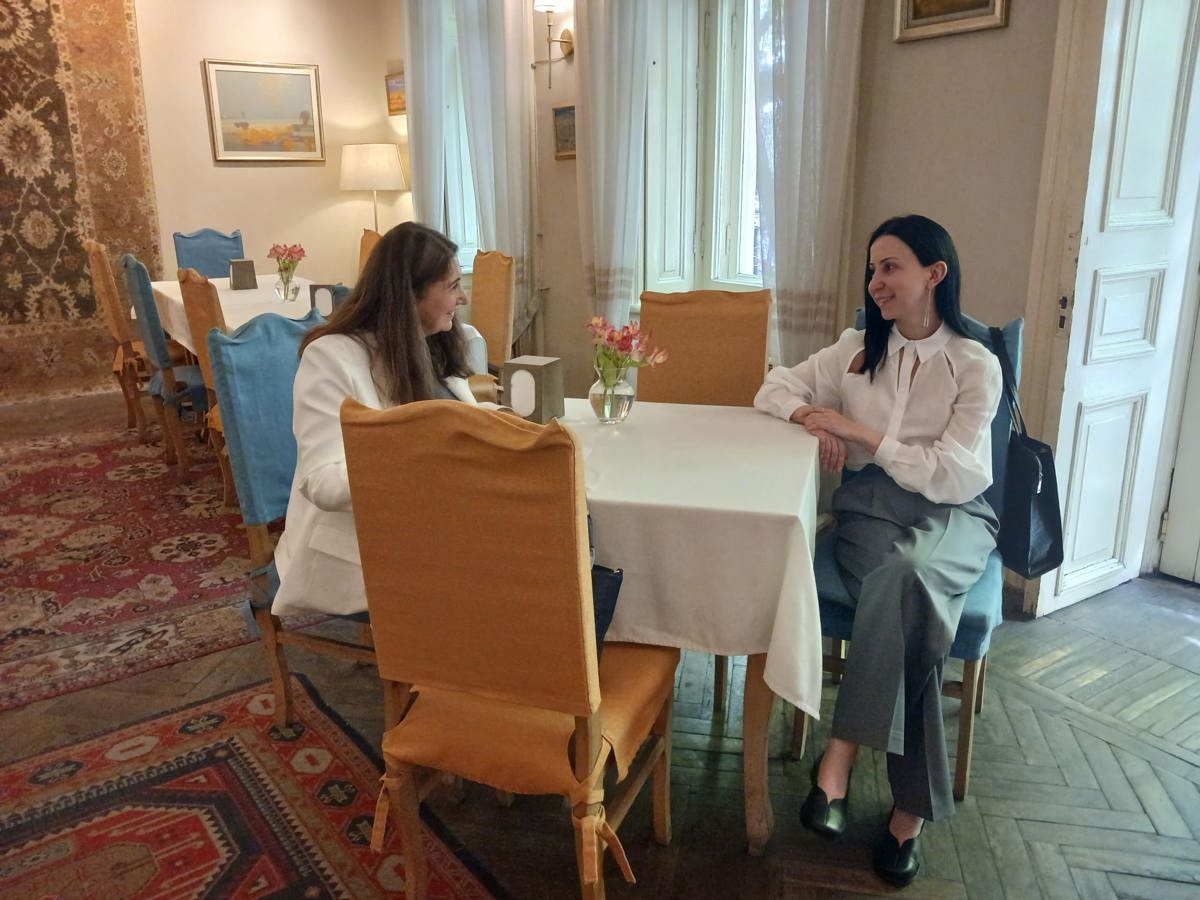
Lusyen Kopar with Maria Karapetyan
Ms. Maria Karapetyan, what did you promise at the rallies?
To preserve peace — meaning to sign and ratify the previously initialed peace treaty, to ratify the 'TRIPP' framework agreement, to build the railway and restore all of Armenia's railways, to continue building not only international but also domestic and inter-village roads, and to sustain the construction of schools and kindergartens. We have also added a new component: the next five years will be the 'Water Infrastructure Year' in Armenia.
This is a very crucial component. Armenia is a water-rich country, but we have major deficiencies in collecting and managing water, both in terms of agricultural irrigation and daily water usage. Focusing on water infrastructure in the next phase has become our main election promise.
Did you have dialogues with opposition citizens at the rallies?
Yes, of course, we encounter skeptical citizens: those who are not convinced. What they need is to experience a longer and lasting realization of the peace process; to see that this new formula—meaning relations based on the mutual recognition of borders with neighbors—actually works. People need time to believe in this. We also need to show tangible results to our opposition-leaning citizens. They need to be able to touch peace so that they can believe.
The primary indicator is the absence of soldier casualties at the border. In addition to this, there are infrastructures that are already open: wheat arrived from Kazakhstan and Russia through Azerbaijani territory, as well as via Georgia. Recently, Turkey also allowed the transportation of goods using the existing railway through Georgia.
But the most fundamental change will be the opening of the Turkish border: opening the current roads via Margara (Alican) and repairing the railway in the Akhuryan (Arpaçay) section. I am talking about the short Gyumri railway. These will be the most convincing arguments to show citizens that the new formula—establishing direct relations with neighbors without intermediaries—actually works.
It is said that Turkey and Azerbaijan want Pashinyan to continue in these elections. Isn't this a sensitive issue?
Yes, this is a sensitive topic. On the one hand, they support our government from many different sides. This is a good thing. It means that the Armenian government has established its relations with different countries around the world in such a way that it has become important to the world. On the other hand, there are accusations that this constitutes interference in our internal affairs. There are indeed moments when threats against Armenia are voiced.
On the flip side, within Armenia, there are political forces presenting our being in power as the reason for the deterioration of relations with other countries. We are aware of this context. Our proposal is this: despite everything, let's focus on what we will do, on the lessons we have learned, and let's make these decisions with an independent mindset. Let us decide what is good for us. If we get support from our partners, that's great, but let the interest of Armenia and the people of Armenia always be at the center.
You describe the opposition parties as the 'three-headed party of war.' Why?
Because they have the same political program, without a single word of difference. All three forces say, "Peace is not possible this way, guarantors are needed." All three say that the TRIPP agreement is not a good program and that something else needs to be considered; yet they do not unite.
Why don't they unite? Because they think that by participating in the elections separately, they can get more votes using their own networks and economic leverage; then they will combine these votes in parliament. We abolished the majoritarian election system, but they are trying to act with a majoritarian logic based on each being elected individually and then forming a coalition after the election.
We have said it clearly: if these forces govern Armenia, a war will break out and this entire peace agenda will be derailed. Because they are not the continuers of the direct, intermediary-free relations we have reached. They say they will officially sign the peace treaty because they know they won't get support if they tell the public they don't want it. But when you ask a few more questions, it turns out they will renegotiate the agreement; which is a direct way to sabotage the peace process.
Hasmik Hagopyan:
"We will not create a new enemy for ourselves"
Hasmik Hagopyan
Trump supports Pashinyan, while Russia seems to be against you. What do you think about this?
We do not think at all that the Russian Federation is a country hostile to us. Think about it, we want to establish friendship and be neighbors with countries with which we have experienced decades of hostility; we will not create a new enemy for ourselves. We want to live peacefully in a sovereign way.
But in recent days, economic sanctions have been increasing significantly, and many describe this as an economic war. In the previous period, we also talked a lot about hybrid attacks and hybrid warfare. As for the economic war, we do not think the Russian Federation needs to launch any attack against Armenia, but its exact overlap with this election period cannot be a coincidence.
We believe that these are only temporary problems and will be resolved very quickly. This was, to a certain extent, an attempt to put pressure on the Armenian voter to make them choose pro-Russian forces. Putin also said in his meeting with our Prime Minister, 'There are pro-Russian forces in Armenia, let them participate due to their Russian passport.' I am not saying this in vain: there are pro-Russian forces, and they are the force that will receive the most votes after us.
In other words, the opposition's 'prime ministerial candidate' holds a Russian Federation passport, do you understand? His large capital is in the Russian Federation. It is as if they are guiding our citizens to choose the easy way and select the pro-Russian force. But I am sure this problem will be resolved in a short time. By the time this interview is read, the problems will have been solved. Because whichever government a country's people vote for, other countries have to work with that government.
What kind of result do you expect? Do you expect a majority that can change the constitution?
From the very beginning, we spoke of an absolute majority; the Prime Minister also stated that we do not have a problem like uniting with another force to form a government. We will win, but at one point we felt that having a constitutional majority was also very realistic. Right now, we are progressing on the path to reaching a constitutional majority, and all polls conducted by various reputable international organizations show that we have the prospect of holding a constitutional majority. Let's see, God knows.
We cannot form a coalition. Because all the forces claiming to enter parliament act outside of Civil Contract. Therefore, what commonality of values do we have with all these forces against us to form a coalition? On the other hand, our support shows us that a simple majority is not an issue. No problem for 51 percent. We are advancing on the path towards 65 percent, which is the constitutional majority.
You emphasize Armenia's current borders. Why do you find this necessary?
You know, we can be very strong, and we held a parade recently; everyone saw the weapons we possess. Our defense industry has developed, we export weapons, we sell what we produce to other countries—we have now become such a country. But against whom, and how strong? We are a small country, the population is small, the army is small, and our economy, for instance, cannot be compared with Turkey, the second strongest country in NATO.
If we remain within our legitimate borders, and if we have no territorial claims on any of the neighboring countries, why should there be a war?
We lay no claim to Western Armenia, nor to Javakhk in Georgia, nor to the Persian-speaking Armenian region in the Islamic Republic of Iran, nor to Karabakh in Azerbaijan. I have listed the territorial claims that the old governments voiced from time to time; they used to feed society with this. But recently, this issue has been talked about so much that our society understands and accepts the real borders of Armenia, making no claims beyond them.


