

In my first two articles, I tried to understand how the mind and conscience retreat into the background. How memory grows tired, forgets, and then forgets that it has forgotten; how conscience, in order to survive, slowly becomes accustomed to everything… If the story ended here, we would be left with nothing but submission and profound hopelessness.
But the story does not end here. Because human beings are not merely creatures that forget and become accustomed; they are also creatures that decide to remember. Memory is a biological reflex; it operates spontaneously. But remembering is an act of will. Moreover, deciding not to forget something, keeping it alive in the mind and conscience, is a moral choice.
Letters around the truck picture
Recently, I went to visit my ninety-three-year-old grandfather. This time, I had not gone simply to see him. I had my phone with me. The stories I had heard in fragments throughout my life from my mother, from him, and from his siblings, I now wanted to record in his own voice. At some point, one realizes that the voices of the people they love have a lifespan too. Then you begin to think about the day when you will hear those voices only in your memories.
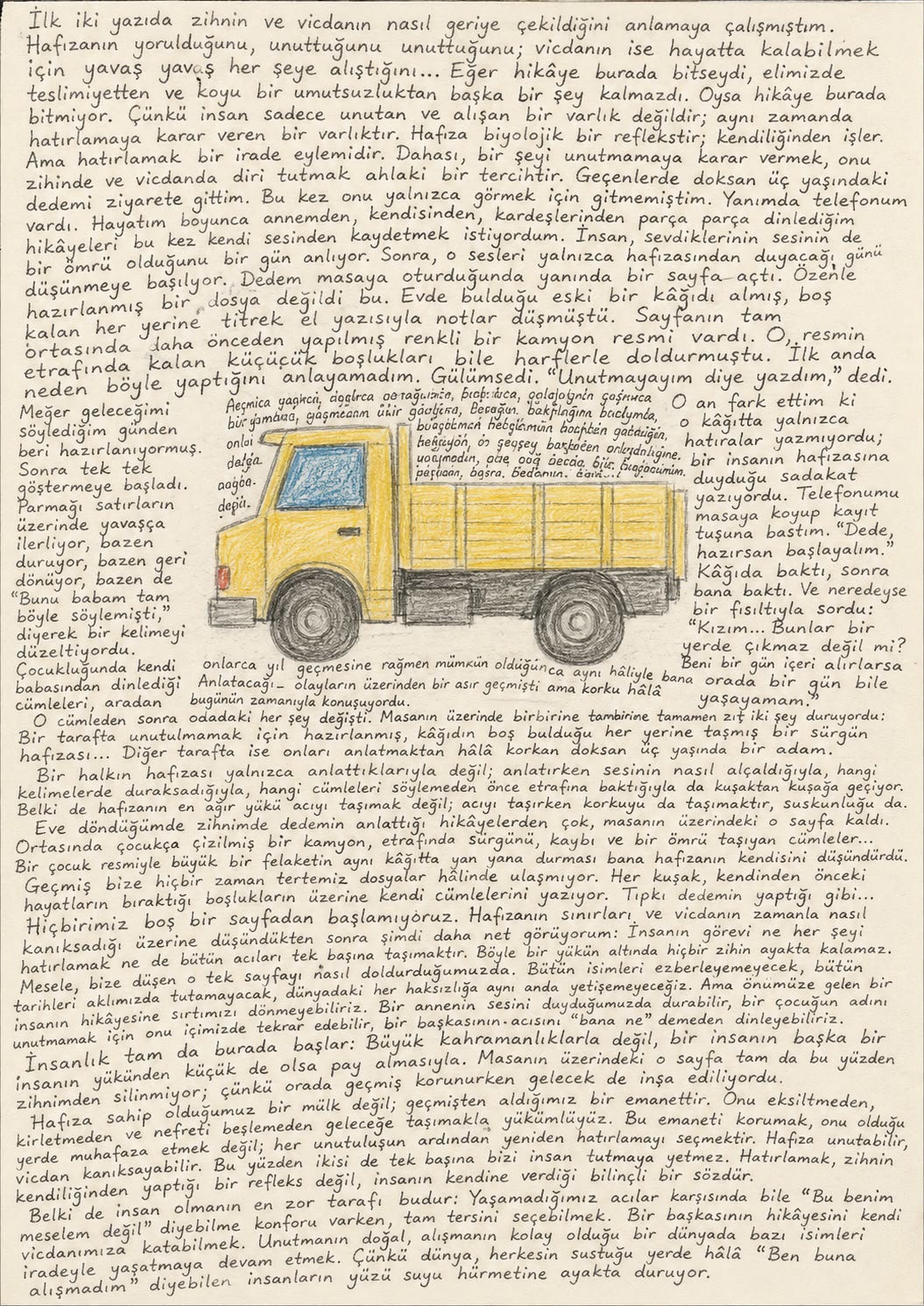
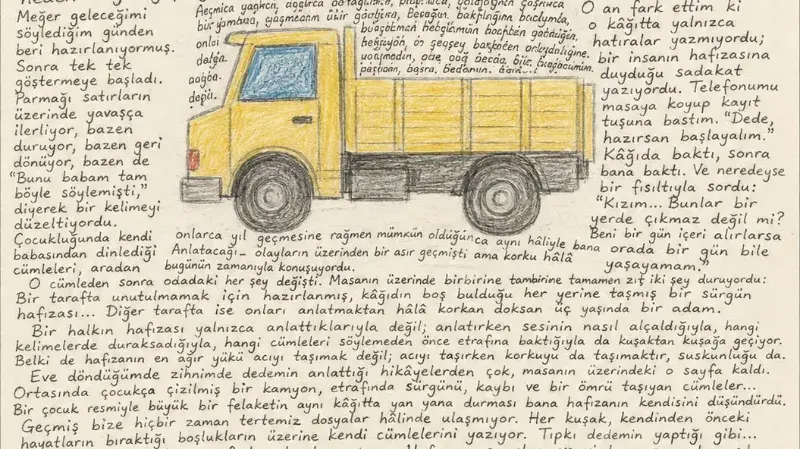
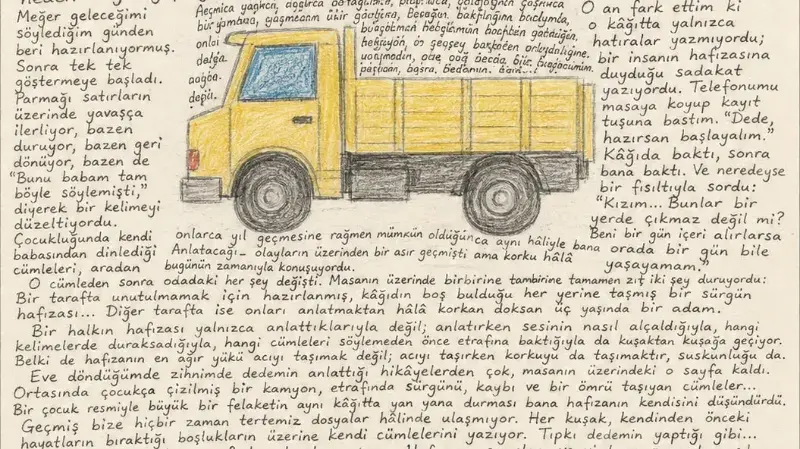
When my grandfather sat down at the table, he opened a page beside him. It was not a carefully prepared file. He had taken an old piece of paper he found at home and filled every empty space with notes in his shaky handwriting. Right in the middle of the page was a colorful drawing of a truck that had been made earlier. He had filled even the tiny spaces around the drawing with letters. At first, I could not understand why he had done this. He smiled.
“I wrote it down so I wouldn’t forget,” he said.
It turned out that he had been preparing ever since the day I told him I was coming.
Then he began showing me the notes one by one. His finger moved slowly along the lines, sometimes stopping, sometimes going back, and sometimes correcting a word by saying, “My father said it exactly like this.” He was trying, despite the decades gone by, to convey to me as exactly as possible the sentences he had heard from his own father during his childhood. At that moment, I realized that what was written on that piece of paper was not merely memories; it was a person’s loyalty to his own memory.
Lives passed down through fear
I placed my phone on the table and pressed the record button. “Grandpa, if you’re ready, let’s begin.”
He looked at the paper, then at me. And almost in a whisper, he asked:
“My girl… These won’t come out somewhere, will they? If they ever put me in jail, I couldn’t survive even a single day in there.”
A century passed since the events he was about to describe, but fear was still speaking in the present tense.
After that sentence, everything in the room changed. On the table lay two completely opposite things: On one side, an exiled memory prepared so as not to be forgotten, overflowing into every empty space on the paper… On the other, a ninety-three-year-old man who was still afraid to tell those stories.
Fear and silence
The memory of a people is passed down from generation to generation not only through what they narrate, but also through how they lower their voices as they tell it, the words at which they hesitate, and the moments when they look around before saying certain sentences. Perhaps the heaviest burden of memory is not carrying pain itself, but carrying fear along with that pain, and carrying silence too.
When I returned home, what remained in my mind more than the stories my grandfather had told me was that page on the table. A truck drawn like a child’s picture in the middle, surrounded by sentences carrying exile, loss, and an entire lifetime… The sight of a child’s drawing and a great catastrophe standing side by side on the same piece of paper made me think about memory itself. The past never reaches us in perfectly organized files. Every generation writes its own sentences over the gaps left behind by the lives that came before them. Just as my grandfather did… None of us begins with a blank page.
As much as a page can carry
After thinking about the limits of memory and how conscience gradually becomes accustomed to things over time, I now see more clearly: A person’s duty is neither to remember everything nor to carry all the pain alone. No mind can remain solid under such a burden. The question is how we fill that one page that falls to us.
We will not be able to memorize every name, keep every date in our minds, or respond to every injustice in the world at the same time. But we can choose not to turn our backs on the story of a person who comes before us. When we hear a mother’s voice, we can pause; we can repeat a child’s name within ourselves so that we do not forget it; we can listen to another person’s pain without saying, “What does it have to do with me?”
Humanity begins precisely here: not with great acts of heroism, but with one person taking even a small share of another person’s burden.
Not a legacy, but deposit
That page on the table stays in my mind precisely for this reason; because while the past was being preserved there, the future was also being built. Memory is not a possession we own; it is a deposit we receive from the past. We are responsible for carrying it into the future without diminishing it, contaminating it, or feeding hatred.
To protect this trust does not mean preserving it exactly where it is; it means choosing to remember again after every act of forgetting.
Final word: An act of will
Memory may forget, and conscience may become accustomed. That is why neither of them alone is enough to keep us human. Remembering is not a reflex that the mind performs spontaneously; it is a conscious promise a person makes to themselves.
Perhaps this is the hardest part of being human: When we have the comfort of being able to say, “This is not my problem,” even in the face of suffering we have not experienced, we can choose the opposite. We can take another person’s story into our own conscience. In a world where forgetting is natural and becoming accustomed is easy, we can continue, through an act of will, to keep certain names alive.
Because the world remains standing, by the grace of those who can still say, “I have not become accustomed to this,” even where everyone else has fallen silent.