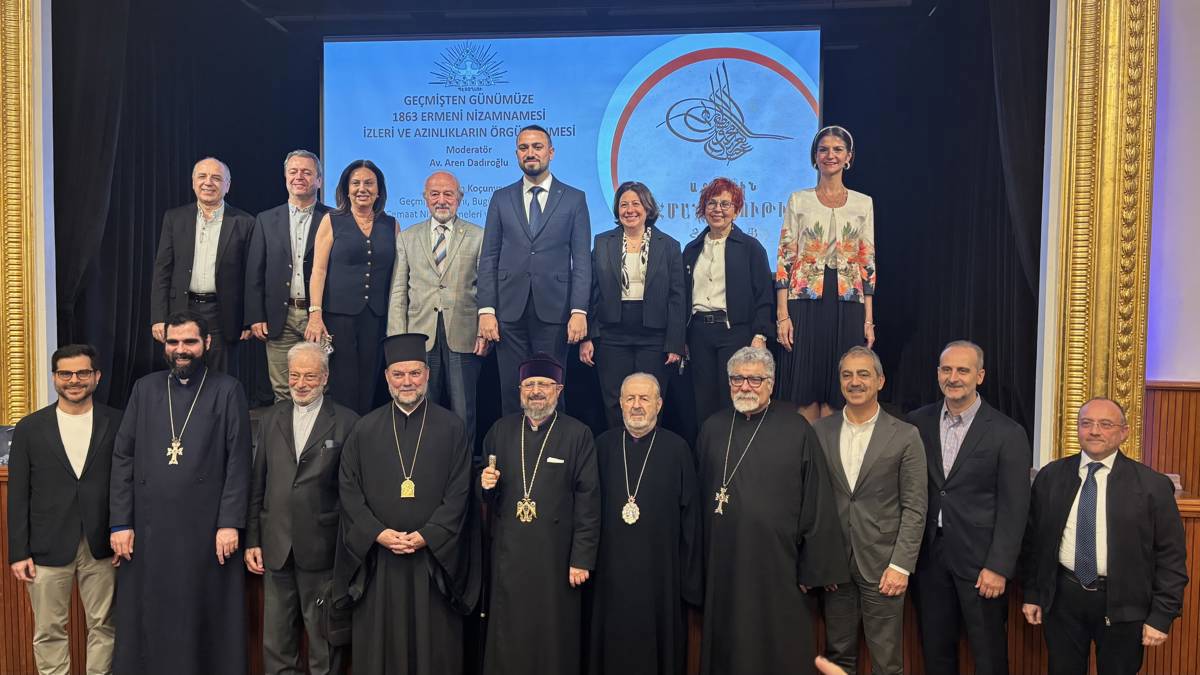


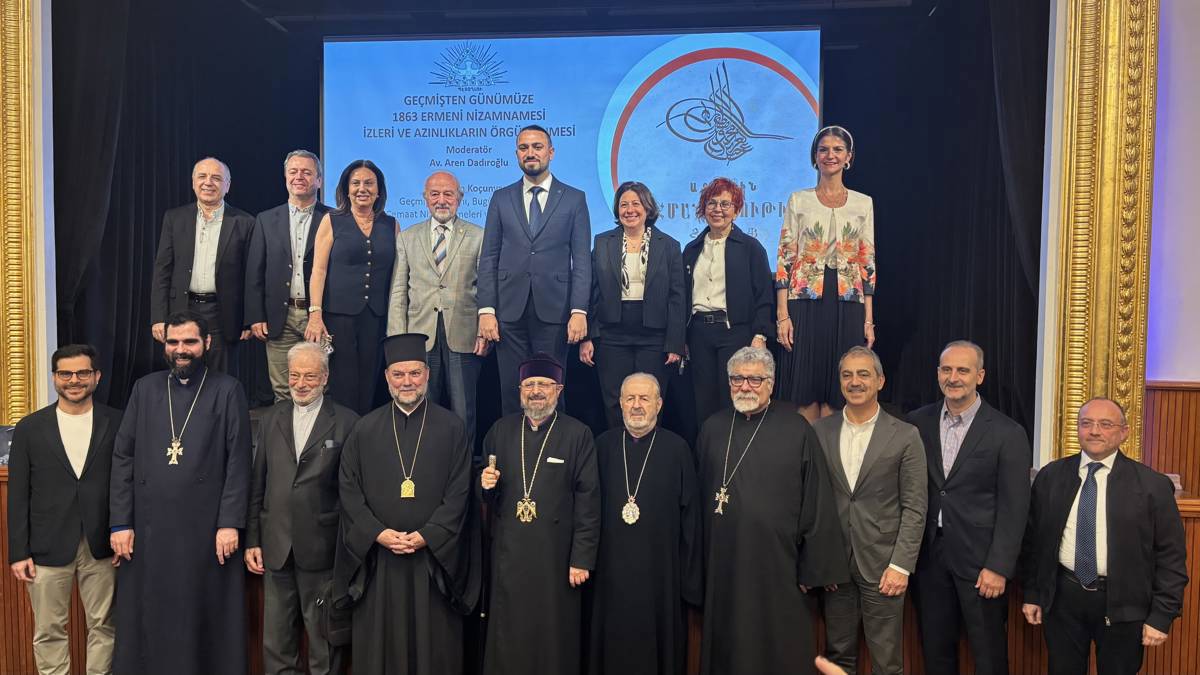
The conference was held on Saturday, May 16, in the Church’s Naregyan Hall. The event was moderated by attorney Aren Dadıroğlu from the foundation’s board of directors. Dadıroğlu commemorated Krikor Odyan and Nahabet Rusinyan, who drafted the Armenian National Constitution.
Speaking first, Dr. Aylin Koçunyan provided information about the emergence of regulations and constitutions during the Ottoman Empire period. Koçunyan said she first encountered the Armenian National Constitution while pursuing her master’s degree at Boğaziçi University. She noted that the millet system began to institutionalize in the 19th century and that the constitution was quite different from the system established after the conquest of Istanbul. In her presentation, Koçunyan explained that the discourse of equality that emerged with the French Revolution created a domino effect, leading to the promulgation of imperial edicts in the Ottoman Empire, and that all these developments laid the groundwork for the Armenian National Constitution.
Can an Umbrella Mechanism Be Established?
Attorney Setrak Davuthan spoke about organizational models in minority communities. Stressing that the Armenian National Constitution was an extremely successful text, Davuthan reminded attendees that the constitution granted Armenian community institutions legal personality. He explained that the spiritual and secular councils established by the constitution governed the community.
Davuthan noted that after the establishment of the Republic, until the 1960s, the constitution was used only for patriarchal elections, while the formation of councils became invalid. He emphasized that establishing an umbrella structure is essential for ensuring accountability among Armenian foundations and that the Armenian Patriarch of Turkey should take initiative.
Davuthan stated: “I believe we would all certainly agree that there is a strong need for an institution with enforcement power that could unite such foundations around common goals and principles; identify deficiencies in administrative and rational continuity; regulate the transfer of voluntary donations to relevant foundations; ensure the structuring of systems; determine the real estate inventory; help revenues reach an economic level appropriate to present-day conditions; oversee the adequacy of individual budgets; and identify rational measures.”
He continued: “The structure we need should solve the financial sufficiency problems of educational institutions, safeguard the rights and benefits of employees and clergy involved in education and religious services, strive to prevent erosion in education and language, establish ethical rules, and also provide internal supervision and coordination among dispersed community foundations while being equipped with legal authority.”
“How Will Consensus Be Achieved?”
Among the conference participants, Community Foundations Representative Can Ustabaşı commented on Davuthan’s proposal for an umbrella organization: “The Directorate General of Foundations has the authority to inspect 167 community foundations. The number of community foundations inspected in the last five years has been very low. If we want inspections, there is no obstacle to this. It can be done by reaching an agreement with an auditing firm. However, I still do not fully understand what the umbrella organization would do. How would this organization organize and allocate responsibilities? Clergy and civilians have different opinions. How will consensus be achieved?”
Ustabaşı also proposed: “Instead of constantly saying ‘this or that should be done’, let us put our wishes and demands into writing and submit them to the relevant authorities.”
“We Are Not Trying to Create a New Constitution”
In his closing remarks, Patriarch Maşalyan said: “We are not trying to create a new constitution. Small modifications matter. Our greatest expectation is from our state. Our biggest problem is the issue of organization. Traditionally, the Patriarch is the head of the community, but he has no authority. This authority existed during the Ottoman period. Later, it was taken away from us. I have been at the Patriarchate for 43 years. We visited Ankara and returned empty-handed for years. The constitution succeeded because it created a collective wisdom that clergy alone could not achieve. It was not an act of disrespect toward the Church. It put things in order. It is fortunate that this constitution existed. I commemorate those who created it. Revolutions took place. We are not striving for a new constitution. Small revisions are important.”